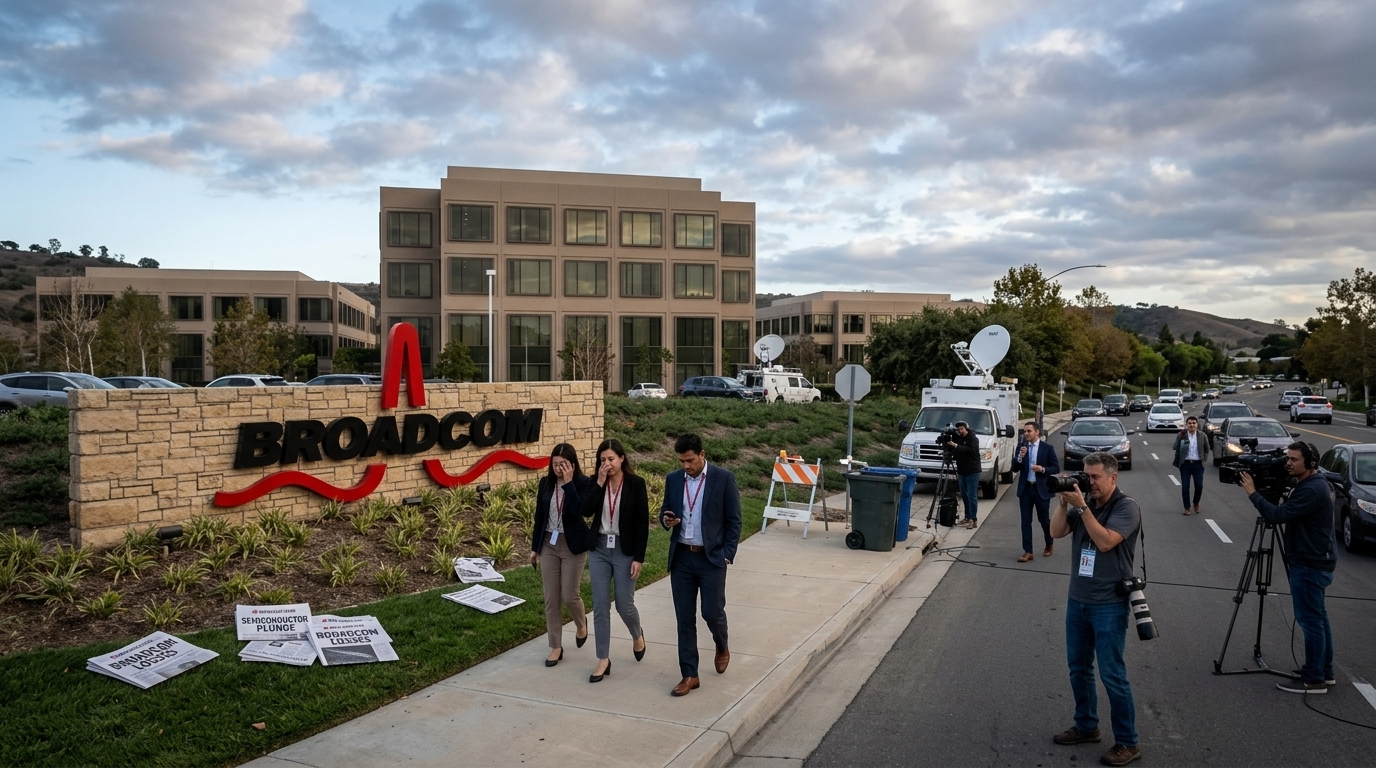
The recent market collapse of Broadcom, which led to a loss of market capitalization exceeding $300 billion, is not merely an isolated news item for investors but a loud wake-up call for the entire artificial intelligence ecosystem. In a period where the market is desperately seeking evidence that billion-dollar investments in AI will bear fruit, Broadcom found itself in the eye of a "perfect storm," where high expectations collided with the harsh reality of traditional technology sectors.
The Expectation Trap and the Revenue Paradox
Despite Broadcom announcing revenues that surpassed analyst estimates, the market reacted violently. This paradox is explained by a shift in investor psychology in 2026. Now, the "promise" of AI is no longer enough. Broadcom, a key supplier of custom chips (ASICs) for giants like Google and Meta, saw its AI division grow rapidly, but this was not sufficient to offset weaknesses in its broadband networking and data storage sectors.
Analysts point out that Broadcom suffers from a "revenue dichotomy." On one side, demand for AI infrastructure remains insatiable. On the other, traditional businesses—which once formed the company's backbone—are showing signs of fatigue. This imbalance creates uncertainty about the sustainability of long-term growth, especially when borrowing costs remain at levels that do not permit easy expansion.
The Shadow of VMware and Integration Strategy
One of the decisive factors in the decline was concern over the progress of the VMware integration. The massive acquisition, completed with the aim of transforming Broadcom into a hybrid hardware and software giant, appears to be facing challenges. Changes to VMware’s licensing model sparked backlash from many corporate clients, leading to fears of mass migrations toward competing open-source solutions.
CEO Hock Tan’s strategy to focus exclusively on the most profitable customers, while historically successful, has this time created a trust gap. The market punished the company not for what it achieved in the past quarter, but for the ambiguity regarding how VMware’s profitability will be maintained in an environment where competition in cloud computing intensifies daily.
Geopolitical Instability and the Chip Wars
The broader geopolitical context of 2026 cannot be ignored. Restrictions on technology exports to China have begun to directly impact the order books of American chip companies. Broadcom, with its extensive supply chain in Asia, finds itself exposed to the fluctuations of diplomatic relations between Washington and Beijing. Every new regulation regarding AI chip export controls adds a layer of risk that investors are no longer willing to ignore.
Furthermore, the emergence of domestic solutions in China and the European Union's efforts to boost its own semiconductor production via the Chips Act are creating a new competitive landscape. Broadcom must prove that its technological superiority is so vast that it can overcome the barriers of protectionism rising globally.
Conclusions and the Path Forward
The loss of $300 billion is a lesson in humility for the technology industry. It shows that even the "invincible" players of the AI revolution are subject to the laws of the market and economic logic. For Broadcom, the challenge is now to prove it can balance innovation with operational stability. For investors, it is a reminder that in the age of AI, volatility is the only certainty.