For decades, Walmart's brand was synonymous with "Always Low Prices." Today, the American retail giant's strategy is shifting toward a new promise: "Always Faster Delivery." At the heart of this transformation lies not just trucks and warehouses, but a sophisticated Artificial Intelligence (AI) ecosystem that is fundamentally reengineering the supply chain. Recent research from Emerj Artificial Intelligence Research highlights how Walmart is utilizing AI not merely as an optimization tool, but as the backbone of a new era of "Adaptive Retail."
Predictive Logistics: From Reaction to Anticipation
The traditional supply chain operated on a reactive basis: a customer buys a product, and the system replenishes the stock. Walmart is flipping this model using predictive analytics. By processing vast amounts of data from millions of daily transactions, the company's AI can predict demand at a neighborhood level before a customer even thinks about making a purchase. This allows for the placement of products in fulfillment centers that are geographically close to the final destination, dramatically reducing transit times.
The use of AI extends to inventory management. Instead of a horizontal distribution of products, the system analyzes local nuances—from weather patterns to local events—to ensure that shelves (both physical and digital) are always stocked correctly. This precision reduces storage costs and the need for clearance markdowns, boosting profit margins in a market defined by razor-thin returns.
Automation and Robotics: The Partnership with Symbotic
One of the key pillars of Walmart's strategy is its collaboration with the robotics firm Symbotic. In its distribution centers, AI directs fleets of autonomous robots that move at speeds of up to 25 mph in high-density environments. These systems don't just move pallets; they use computer vision algorithms to identify, sort, and place products with millimeter precision.
The significance of this technology lies in its ability to create "smart pallets." The AI organizes products on the pallet based on the aisle layout of the specific store they are headed to. Thus, when the truck arrives at the store, staff can unload and stock items in a fraction of the time previously required. This integration between the distribution center and the retail store represents Walmart's competitive edge over purely digital players like Amazon.
The Last Mile and the Drone Revolution
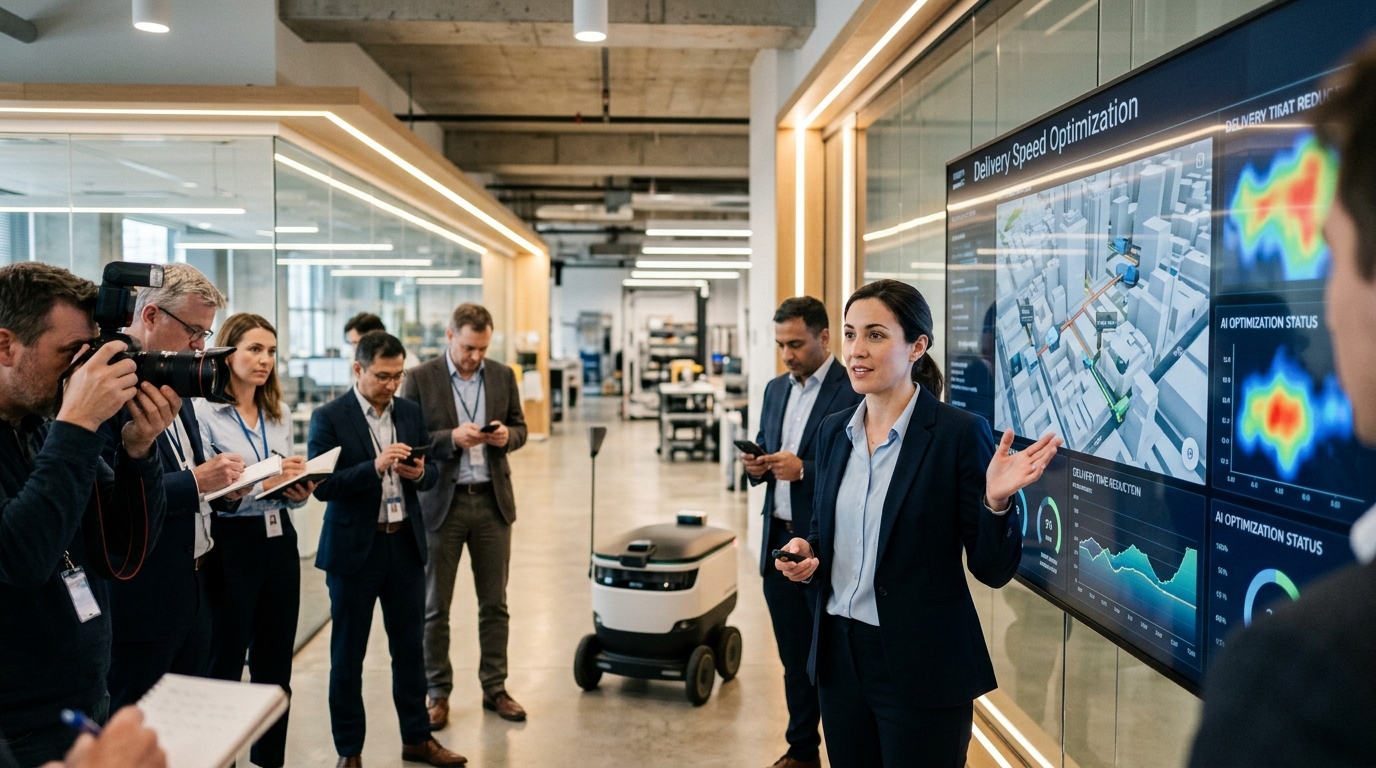
The "last mile" of delivery remains the most expensive and complex part of the chain. Walmart is experimenting heavily with autonomous vehicles and drones to solve this problem. Through partnerships with companies like Wing (owned by Alphabet) and Zipline, the retailer has already conducted thousands of aerial deliveries in selected US states. AI here takes over real-time route planning, accounting for air traffic and weather conditions, aiming for delivery within 30 minutes of an order.
Furthermore, the application of Generative AI in product search is changing how consumers interact with the platform. Instead of searching for "chips" or "soda," users can ask the AI to "plan a football-themed party for 10 people." The AI automatically compiles a shopping list, optimizes delivery from the nearest point, and suggests complementary products, creating a personalized experience that increases customer loyalty.
Challenges and Societal Implications
Despite the technological euphoria, Walmart's shift toward hyper-automation raises significant questions. Concerns about job displacement by robots are intense, although the company argues that technology "upskills" worker roles by relieving them of the most strenuous manual tasks. Additionally, the collection and processing of massive amounts of consumer data to feed AI algorithms poses questions regarding privacy and the ethical use of information.
In a world where speed is becoming the ultimate currency, Walmart is demonstrating that the future of retail is not just "online," but "intelligent." The success of this strategy will be judged by the company's ability to balance technological superiority with the human experience, while maintaining the trust of a global consumer base.