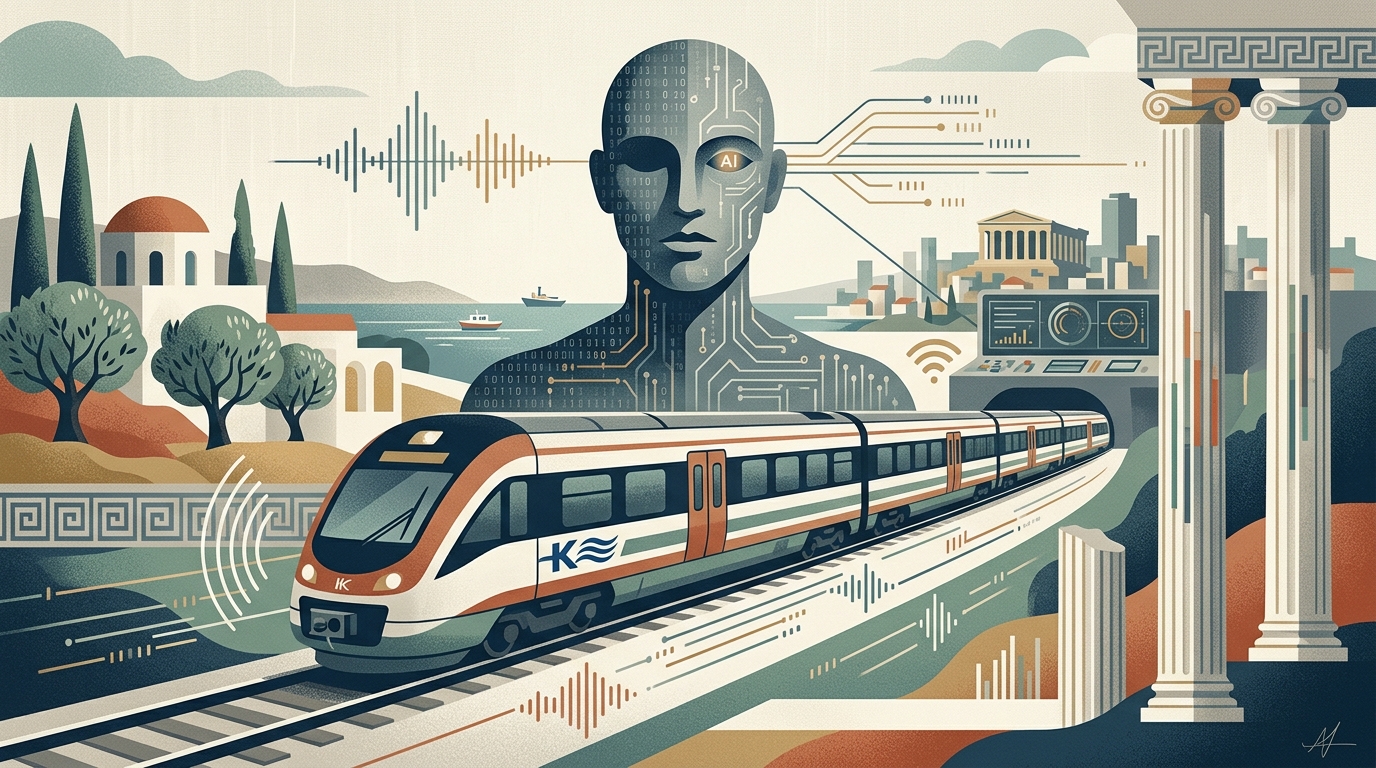
In an effort to heal the wounds left by the national tragedy of Tempi and modernize the outdated safety system of the Greek railways, the government is turning to cutting-edge technology. Deputy Minister of Digital Governance, Konstantinos Kyranakis, revealed the implementation of an Artificial Intelligence (AI) system that will monitor and analyze real-time conversations between station masters and train drivers. This move marks a new era of "digital surveillance" aimed at eliminating human error, while simultaneously raising critical questions about privacy and the limits of technological intervention.
The Architecture of Digital Safety
The proposed system is not merely a recording device but an active "interlocutor" that processes data as it is generated. Utilizing Natural Language Processing (NLP) and Large Language Models (LLMs) tailored to the Greek language and specific railway terminology, the AI will be able to recognize whether strict safety protocols are being followed. For instance, if a station master issues an order that contradicts traffic rules or if a critical confirmation is omitted, the system will trigger an immediate alert to a central control center.
The implementation of this project relies on the digitization of radio frequencies (VHF and GSMR) currently in use. Until now, conversations were recorded on local systems, and their analysis was retrospective—often occurring only after an accident. With the new technology, prevention is shifted to the present. The AI will even be able to detect signs of fatigue or stress in the employees' voices, providing an additional layer of protection that the human factor often fails to maintain under pressure.
The Tempi Trauma as a Catalyst
One cannot ignore the fact that political pressure regarding train safety in Greece remains at its peak. The government, facing public distrust, seeks to demonstrate that technology can provide the guarantees that the state failed to deliver for decades. Mr. Kyranakis emphasized that this system will act as an "incorruptible witness," ensuring that no bypass of the rules goes unnoticed.
However, introducing AI into the railway is not without its challenges. The Greek language, with its idiosyncrasies and regional dialects, requires extremely precise training models to avoid "false positives." Furthermore, the railway environment is noisy, making clear voice capture and analysis a technical feat. The government appears to be investing in partnerships with domestic research centers and international IT giants to overcome these hurdles.
The Conflict with Privacy and Labor Rights
As expected, the announcement sparked reactions from employees and data privacy advocates. The idea of an AI that "hears everything" in real-time brings to the fore the danger of a digital panopticon. Railway labor unions express fears that the system could be used not only for safety but also for punitive employee evaluation or psychological pressure.
"Safety is non-negotiable, but it cannot become a pretext for the complete abolition of privacy in the workplace," industry sources state.
The Hellenic Data Protection Authority (HDPA) is expected to play a decisive role in the system's approval. It must be ensured that the data collected is used exclusively for safety purposes, that access is restricted, and that anonymization is applied where feasible. The balance between "public safety" and "individual liberties" is being tested once again on the altar of technological progress.
Conclusions and Outlook
The Ministry of Digital Governance's initiative is ambitious. If successful, Greece could become a pioneer in Europe in using AI for infrastructure safety. However, technology alone is not a panacea. Without proper network maintenance, the completion of remote control systems, and adequate staffing, the AI will remain a sophisticated observer of a decaying infrastructure. The challenge for Mr. Kyranakis and the government is to prove that the digital "eye" is a life-saving tool and not just a way to communicatively manage a deep crisis of trust.