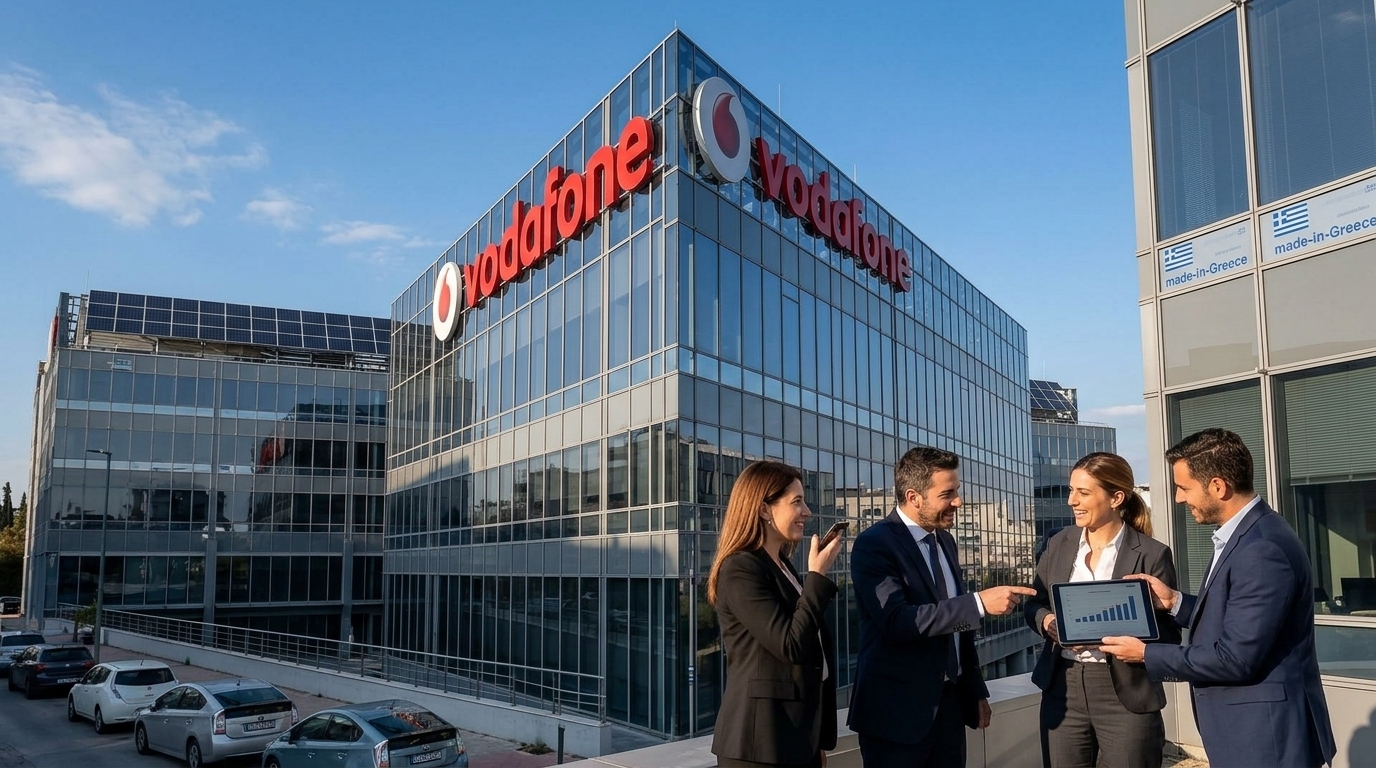
In a period marked by intense geopolitical turbulence and technological transformation, Vodafone Group appears to be vindicated for the bold strategic choices made over the past two years. The financial results for the fiscal year April 2025 – March 2026 reveal a picture of consolidation and focus on core markets, with Greece maintaining a pivotal role as a pillar of stability in Southeast Europe. Despite the challenges of inflation and energy costs, the company has managed to transform its operational structure into a more efficient value-generating machine.
The Greek Reality: Profitability Over Revenue
For Vodafone Greece, the fiscal year ending in March 2026 is characterized by an interesting paradox: a marginal revenue decline of 0.7%, accompanied by an impressive 24.8% increase in operational profitability (EBITDAaL). This divergence is not accidental. It reflects a strategic shift by management toward higher-margin services and strict discipline regarding operational expenditures.
The stability of revenue in Greece, within a market defined by fierce competition among three major players (OTE, Vodafone, Nova), underscores the resilience of the customer base. Vodafone has systematically invested in upgrading Fiber-to-the-Home (FTTH) networks and expanding 5G, sectors that are now beginning to bear fruit through increased average data consumption and the attraction of corporate clients. Major contracts for the digital transformation of the public sector, funded by the Recovery and Resilience Facility (RRF), have also been a critical factor in supporting revenue.
The Group on a Recovery Path
Globally, Vodafone Group, under the leadership of Margherita Della Valle, seems to be moving past its period of introspection. The "Rightsize" strategy—which included divesting operations in Spain and Italy, as well as the merger with Three in the UK—has created a leaner, more agile organization. Group revenue showed an upward trend, driven primarily by positive performance in Germany, its largest market, and strong growth in Africa via Vodacom.
The Group's focus has now shifted to customer experience and Business-to-Business (B2B) services. The integration of Artificial Intelligence tools in customer service and network management has significantly reduced operating costs, allowing the Group to invest more in next-generation infrastructure. Vodafone no longer seeks to be the largest player in every market, but rather the most profitable and technologically advanced in the markets where it maintains a presence.
Challenges and Investment Roadmap
Despite the positive signals, the road ahead is not without obstacles. The European telecommunications sector continues to suffer from low returns on invested capital compared to the US or Asia. Vodafone Greece must manage the high cost of FTTH investments in a country where high-speed penetration remains lower than the European average.
- Expansion of the FTTH network to an additional 150,000 households within the next year.
- Strengthening Cloud and Cybersecurity services for small and medium-sized enterprises.
- Further utilization of RRF funds for digitization projects.
- Targeting full 5G coverage nationwide by 2027.
The company's strategy for 2026-2027 focuses on service convergence (fixed, mobile, TV) and offering personalized solutions through the Vodafone TV platform, which continues to gain market share thanks to exclusive partnerships with content providers.
"Our ability to generate strong cash flows in an environment of stable revenue proves the effectiveness of our transformation," company executives state, setting the tone for the future.
In conclusion, Vodafone seems to have found the sweet spot between maintaining its scale and improving its profitability. For the Greek market, the company's trajectory serves as an indicator of how telecom providers can evolve from mere connectivity providers into integrated digital transformation partners.