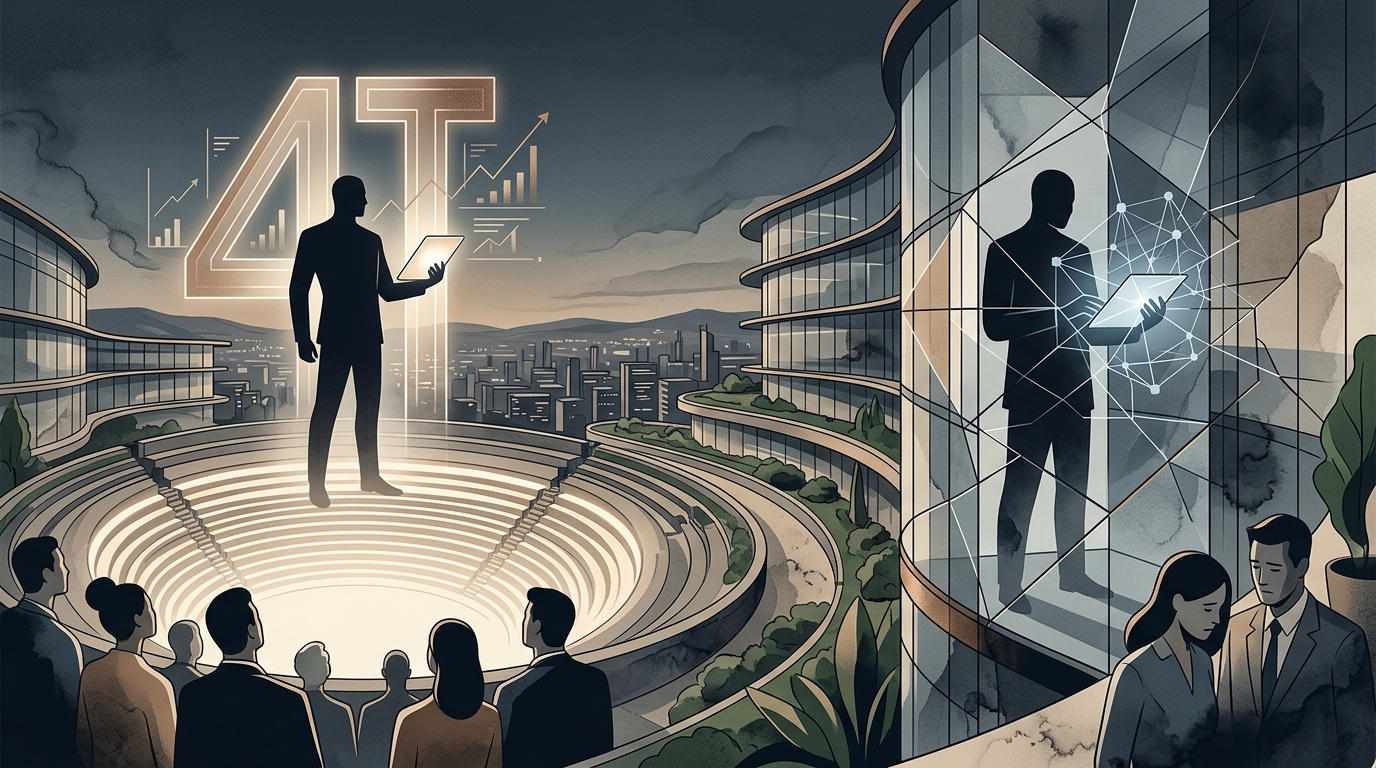
April 25, 2026, will be etched in technology history as the day Apple achieved the unthinkable: a $4 trillion market capitalization. Yet, behind the celebrations on Wall Street, a leadership drama is unfolding that touches the very soul of Silicon Valley. Tim Cook, the man who transformed Apple from a boutique creator of "tools for the mind" into a global empire of supply chains and services, is facing the paradox of his own achievement. The meticulousness, risk aversion, and obsession with operational excellence—the very traits that sent the stock price soaring—are now seen as the anchors preventing Apple from leading the Artificial Intelligence revolution.
The Legacy of Efficiency
When Tim Cook took the reins from Steve Jobs in 2011, skeptics were everywhere. Jobs was the visionary, the artist who could bend reality. Cook was the numbers man, the logistics wizard. In his 15 years of leadership, he proved that Apple didn't necessarily need a revolutionary new product every two years to dominate. It needed ecosystems, subscriptions, and a supply chain so tight it would stifle the competition.
Under his watch, the iPhone became the most profitable money-making machine in history. Cook didn't invent the smartphone, but he perfected it as a business model. His strategy relied on "incrementalism": small, controlled improvements every year that ensured steady revenue and minimal risk. This approach built a financial fortress, but it also fostered a culture that fears making mistakes.
The AI Inflection Point
The emergence of Generative AI in 2023 and its rapid evolution through to today in 2026 has exposed the cracks in Cook’s edifice. While Microsoft, Google, and Meta were investing billions in compute infrastructure and Large Language Models (LLMs), Apple remained wedded to its philosophy: "wait until we can make it perfect." In the hardware world, this is a virtue. In the AI world, where data and iteration speed are everything, delay is fatal.
Siri, once a pioneer, ended up looking like a relic of a bygone era. Apple’s attempts to integrate AI into its devices ran headlong into Cook’s obsession with privacy and total control over the user experience. These values, while noble, acted as a brake on training models that require vast amounts of data. Apple found itself in the uncomfortable position of having to license technology from OpenAI and Google, essentially admitting that its own internal culture failed to produce innovation of the same caliber.
The Success Trap
The question now haunting Apple Park is whether a leader can outgrow their own success. Cook built a company so large that any failure could be catastrophic for the global economy. This scale breeds conservatism. When you are managing a $4 trillion valuation, you don't "move fast and break things." Instead, you protect what you have built.
- The dependence on the iPhone remains the single greatest risk, despite the growth of services.
- The Vision Pro, while a technological marvel, failed to become humanity's "next screen" under the pressure of maintaining high profit margins.
- Apple’s culture has become overly bureaucratic, losing top AI talent who prefer the agility of startups.
Cook’s departure, now being discussed openly, marks the end of the era of the "Operationalists." The Apple of 2026 needs a visionary again—someone who understands that the future lies not in the profit margins of components, but in the intelligence that resides within them. Cook achieved his goal: he delivered the most valuable company in the world. But perhaps the price was Apple's ability to define the future.