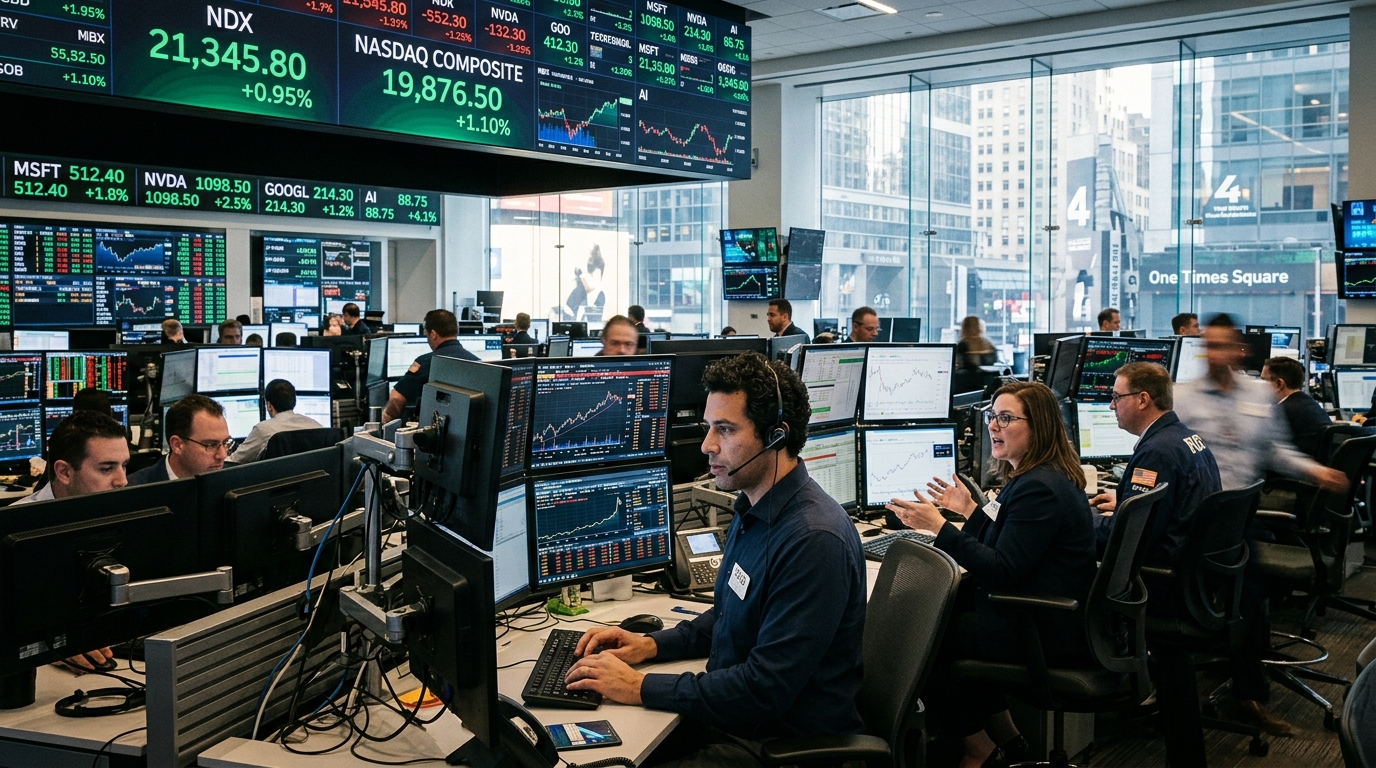
As we navigate the second quarter of 2026, the Nasdaq index continues to defy traditional economic gravity, propelled by an unprecedented influx of capital into the Artificial Intelligence (AI) sector. What began in 2023 as a fervor for large language models has now evolved into a structural re-engineering of the global economy. Wall Street analysts are converging on a single conclusion: AI is not a speculative bubble, but a new industrial revolution poised to propel markets to uncharted territories.
Nvidia: The Indisputable Hardware Sovereign
Nvidia remains the "goldsmith" of this new era. With the Blackwell architecture fully integrated into the market and whispers of the next generation of processors already circulating, Jensen Huang's firm is no longer just selling chips; it is selling the very "fuel" of digital civilization. Demand for GPUs in data centers remains insatiable, as not only tech titans but entire nations (Sovereign AI) scramble to build their own AI infrastructures.
Nvidia's competitive moat lies not just in hardware, but in its CUDA ecosystem, which makes it prohibitively difficult for developers to pivot to alternative solutions. Despite the entry of new players into the market, Nvidia maintains profit margins that would be the envy of luxury brands, making it the primary choice for any portfolio targeting AI-driven growth. In 2026, the question is no longer if Nvidia will grow, but how high its ceiling truly is.
Microsoft: The Master of Software Integration
If Nvidia provides the hardware, Microsoft provides the platform. Through its strategic investment in OpenAI and the universal integration of Copilot across its product suite—from Azure to Office 365—the company has successfully converted AI potential into immediate revenue streams. By 2026, Azure is no longer viewed merely as a cloud service, but as the "operating system" of global Artificial Intelligence.
Microsoft's ability to convince Fortune 500 enterprises to adopt generative AI tools has led to a consistent increase in average revenue per user (ARPU). Furthermore, the acquisition of Activision Blizzard is now yielding significant results in the gaming sector, where AI is utilized to create dynamic worlds and more sophisticated non-player characters (NPCs), opening up multi-billion dollar markets previously untapped by traditional software metrics.
Amazon: The Sleeping Giant of Infrastructure
Amazon represents the third pillar of this ascent, often underrated compared to its peers. AWS (Amazon Web Services) remains the world's largest cloud provider, and its pivot toward internal AI silicon, such as Trainium and Inferentia, allows it to offer lower costs to customers while simultaneously boosting its own margins. This vertical integration is the key to Amazon's dominance in the coming years.
Beyond the cloud, Amazon is leveraging AI to optimize its massive logistics network, reducing delivery times and operational costs to levels that competitors find impossible to match. Its advertising business, powered by AI algorithms that predict consumer behavior with uncanny precision, is emerging as one of the company's most profitable segments. This makes Amazon's stock an essential component for the long-term upward trajectory of the Nasdaq.
Market Dynamics: Beyond the Hype and Into the Fundamentals
Despite the prevailing optimism, investors must remain vigilant. The valuations of these companies are at historic highs, meaning any disappointment in quarterly earnings could trigger sharp corrections. Furthermore, the regulatory environment in the European Union and the United States is becoming increasingly stringent, with antitrust investigations threatening the dominance of Big Tech.
However, the fundamental shift in productivity offered by AI is undeniable. The companies that control the infrastructure and applications of this technology are the ones that will reap the greatest rewards. The Nasdaq of 2026 is no longer just a technology index; it is a barometer for the advancement of Artificial Intelligence and its integration into the fabric of human society.