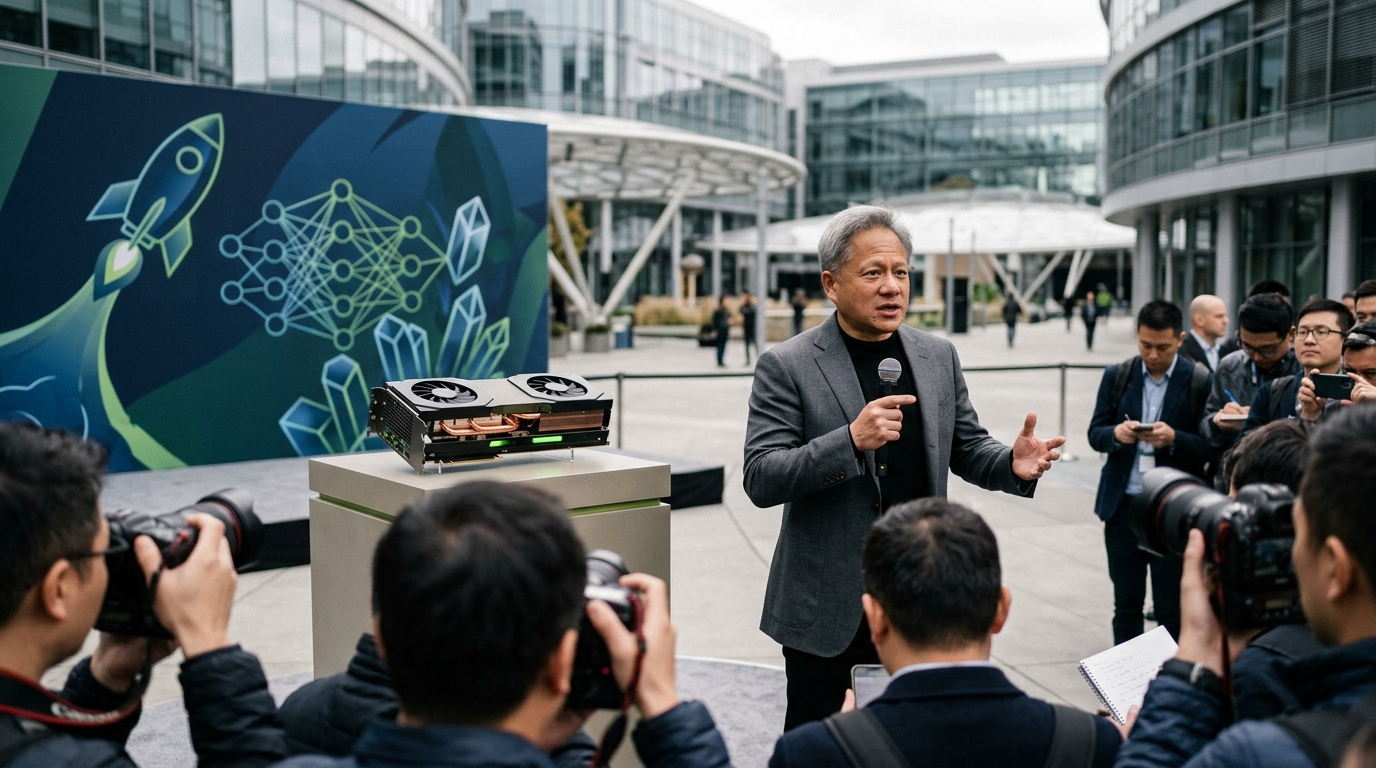
At the heart of the digital revolution, where computing power has become the new 'oil' of the global economy, a titan-scale conflict is brewing on the horizon. SpaceX, the company that redefined the aerospace industry, is now making a bold leap into the graphics processing unit (GPU) market, directly challenging Nvidia's undisputed dominance. This move is not merely a business expansion; it is a strategic necessity for Elon Musk's interconnected ecosystem, which includes Tesla, xAI, and the Starlink network.
The Logic of Vertical Integration
For those closely following the trajectory of Musk's ventures, this news is hardly a surprise. The philosophy of 'vertical integration' is the cornerstone of his success. Just as SpaceX built its own rockets to slash costs and Tesla designed its own FSD (Full Self-Driving) chips for autonomy, the insatiable demand for massive computing power is now driving internal GPU production. Reliance on Nvidia, which controls over 80% of the AI chip market, has become a costly and risky bottleneck for the rapid development of xAI and its Grok model.
SpaceX already possesses significant expertise in manufacturing specialized semiconductors for Starlink satellites and Falcon rocket guidance systems. These chips must be exceptionally efficient, radiation-hardened, and capable of processing vast streams of data in real-time. By pivoting this expertise toward data centers, SpaceX aims to create a new generation of GPUs that compete not just on raw speed, but on energy efficiency—a critical factor for the long-term sustainability of Large Language Models (LLMs).
The Nvidia Fortress and the Software Moat
However, the battle will not be won on hardware alone. Nvidia's greatest advantage is not just its silicon, but the CUDA ecosystem. This software platform allows developers to harness GPU power for general-purpose computing. Millions of lines of AI code globally are written specifically for CUDA, making it incredibly difficult for developers to switch to a competitor's architecture.
SpaceX appears to be taking a pragmatic route. Rather than immediately trying to convince the entire market to abandon Nvidia, it will use its proprietary GPUs to fuel its own internal needs. With xAI requiring hundreds of thousands of chips for training future iterations of Grok, SpaceX has a guaranteed 'captive' customer. This allows them to optimize their software stack in a controlled environment before potentially opening the technology to third parties. If they can prove their solutions offer a superior performance-per-watt ratio, major cloud providers like Microsoft and Amazon will be forced to take notice.
Geopolitical Implications and Silicon Sovereignty
This move carries deep geopolitical weight. In an era where the semiconductor supply chain is a matter of national security, creating an alternative high-tech production source within the United States strengthens the country's strategic position. SpaceX, with its deep ties to the U.S. Department of Defense, could evolve into a strategic supplier of 'military-grade GPUs,' capable of operating in extreme environments where standard Nvidia hardware might fail.
Furthermore, SpaceX's entry into the GPU market exerts downward pressure on prices. Nvidia's near-monopoly has led to astronomical profit margins, making AI access prohibitively expensive for smaller players. Competition from a player with SpaceX's financial depth and aggressive engineering culture could democratize computing power, accelerating breakthroughs in medicine, climate modeling, and autonomous systems.
Conclusion: The Future of the Compute Landscape
The clash between SpaceX and Nvidia signals the end of the era of 'one-size-fits-all' solutions. We are moving toward a world where tech giants design their own silicon to meet the hyper-specific needs of their proprietary algorithms. While Nvidia remains the king of the sector, the emergence of a competitor that isn't afraid to blow up rockets to learn how to build them better should be a cause for concern in Santa Clara. The battle for AI supremacy will not be decided solely by algorithms, but in the fabrication plants and the ability of machines to process thoughts faster than ever before.