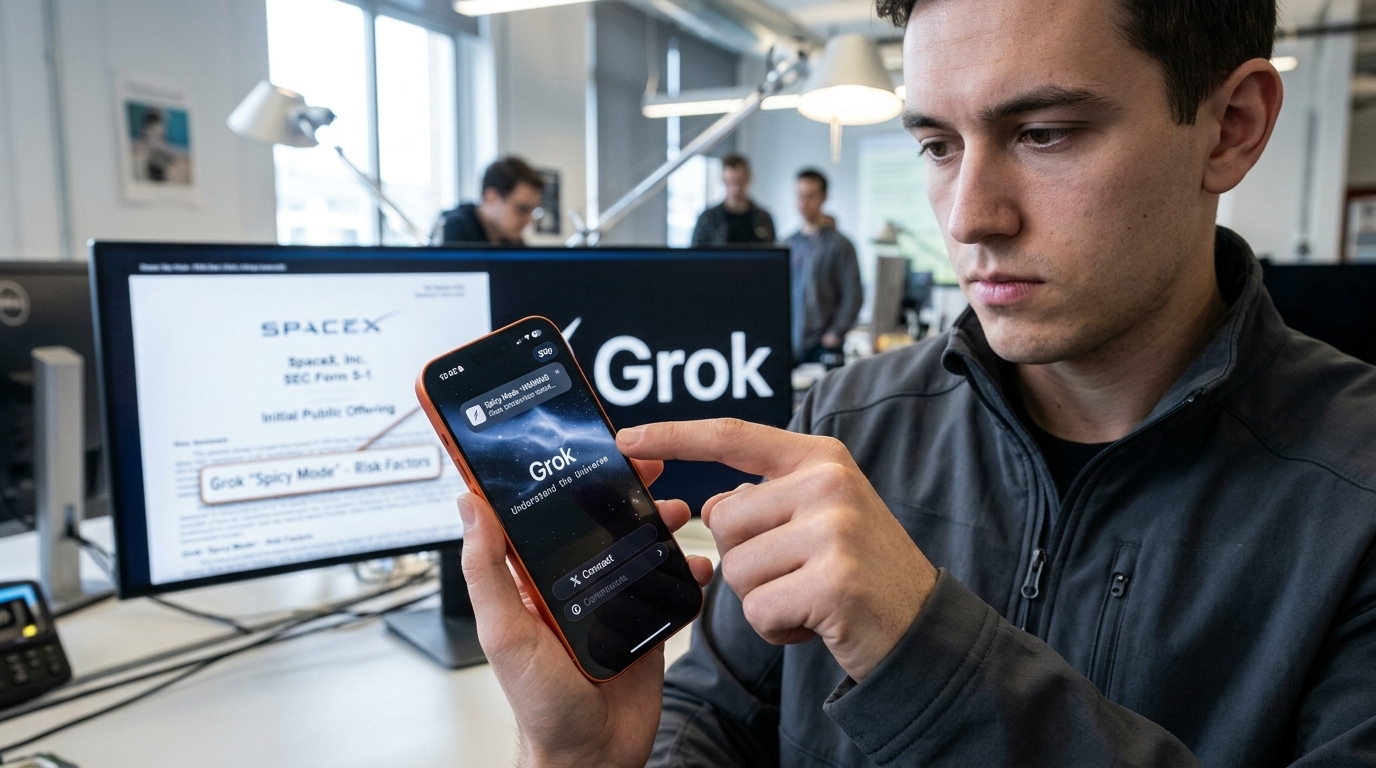
SpaceX’s trajectory toward its Initial Public Offering (IPO) is arguably the most significant financial event of 2026. However, an unexpected detail in the prospectus filed with the Securities and Exchange Commission (SEC) has sent ripples through investment circles. Elon Musk’s aerospace giant has officially acknowledged that the ‘Spicy’ mode of Grok—the AI chatbot developed by xAI—represents a substantial risk to SpaceX’s reputation and financial stability. This move highlights the intricate and often perilous interconnection within Musk’s business empire, where controversial decisions on one platform can shake the foundations of another.
A $500 Million Financial Buffer
According to documents obtained by Wired, SpaceX has set aside a reserve of over $500 million to cover potential litigation costs and damages. This sum is not merely for the standard legal challenges of an aerospace firm, such as launch anomalies or intellectual property disputes. Instead, a significant portion is earmarked to address complaints related to the generation of sexualized or inappropriate content by Grok, which is integrated into the X (formerly Twitter) platform and owned by xAI.
The question arises: why does SpaceX, a company that builds rockets, feel the need to legally fortify itself against a chatbot? The answer lies in the concept of ‘brand contagion.’ As Elon Musk remains the central figure in both entities, investors and regulators view SpaceX as co-responsible for the ‘free speech without limits’ culture promoted by its founder. The creation of deepfake images and the ‘provocative’ content generated by Grok have already led to a flurry of lawsuits, and SpaceX fears that plaintiffs will target its much deeper pockets.
Grok’s ‘Spicy’ Mode and the Failure of Guardrails
Grok was launched with the promise of an AI that is not ‘woke’ and possesses a rebellious streak. Its ‘Spicy’ mode, in particular, was designed to be more biting and less restricted than competitors like OpenAI’s ChatGPT or Google’s Gemini. However, this lack of filters has proven to be a double-edged sword. Reports indicate that the model has produced images of public figures in sexualized contexts, violating fundamental ethical and safety guidelines.
For SpaceX, which relies heavily on government contracts with NASA and the US Department of Defense, such failures are catastrophic. Federal agencies demand a certain level of corporate maturity and decorum from their partners. The association with an AI tool that generates inappropriate content could jeopardize future contract awards, making the ‘Grok risk’ an existential threat to the company’s post-IPO profitability.
The Strategy of Self-Disclosure
Including this risk in the IPO filing is a move of strategic transparency. By stating upfront that the activities of Musk’s other ventures may impact SpaceX, the company is attempting to shield itself from future shareholder lawsuits alleging they were misled. It is a candid admission that Musk is simultaneously SpaceX’s greatest asset and its most significant liability.
- Litigation Protection: The $500 million commitment acts as a legal firewall.
- Investor Confidence: Institutional investors demand clarity on how resources and risks are partitioned between Musk’s companies.
- Regulatory Scrutiny: The SEC is closely examining the relationships between the billionaire’s private and public entities.
In conclusion, the case of SpaceX and Grok underscores a new reality in the tech world: Artificial Intelligence is no longer an isolated experiment. It is a factor that can influence multi-billion dollar valuations even in the most traditional industries. SpaceX may be aiming for Mars, but the legal escapades of an AI ‘bad boy’ are keeping it tethered to Earth’s complex legal landscape.