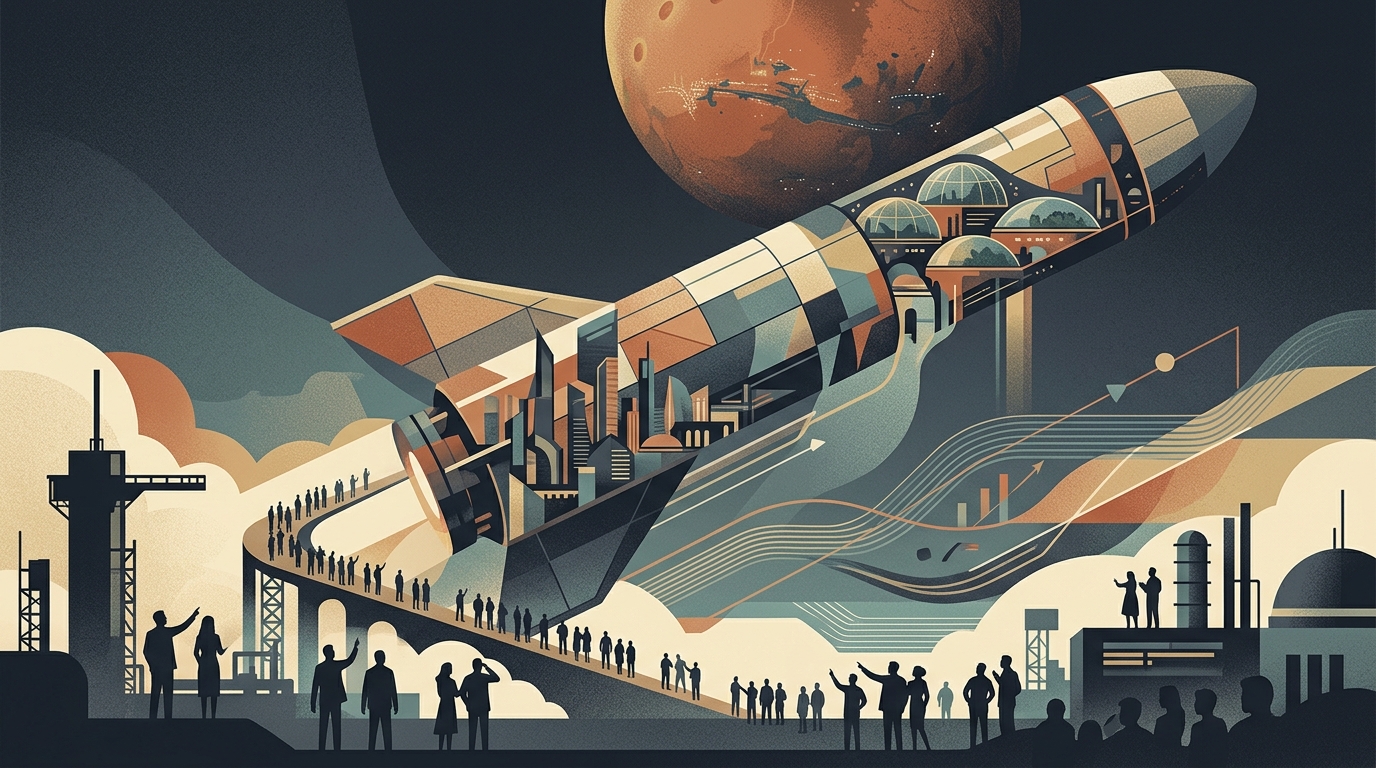
May 20, 2026, will likely be recorded in the annals of financial history as the moment humanity stopped viewing space as a field of scientific research and began treating it as the next great real estate and infrastructure market. The filing of the prospectus for SpaceX’s Initial Public Offering (IPO) is not just financial news; it is the official declaration of the birth of a corporate "monster" with a valuation approaching $1 trillion, driven by a single, almost religious purpose: making humanity a multi-planetary species.
The Contract of the "Emperor" of Mars
At the heart of the filing lies the proposed pay package for Elon Musk, which makes his previous Tesla compensation look modest. This is not a salary, but a series of stock options that unlock only upon achieving milestones that were previously the stuff of science fiction. These goals include the successful landing of Starship on Mars, the establishment of the first viable oxygen and fuel production plant on the planet’s surface, and the transport of the first 100 colonists.
Wall Street analysts point out that this compensation structure essentially turns Musk into the de facto governor of future Martian infrastructure. Should SpaceX achieve these goals, Musk’s personal wealth could exceed any historical precedent, making him the planet’s first "trillionaire," based on assets located millions of miles away. The prospectus frames this not as greed, but as the necessary incentive to drive the most difficult engineering feat in history.
Starlink: The Money Printing Machine
To understand how a company spending billions on experimental rockets can be worth $1 trillion, one must look at Starlink. The satellite internet network is no longer a side project; it is the backbone of global telecommunications. With over 15,000 satellites in orbit (as of May 2026) and tens of millions of subscribers, Starlink generates the cash flow required to fund the Mars vision.
The prospectus reveals that Starlink now holds 40% of the global broadband market in rural and remote areas and has become the exclusive provider for the armed forces of most NATO nations. This monopolistic power is what gives SpaceX the stability to promise investors that the "Mars adventure" is not a risk without a safety net, but a logical expansion of a dominant technological empire. The revenue from Earthly connectivity is literally fueling the engines of interplanetary migration.
The Rhetoric of Survival and the Fate of Dinosaurs
Perhaps the most striking part of the document is its introduction, which uses almost apocalyptic language. “We do not want humans to have the same fate as dinosaurs,” the text reads, emphasizing that SpaceX is not just selling tickets to space, but “life insurance for the human species.” This approach shifts the narrative from profitability to existential necessity.
However, critics argue that this rhetoric masks a dangerous concentration of power. If a private corporation controls the only escape route from Earth, then the rules of democracy and international diplomacy may not apply in the vacuum of space. The question posed by the IPO is not just whether the stock will rise, but whether we are ready to cede the future of our species to a private tycoon. The prospectus even hints at a unique governance model for Mars, one that prioritizes "operational efficiency" over traditional bureaucratic structures.
Geopolitical Implications and the New Space Cold War
SpaceX’s move to go public comes at a time of intense tension between the US and China over lunar dominance. NASA, which relies heavily on Starship for the Artemis program, finds itself in a peculiar position: it is simultaneously the largest customer and the regulator of a company that will soon have more financial power than the agency’s own budget. The IPO provides SpaceX with a capital base that no government agency can match.
China has already voiced concerns at the UN, arguing that the “privatization of strategic orbit” by SpaceX constitutes a threat to global security. With the IPO, SpaceX gains access to capital that accelerates a race likely to result in the first Martian colony within the next decade, long before any national program. The financialization of Mars means the Red Planet is no longer a scientific frontier, but a line item on a balance sheet.