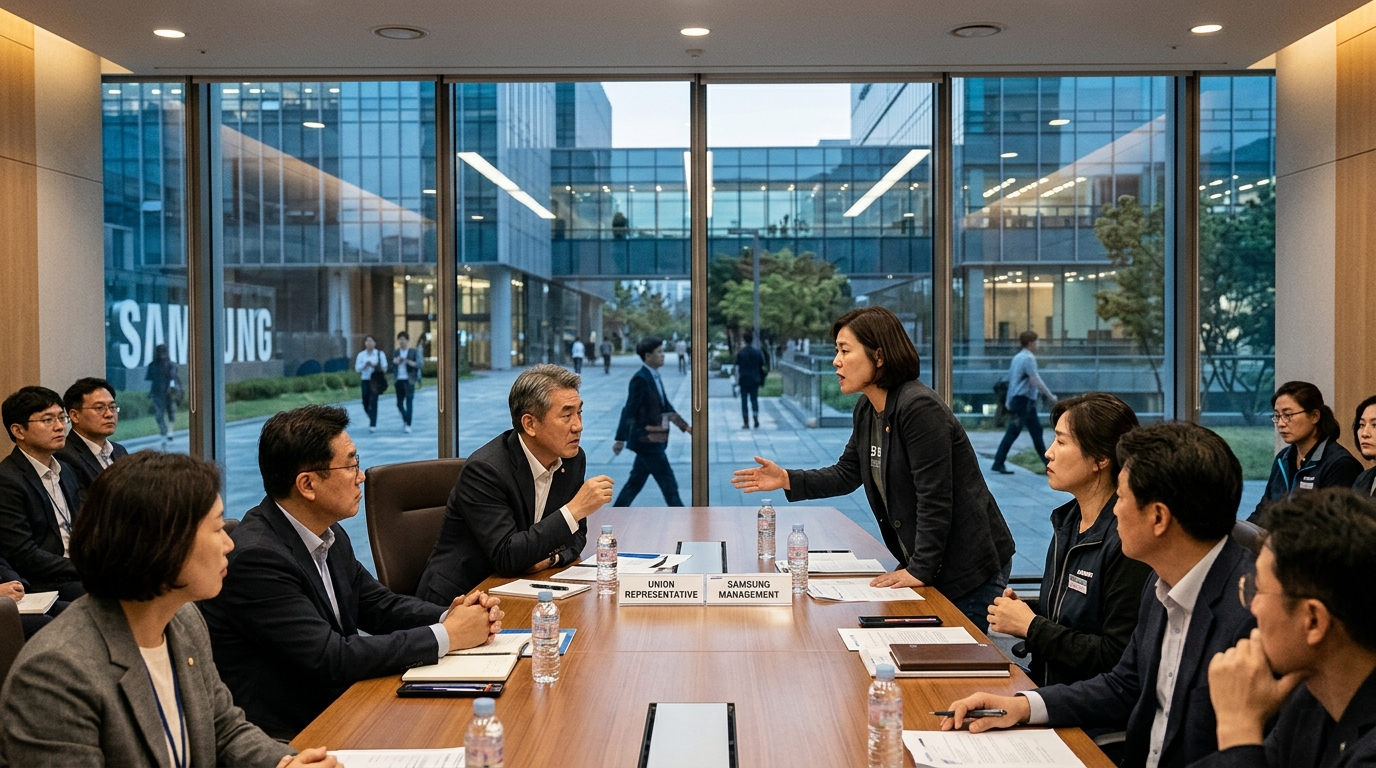
At a historical juncture where the global semiconductor market is on high alert due to the explosive demand for Artificial Intelligence chips, tech giant Samsung Electronics Co. faces an internal crisis that threatens to shake its foundations. On Monday, company leadership and the National Samsung Electronics Union (NSEU)—the firm's largest labor organization—will sit down for what many describe as a "last chance" to avert a full-scale strike.
The Stakes of a National Crisis
Samsung’s significance to the South Korean economy cannot be overstated. Accounting for approximately 20% of the nation’s GDP, any malfunction in its production lines translates directly into national economic instability. Prime Minister Han Duck-soo has personally intervened, warning that a strike at this stage could wreak "havoc" not only on the domestic economy but also on global supply chains, which rely on Samsung for DRAM and NAND flash memory.
Workers are demanding wage increases, improved bonus systems, and, above all, transparency. The NSEU, which now boasts over 28,000 members (roughly 24% of the company’s domestic workforce), argues that management has failed to recognize employee contributions to the company's profitability, especially following the recent rebound in semiconductor prices.
The Battle for AI Chips and Competition
The timing of this labor unrest is the worst possible for Samsung. While the company remains the world’s largest memory chip maker, it has found itself on the defensive in the field of High Bandwidth Memory (HBM), which is essential for Nvidia’s AI processors. Rival SK Hynix has gained significant ground, leaving Samsung struggling to certify its own HBM3E chips.
- Production interruptions would further delay the testing and delivery of new AI chips.
- Loss of trust from major clients like Nvidia and Apple could be irreversible.
- The cost of a strike is estimated at hundreds of millions of dollars per day due to the nature of semiconductor manufacturing, which requires continuous clean room operations.
The Chaebol Legacy and the New Reality
Historically, Samsung followed a strict "no-union" policy, a legacy started by founder Lee Byung-chul. However, in 2020, under pressure from judicial investigations and public opinion, current leader Jay Y. Lee promised to end this practice. The current crisis is the first major test of that promise. Workers are no longer just asking for money; they are demanding a fundamental shift in South Korean corporate culture, challenging the traditional "Chaebol" model (family-owned conglomerates) where management decides unilaterally.
"We are not just asking for raises. We are asking for respect and a fair share of the value we create," said an NSEU spokesperson.
Predictions and Implications
If Monday's talks fail, a strike appears inevitable. Analysts suggest that Samsung may be forced to concede on certain demands to ensure production continuity, especially as geopolitical pressure from the US and China over chip dominance intensifies. A prolonged conflict could lead to a rise in global electronics prices as memory inventories rapidly deplete. Tomorrow is not just about wages in Seoul; it is about the stability of the 2026 digital economy.