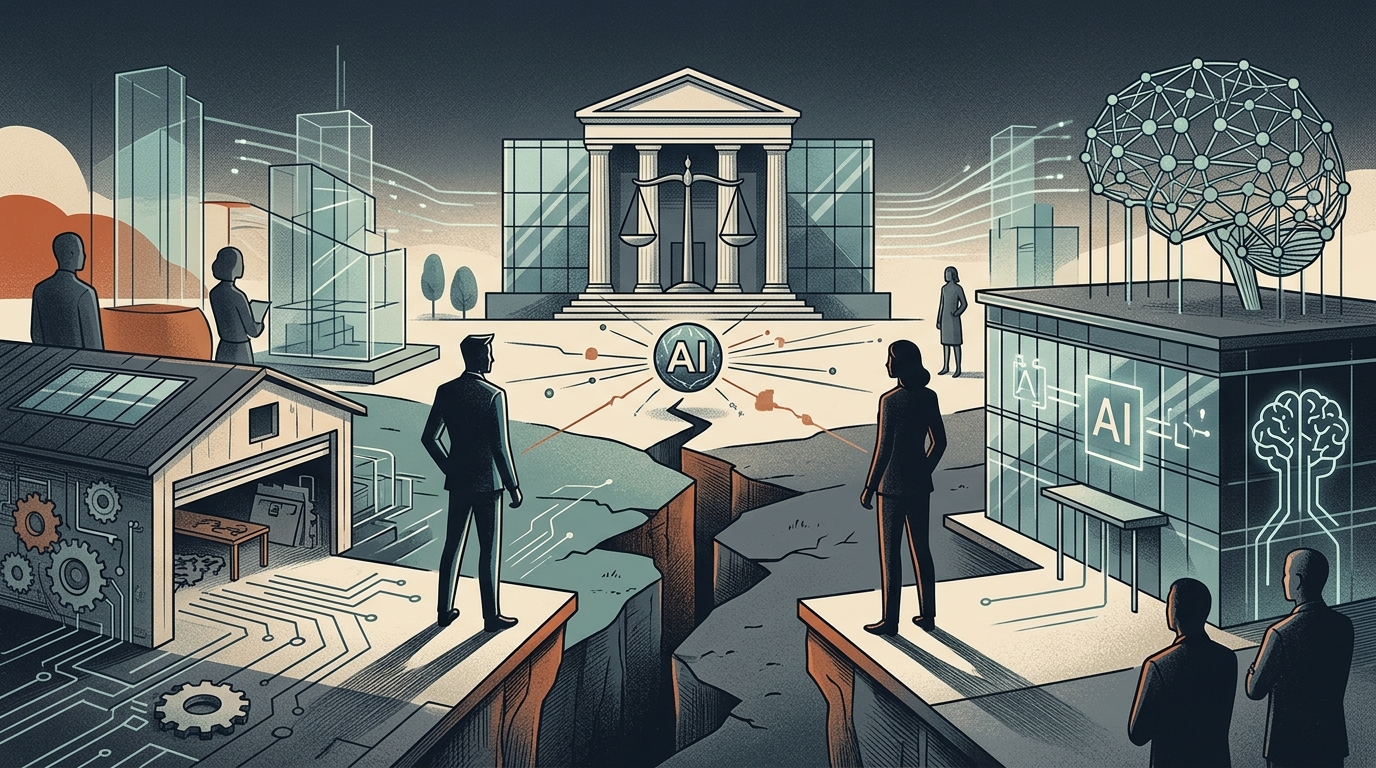
In the heart of San Francisco, in a courtroom that has become the epicenter of global technological interest, the long-awaited trial between Elon Musk and the leadership of OpenAI has commenced. This is no ordinary corporate dispute; it is an ontological battle for the soul of Artificial Intelligence. Musk, a co-founder of OpenAI who departed in 2018, accuses Sam Altman and Greg Brockman of "betraying" the company's founding mission, arguing that its transformation from a non-profit organization into a de facto subsidiary of Microsoft constitutes a flagrant breach of contractual obligations.
The Chronicle of a Foretold Clash
The case focuses on what Musk calls the "Founding Agreement." According to the plaintiff's side, OpenAI was established with the promise that Artificial General Intelligence (AGI) would be developed for the benefit of humanity, free from commercial interests and based on open-source principles. Musk's legal team presented documents and correspondence from 2015, claiming that the multi-billion dollar investment from Microsoft turned OpenAI into a "closed" organization maximizing profits for one of the world's largest corporations.
On the other side, OpenAI, under the leadership of Sam Altman, dismisses the claims as "incoherent" and "frivolous." The company's lawyers argue that there was never an official written "founding agreement" in the way Musk describes it. Instead, they contend that Musk himself had previously proposed merging OpenAI with Tesla or taking full control of it before leaving when his proposals were rejected. The defense focuses on the fact that developing AGI requires resources that only a for-profit structure could attract.
The Shadow of Microsoft and the AGI Question
One of the most critical points of the trial is the definition of AGI. In OpenAI's contract with Microsoft, the latter has rights to OpenAI's technology up to the point where it is deemed "Artificial General Intelligence." Once this milestone is reached, Microsoft's license expires. Musk claims that GPT-4 and subsequent models are already early forms of AGI, and that OpenAI is deliberately delaying this admission to maintain the flow of funding from the Redmond giant.
Sam Altman's testimony is being awaited with bated breath. Altman is expected to explain how the "capped-profit" structure ensures that shareholder interests do not override human safety. The trial is bringing to light internal messages showing the tension between the founders, with Musk appearing at times as a visionary and at others as an authoritarian leader seeking to impose his own agenda.
Implications for the Tech Ecosystem
The court's decision could set a massive legal precedent. If the judge rules in favor of Musk, OpenAI might be forced to open-source its code or radically change its governance structure, which would cause an earthquake in the markets and its relationship with Microsoft. Furthermore, the question arises: can a non-profit organization mutate into a for-profit colossus without being accountable to its original benefactors?
- Transparency: The demand for public disclosure of algorithms.
- Ethics: Who defines when a machine becomes as "intelligent" as a human?
- Competition: The trial's impact on Musk's xAI and other competitors like Anthropic.
In conclusion, this trial is not just about two billionaires. It is about how society will control the most powerful technology ever created. As testimonies continue, the global community watches a confrontation that will determine whether AI remains a public good or the ultimate wealth-generation tool for a select few.