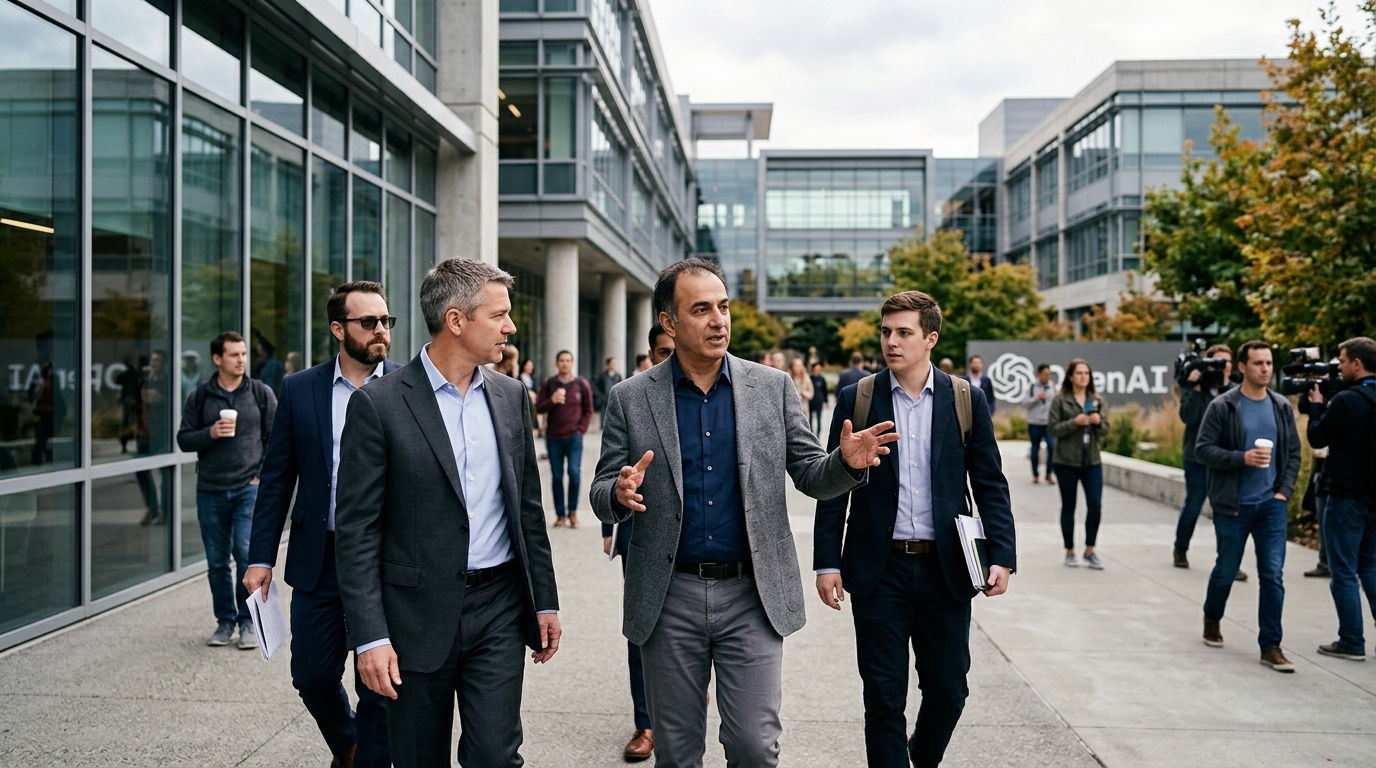
The news hit the corridors of Wall Street and Silicon Valley like a lightning bolt: OpenAI, the company that ignited the generative AI revolution, is reportedly preparing a fast-tracked Initial Public Offering (IPO). According to sources cited by Reuters, Sam Altman and the company’s board have laid the groundwork for an IPO that could redefine the investment landscape of the decade. This move is not merely a business decision, but the final metamorphosis of an organization that began as a non-profit research lab into a capitalist titan of unprecedented scale.
The Mutation of a Giant: From Altruism to Profit
OpenAI’s path to the stock market is riddled with contradictions. Founded in 2015 with the promise to develop AI for the benefit of humanity, free from financial pressures, the company was forced to restructure in 2019, creating a "capped-profit" arm. Today, the need for capital is more pressing than ever. Training models like GPT-5 and developing semiconductor infrastructure require billions of dollars—amounts that even Microsoft’s generous funding struggles to fully cover.
The restructuring of the company into a full-profit "benefit corporation" is seen as the final step before filing documents with the Securities and Exchange Commission (SEC). This shift will allow OpenAI to attract institutional investors who previously hesitated due to its complex and often opaque governance structure. However, this move raises questions about the company’s commitment to AI safety, as shareholder pressure for quarterly earnings may clash with the slow, deliberate pace required for ethical technology development.
The Microsoft Factor and Global Competition
OpenAI’s relationship with Microsoft remains the key to the equation. With investments exceeding $13 billion, the Redmond tech giant holds a significant share of profits but no direct control. An IPO would offer Microsoft a clear exit path or, conversely, an opportunity to solidify its position as the dominant player in the age of intelligence. Meanwhile, competition from Anthropic, Google, and Elon Musk’s xAI is forcing OpenAI to "lock in" its market dominance while momentum is still in its favor.
Analysts estimate that OpenAI’s valuation in a potential IPO could exceed $150 billion, making it one of the largest public offerings in U.S. history. This capital will not only be used for software development but also for Altman’s ambitious plan to build a global network of chip fabrication plants, reducing reliance on Nvidia and TSMC.
Risks and Challenges: Transparency Under the Microscope
Going public means the end of secrecy. OpenAI will be required to disclose detailed financial data, cloud computing expenditures, and, most importantly, the risks associated with its technology. Regulators in the US and EU are closely monitoring developments, especially regarding the copyright of training data and the concentration of power in a few hands.
"OpenAI is no longer an experiment; it is the backbone of the new digital economy. The IPO is the moment of truth where utopia meets the balance sheet," says a leading Silicon Valley analyst.
Furthermore, the internal stability of the company remains a concern. Following the dramatic "coup" and Altman’s return in 2023, the company has lost several top executives and researchers who were concerned about the commercialization of its mission. A public offering could lead to a mass exodus of employees cashing out their stock options, creating a talent vacuum at a critical juncture.
Conclusion: A New Era for AI
The rush for OpenAI’s IPO signals the maturation of the AI industry. We are moving from the era of promises to the era of accountability and mass scale. If OpenAI manages to balance investor demands with its responsibility to humanity, it will remain the leader of the 21st century. However, if it sacrifices safety on the altar of the share price, the consequences will be felt far beyond the Nasdaq ticker.