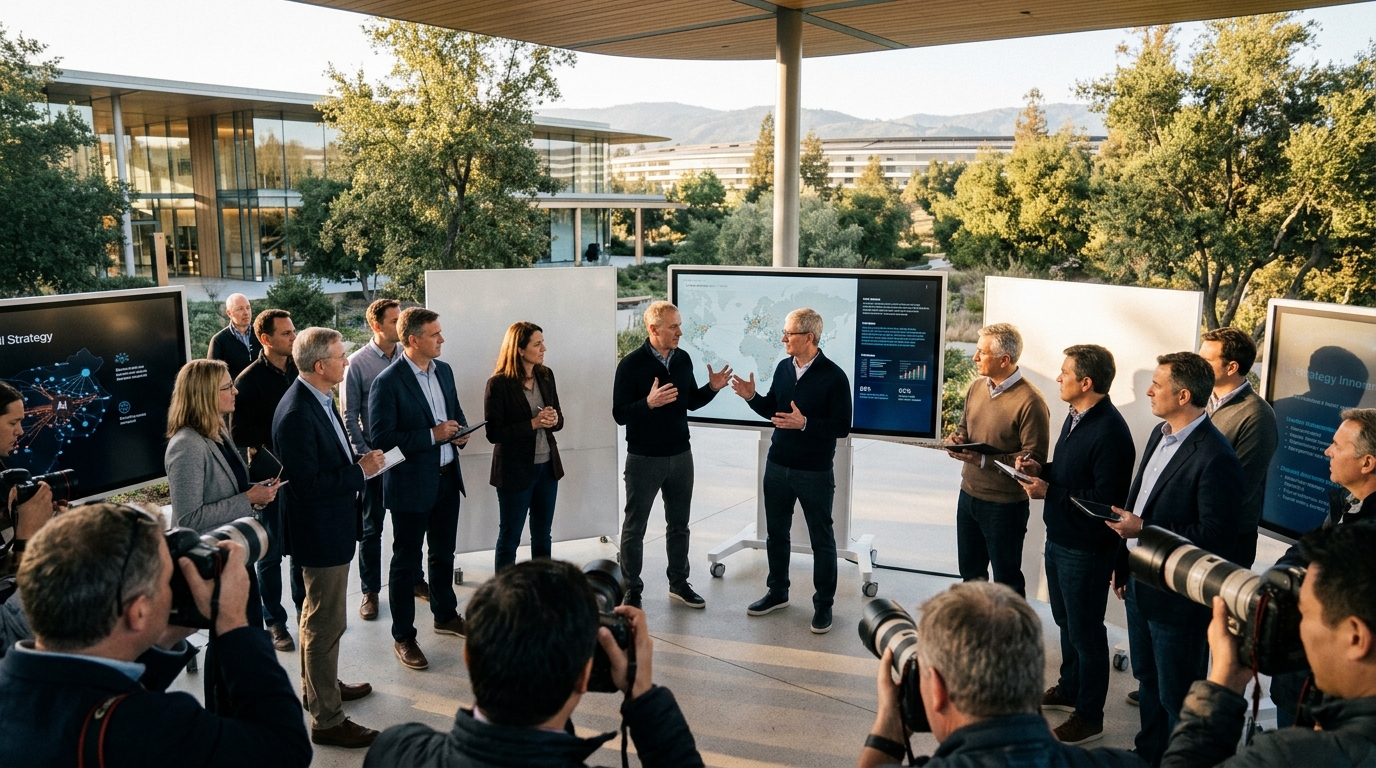
It was a rainy Tuesday in late 2024 when Apple’s top brass gathered at the Steve Jobs Theater for a meeting that appeared on no official calendar. According to sources cited by Bloomberg, Tim Cook and his closest lieutenants faced a harsh reality: the iPhone risked becoming a technological "hollow shell" if the company failed to integrate Generative AI into its core. This meeting, now being described as Apple’s "Sputnik moment," laid the groundwork for what we are about to witness at WWDC 2026.
The Secret Summit That Redefined Cupertino
For years, Apple followed a strategy of "watchful waiting." While Google, Microsoft, and OpenAI were unveiling one breathtaking model after another, Cupertino stuck to the term "Machine Learning" and prioritized privacy above all. However, during that closed-door session, internal reports were presented showing that users were beginning to find Siri obsolete and Apple’s ecosystem "closed" in the negative sense of the word. The decision made was radical: Apple would have to redesign its software from the ground up, placing AI as the top priority, even above hardware aesthetics.
The result of this pivot is Project Hera, a clandestine initiative aimed at developing an internal large language model (LLM) capable of running locally on the device without sacrificing privacy. This technological leap required unprecedented collaboration between the software and silicon divisions, leading to the creation of the M5 chip and the A20 Pro, which feature specialized Neural Engine units capable of handling trillions of parameters per second.
WWDC 2026: The Unveiling of iOS 27
This year's Worldwide Developers Conference is expected to be the most significant in the company’s history since the introduction of the original iPhone. iOS 27 will not just be an update; it will be the first "AI-native" version of the operating system. Reports suggest that Siri will be replaced by a new digital assistant with full context awareness, capable of performing complex tasks across different apps and possessing a near-human voice and personality.
- Autonomous App Management: AI will be able to book appointments, draft emails based on previous conversations, and edit photos using simple voice commands.
- Personal Knowledge Base: The device will learn user habits locally, creating a profile that never leaves the phone.
- Vision Pro Integration: AI will play a decisive role in augmented reality, recognizing objects in physical space in real-time.
The Privacy-First AI Strategy
The big bet for Tim Cook is to convince the public that Apple’s AI is safer than the competition’s. While Google and Meta rely on user data to train their models, Apple is pushing the "On-Device Processing" model. When a task is too heavy for the iPhone, it will be offloaded to specialized Apple servers using its proprietary Private Cloud Compute technology, where data is deleted immediately after processing. This approach is not just ethical; it is a shrewd business move to differentiate itself in a saturated market.
"We don't want to be the first to build an AI that does everything. We want to be the first to build an AI you can trust with your life," Craig Federighi reportedly stated in an internal memo.
In conclusion, WWDC 2026 will be the final test of whether Apple can lead in the age of intelligence or if it will remain a secondary player in a rapidly changing world. The secret meeting of 2024 was the beginning of a new era, and now Cupertino is ready to show its hand.