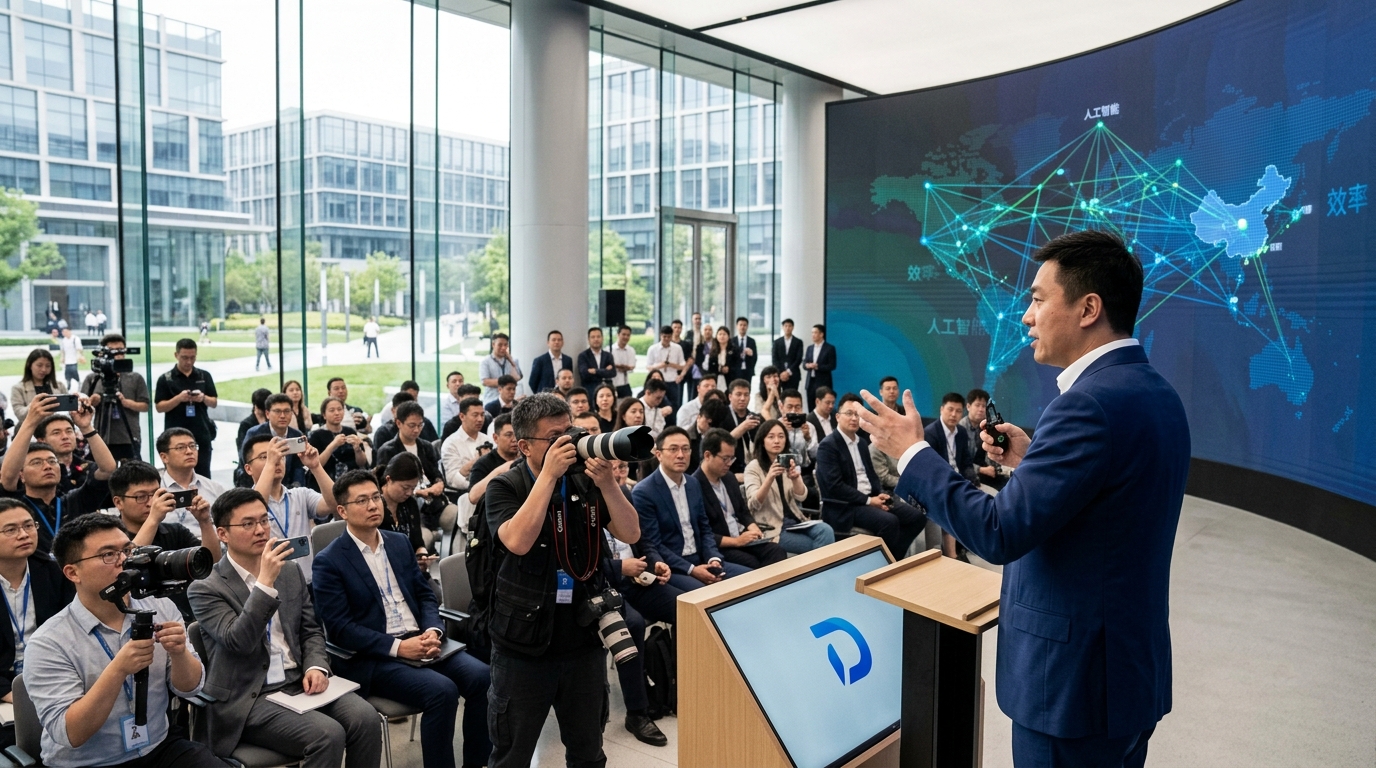
In the global geopolitical chess match of artificial intelligence, DeepSeek is no longer just a player; it is an existential threat to the Silicon Valley establishment. The news that the Chinese startup, owned by High-Flyer Capital Management, is targeting a $59 billion valuation in its first major funding round marks a new phase in the technological 'Cold War.' After disrupting the industry in early 2025 with the release of its R1 model, DeepSeek is now attempting to capitalize on its reputation as the company that can do more with less.
The Strategy of Efficient Intelligence
DeepSeek differentiated itself from OpenAI and Google not through brute computational force, but through architectural ingenuity. While American giants spend billions on Nvidia infrastructure, DeepSeek proved that by using techniques like Mixture-of-Experts (MoE) and training optimization, it can achieve GPT-4 level performance at a fraction of the cost. This 'frugal' approach is what now attracts investors, as the question of AI profitability becomes increasingly urgent.
However, the $59 billion valuation is not just about algorithms. It is about the survival of the Chinese AI ecosystem under the regime of strict US semiconductor export restrictions. DeepSeek managed to innovate using older technology or a limited number of modern chips, creating a precedent that China hopes to generalize across its entire domestic industry.
The Invisible Ceiling: What Money Cannot Buy
Despite the excitement, DeepSeek faces challenges that no amount of funding can solve immediately. First and foremost is the 'data barrier.' While its models are exceptional at mathematics and programming, they lag in cultural breadth and creative writing, partly due to strict censorship regulations in China. The need to align models with Beijing's guidelines inevitably limits the 'cognitive freedom' of the AI, making it less competitive globally for applications requiring open-ended thinking.
"DeepSeek is the symbol of a China that was forced to become smarter because it could not become more powerful at the hardware level," says a market analyst.
Furthermore, there is the issue of scaling. Efficiency is impressive, but to reach Artificial General Intelligence (AGI), history shows that the sheer volume of data and energy remains decisive. DeepSeek may be the 'cheaper' solution, but the question remains: can cheap AI lead to the true revolution, or will it remain a specialized optimization tool?
Geopolitics and Investment Risk
The move to raise capital comes at a time when US-China relations are at a breaking point. Investors participating in this round—primarily domestic state actors and some bold international funds—are betting on DeepSeek's ability to serve as China's national bastion. If the company fails to maintain its technological edge as the US moves to next-generation chips, the $59 billion valuation could prove to be one of the decade's largest bubbles.
In conclusion, DeepSeek is not just selling a chatbot; it is selling the vision of an alternative path to the future. A path where intelligence is not measured by the number of transistors, but by the elegance of the code. Whether this vision will withstand the pressure of the real market and geopolitical rivalries remains to be seen.