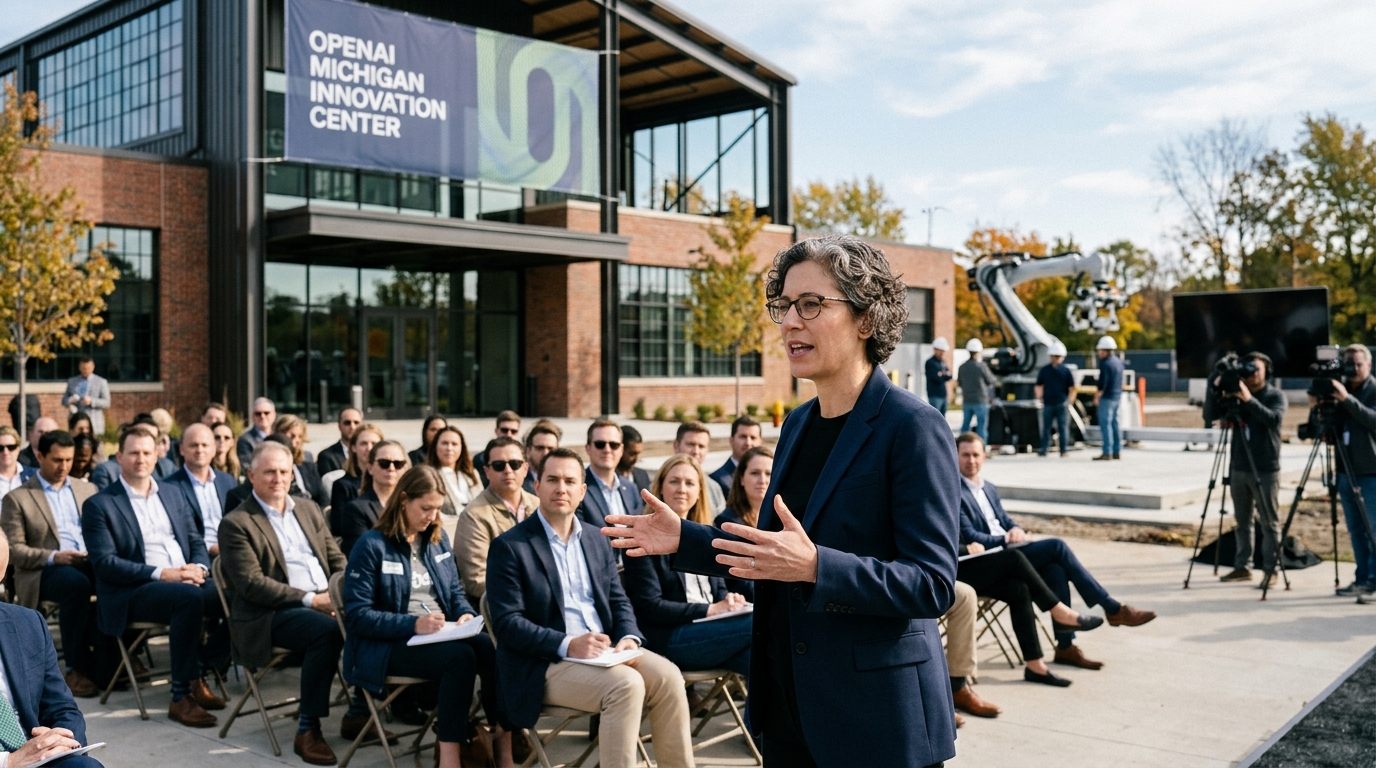
In a move that redraws the geopolitical map of technology within the United States, OpenAI has announced the commencement of a new, state-of-the-art AI infrastructure project in Michigan. This decision is not merely a capacity expansion but a strategic pivot toward leveraging the industrial fabric of the 'Rust Belt,' a region seeking a new identity in the digital age. Sam Altman’s company is highlighting the growing necessity for massive computing power, which now requires access to stable energy grids and abundant water resources for cooling systems.
The Strategic Choice of Michigan
Why Michigan? The answer lies in the combination of three factors: energy, infrastructure, and political will. The state boasts one of the most resilient electrical grids in the U.S., bolstered by nuclear power plants that offer a steady flow of carbon-free energy—essential for OpenAI’s sustainability goals. Furthermore, proximity to the Great Lakes ensures the feasibility of advanced liquid cooling systems for next-generation processor racks, drastically reducing operational costs compared to traditional air-cooling methods.
The Michigan state government, through the Michigan Strategic Fund, offered an incentive package including tax breaks and subsidies for workforce training. For a state identified for decades with the automotive industry, OpenAI's arrival represents a 'golden ticket' for transitioning to a knowledge-based economy. The new facilities are expected to create thousands of jobs, not just for software engineers, but for specialized infrastructure technicians and energy management experts.
The Convergence of AI and Industrial Manufacturing
OpenAI’s presence in Michigan creates unique opportunities for synergies with Detroit’s giants. Ford, General Motors, and Stellantis are already integrating AI into their production lines and autonomous vehicles. Having an OpenAI data center 'in their backyard' reduces data latency and enables the development of specialized models that can control robotic systems in real-time with unprecedented precision.
"We are not just building servers. We are building the engine of the next industrial revolution," an OpenAI executive stated during the project presentation.
The project, codenamed 'Project Ironwood,' is expected to house tens of thousands of next-generation Nvidia GPUs, as well as the new custom processors OpenAI is developing in collaboration with TSMC. The data center's architecture is designed to be modular, allowing for rapid expansion as the requirements for training models like GPT-5 and GPT-6 grow exponentially.
Challenges and Social Implications
Despite the excitement, there are concerns. Local communities have raised questions about water consumption and the potential for rising electricity prices. OpenAI has committed to investing in local renewable energy projects to offset its footprint; however, the scale of the facility is such that it will test the state's infrastructure resilience. Additionally, there is the question of the 'digital divide': will Michigan residents benefit from these high-skilled jobs, or will we see an influx of California executives driving up the cost of living?
In conclusion, OpenAI’s investment in Michigan is a bet on the future of America. It is an attempt to prove that high technology can take root in places that globalization left behind. If the experiment succeeds, Michigan will no longer be just the capital of wheels, but the brain of global artificial intelligence.