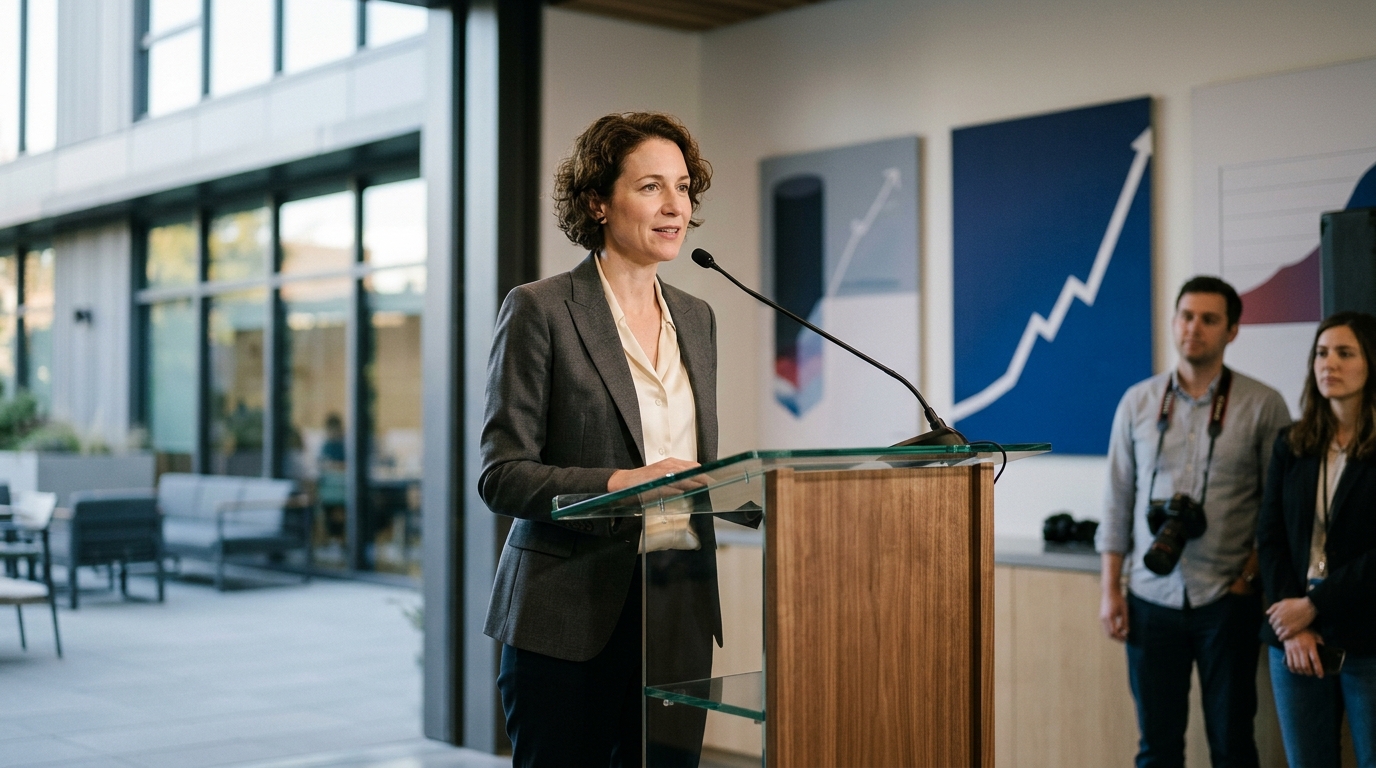
In May 2026, the conversation surrounding artificial intelligence has shifted from the initial shock of innovation to the raw reality of scaling and profitability. In a revealing interview with Bloomberg, Sarah Friar, OpenAI’s Chief Financial Officer, used a phrase that is already reverberating through Wall Street: a “vertical wall of demand.” Friar, who took the financial helm of the company at a critical juncture, made it clear that OpenAI is not only meeting its internal targets but is facing a hunger for compute power and services that is unprecedented in corporate history.
Rebutting Skepticism and the Growth Strategy
Over the past few weeks, reports circulated suggesting that OpenAI was struggling to hit the ambitious revenue milestones set during its last massive funding round. Friar, bringing her seasoned experience from leadership roles at Square and Nextdoor, was emphatic in her rebuttal. “The reality inside the building is very different from the external noise,” she stated. The CFO explained that the transition from GPT-4 to GPT-5 and subsequent iterations has created a new dynamic where businesses are no longer just experimenting with AI—they are embedding it into the very core of their operations.
OpenAI’s strategy for 2026 is laser-focused on enterprise-grade solutions. The “wall of demand” Friar refers to doesn't just stem from individual ChatGPT users, but primarily from the Fortune 500 sector. Companies are now demanding “AI agents” capable of executing complex tasks autonomously—from supply chain management to advanced software engineering. This shift has catapulted Enterprise subscription revenue, creating a stable and predictable cash flow that has calmed investor nerves.
The Infrastructure Challenge and the Cost of Dominance
However, a “vertical wall of demand” brings with it vertical challenges. The most significant bottleneck remains infrastructure. Friar admitted that the limiting factor for OpenAI’s growth is not a lack of customers, but the availability of silicon and energy. The close partnership with Microsoft on project “Stargate”—the rumored $100 billion data center initiative—is the primary answer to this constraint.
- GPU demand remains at record highs, despite new entrants in the semiconductor market attempting to challenge Nvidia's dominance.
- The power consumption of next-generation models requires massive investments in nuclear energy and renewables, areas where CEO Sam Altman is heavily involved.
- Geopolitical instability continues to affect the supply chain, forcing OpenAI to diversify its hardware partnerships.
The CFO emphasized that managing these costs is just as vital as growing the top line. “We are no longer a startup burning cash without a tomorrow. We are an organization building the infrastructure of the future global economy, and that requires rigorous financial discipline,” she noted. This statement aims to reassure those fearing an “AI bubble,” arguing that the value generated is tangible, measurable, and deeply integrated into productivity gains across industries.
The Future: From Chatbot to Global Compute Engine
Looking toward the second half of 2026, OpenAI appears to be preparing for a new phase of monetization. Friar hinted that the company is exploring new pricing models that reflect the computational complexity of requests. Instead of a flat monthly fee, large enterprises might soon be charged based on “value generated” or real-time compute power consumed.
“We aren't just selling software. We are selling intelligence as a service, and the demand for that intelligence is practically infinite,” Friar said.
This approach positions OpenAI in a unique spot in the global market. If the company can successfully navigate the infrastructure hurdles, the “wall of demand” could propel it to become the most valuable company in the world, surpassing traditional tech giants. The challenge for Friar and her team will be balancing this explosive growth with ethical, safe development in an environment that demands ever-increasing results.
In conclusion, Sarah Friar’s intervention was more than just a response to financial rumors; it was a statement of power. OpenAI is signaling that it is ready to lead the “Age of Intelligence,” armed with undeniable market preference and a financial roadmap designed for long-term dominance.