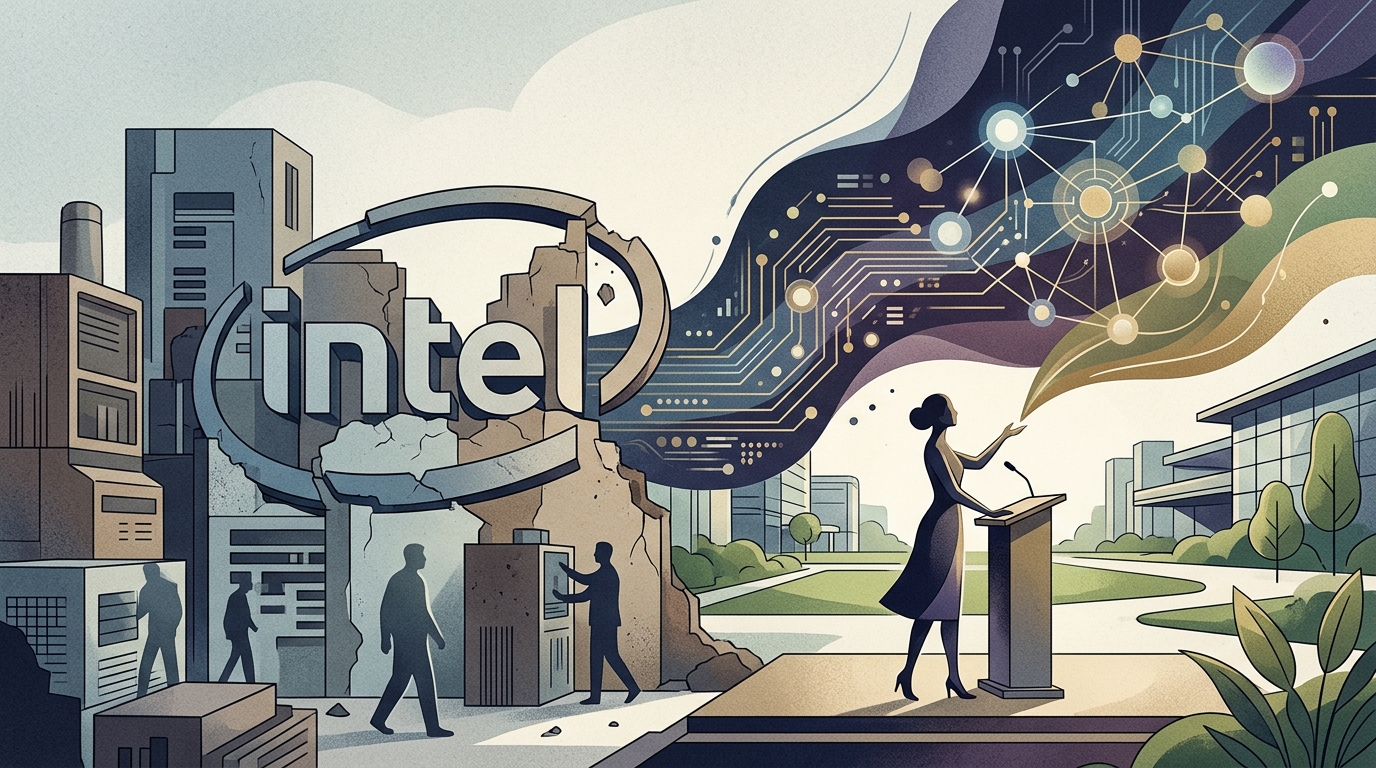
For years, Intel was perceived as the "sleeping giant" of Silicon Valley. While Nvidia and AMD surged ahead in the Artificial Intelligence era, Intel seemed mired in internal restructuring and manufacturing delays. However, the recent announcement of its Q1 2026 financial results has abruptly shifted the narrative. With revenues significantly exceeding analyst estimates and an impressive expansion in profit margins, the company's stock soared, prompting a critical question: Has Intel just become Wall Street's newest AI darling?
The IDM 2.0 Strategy Bears Fruit
Since taking the helm, CEO Pat Gelsinger has championed a vision known as IDM 2.0. This strategy involves not only designing chips but also transforming Intel into a major foundry service provider for third parties, directly rivaling TSMC. Recent data suggests that the transition to the 18A (1.8nm) process node is progressing faster than anticipated. This is pivotal, as AI demands the highest possible transistor density and energy efficiency.
The market responded positively primarily due to the demand for "Gaudi 3" AI accelerators. While Nvidia dominates with its H100 and B200 units, Intel is positioning itself as the more cost-effective and efficient alternative for enterprises that don't require the absolute raw power of Nvidia's GPUs but demand reliability and scalability. Intel has successfully secured deals with major cloud providers, proving there is room for a formidable second player in the data center.
The "AI PC" as a Growth Catalyst
Beyond data centers, Intel is betting heavily on the revival of the personal computer market through the "AI PC." By integrating Neural Processing Units (NPUs) into its new Core Ultra processors, the company promises that AI will not only run in the cloud but locally on every laptop. This paradigm shift is expected to trigger a massive global hardware upgrade cycle, with Intel holding the lion's share of the x86 architecture market.
Analysts note that Intel is also benefiting from geopolitical instability. As the U.S. seeks to repatriate semiconductor manufacturing through the CHIPS Act, Intel stands as the only player with the infrastructure and expertise to execute this plan. This government backing, combined with technological recovery, creates a "moat" that Wall Street is beginning to value significantly.
Challenges and the Road Ahead
Despite the euphoria, the path forward is not without hurdles. Intel must prove it can maintain manufacturing consistency and avoid the pitfalls of its past. Competition from Apple (with its M-series silicon) and Qualcomm (making aggressive moves into Windows laptops) remains fierce. Furthermore, the cost of constructing new fabrication plants (fabs) is astronomical, weighing on the company's short-term cash flows.
Nevertheless, the sentiment has shifted. Intel is no longer viewed as a company in decline, but as a tech titan that has found its stride. If it can solidify the 18A node as the global manufacturing standard by 2027, today's stock surge may just be the beginning of a new golden era.
- IDM 2.0 strategy is successfully pivoting Intel toward a foundry model.
- Gaudi 3 accelerators are gaining traction as a viable alternative to Nvidia.
- The AI PC category is driving a new revenue stream in the consumer sector.
- Geopolitical alignment with U.S. interests bolsters investor confidence.