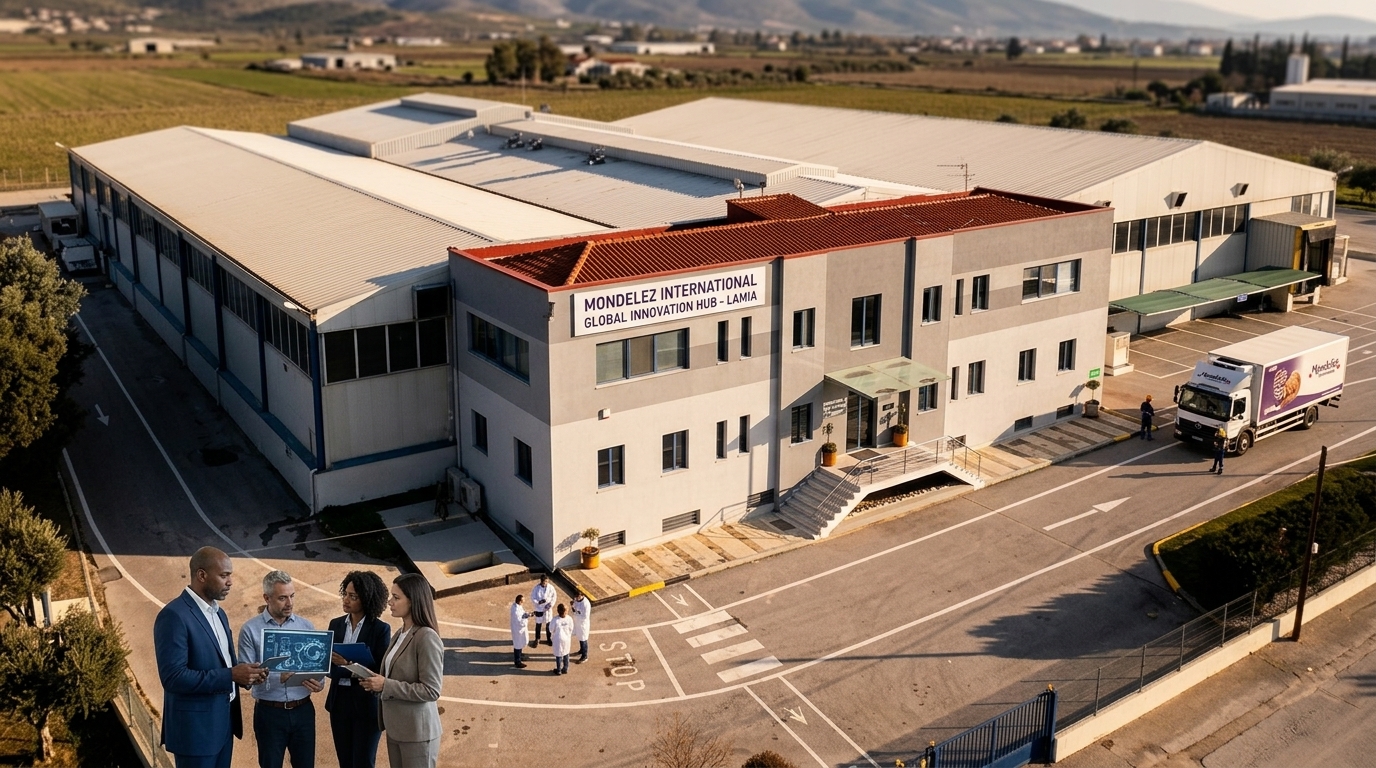
The image of Greece as a country relying solely on tourism and shipping is beginning to give way to a new, more complex narrative: that of an exporter of innovation and high technology. The case of Mondelez International, one of the world's largest food groups, is the most characteristic example of this transformation. Centered in Lamia and Athens, Greece is no longer just a consumption market, but a hub for generating ideas and digital solutions implemented across five continents.
The Chipita Legacy and the Center of Excellence in Lamia
The story begins with the acquisition of Chipita in 2022, a move that cost approximately $2 billion and redefined the snacks industry. Mondelez didn't just buy a distribution network or a famous brand; it acquired unique expertise in the baked snacks category. The Lamia plant was upgraded to a Global Center of Excellence, taking on the weight of Research and Development (R&D) for products consumed from Chicago to Sydney.
In Lamia, food science meets industrial scale. Greek food scientists and technologists work on challenges regarding product shelf life, flavor preservation without excessive preservatives, and the creation of new dough textures. This "Greek recipe" is now the standard for Mondelez production lines worldwide. This success debunks the myth that the Greek provinces cannot support knowledge-intensive investments.
Athens: A Digital Sentinel for the Global Giant
While Lamia focuses on production, Athens has taken on an equally critical role in digital transformation. The Greek capital hosts one of Mondelez's three Global Cyber Security Hubs worldwide. In an era where cyberattacks pose the greatest threat to supply chains, choosing Greece to shield the systems of a multi-billion dollar giant is a vote of confidence in local talent.
The Athens center does not only serve the Greek market. It monitors, analyzes, and prevents threats in real-time for all the company's international activities. Staffed by Greek IT engineers and cybersecurity experts, it proves that "Brain Regain" is possible when the right infrastructure and growth prospects exist. Mondelez recognized that the quality of Greek STEM (Science, Technology, Engineering, Mathematics) graduates is globally competitive, while offering operational costs that remain attractive compared to Silicon Valley or London.
The Strategic Importance of Foreign Direct Investment
The case of Mondelez in Greece is not isolated; it is part of a broader context of increasing Foreign Direct Investment (FDI) aimed at value-added sectors. Transitioning from a "cheap labor" model to a "specialized innovation" model is the only path for the sustainable growth of the Greek economy. The presence of such hubs creates an ecosystem around them, attracting suppliers, startups, and university research programs.
Furthermore, Greece's geopolitical position acts as a catalyst. As an entry point to the European Union and a connection point with the Middle East and Africa, the country offers Mondelez a strategic advantage in the supply chain. The ability to produce innovation locally and export it globally reduces risk and increases the speed of response to market needs.
Conclusions and Outlook
The challenge for Greece in the coming years is to multiply such examples. Mondelez's success shows that the country possesses the necessary ingredients: talent, strategic location, and industrial tradition. However, continuous investment in education and further reduction of bureaucracy is required to maintain this momentum. Lamia is no longer just a stop on the highway but a reference point on the global food industry map, proving that Greek innovation can travel anywhere, provided it has the right foundations.