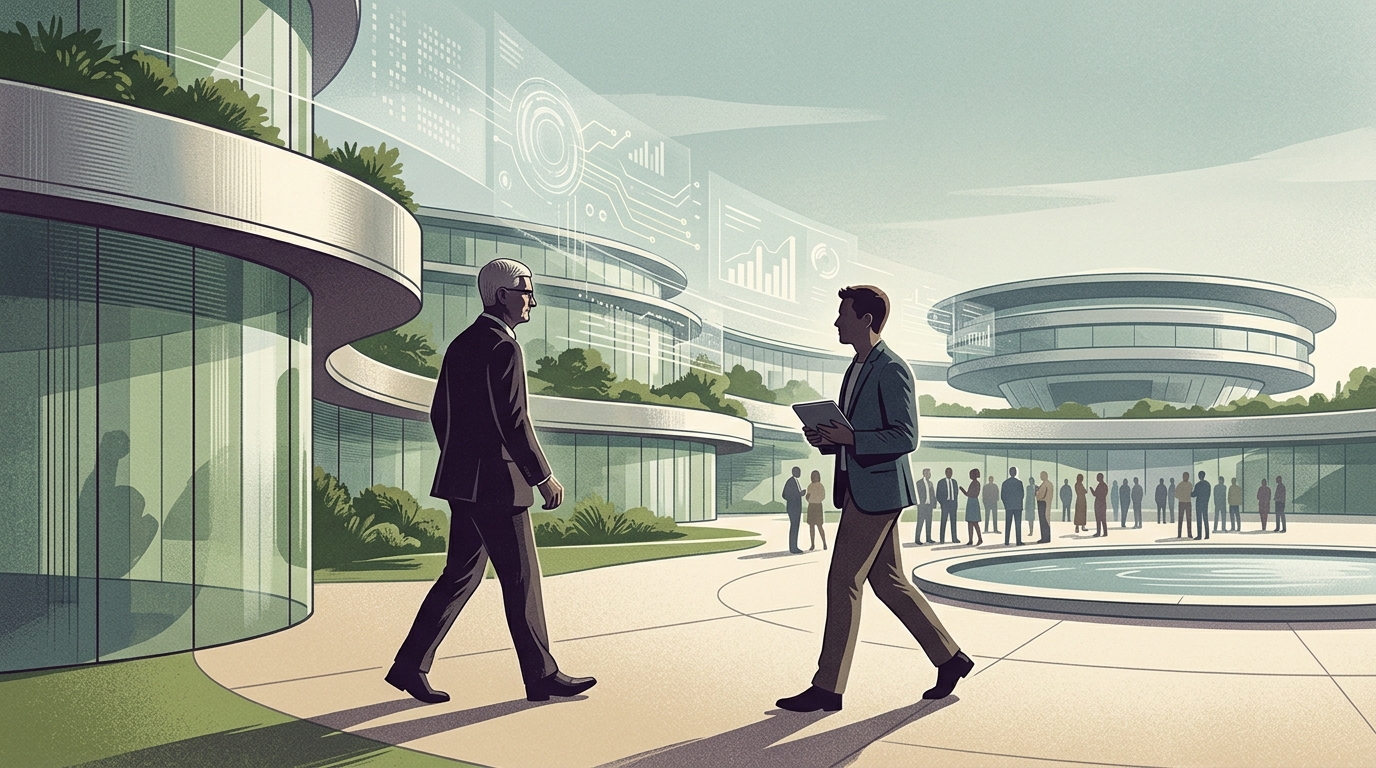
Monday's announcement was more than just corporate news; it was the epilogue to one of the most successful chapters in the history of global capitalism. Tim Cook, the man who shouldered the burden of succeeding Steve Jobs in 2011 and transformed Apple from a tech company into a multi-trillion-dollar economic and cultural behemoth, has announced his departure. Starting September 2026, the company’s reins will pass to John Ternus, the former head of Hardware Engineering, confirming years of internal succession rumors.
Tim Cook’s Legacy: Beyond the Balance Sheet
When Cook took leadership, the market was skeptical. Could an "operations guy" maintain the creative spark ignited by Jobs? Fifteen years later, the answer has been delivered through a market capitalization that defied all expectations and a strategic pivot toward services (Apple Music, iCloud, Services). Cook didn't try to be the next Jobs; instead, he perfected the supply chain, established Apple as a gold standard for privacy, and led the company into the era of Apple Silicon, breaking its dependence on Intel.
However, his tenure was not without friction. Cook’s Apple frequently found itself in the crosshairs of regulators in Europe and the US over antitrust concerns, while geopolitical tensions with China forced the company into a painful and costly diversification of its manufacturing base to India and Vietnam. His final major move, the Vision Pro, while a technical marvel, remains a bet on the future that his successor will now have to manage.
Who is John Ternus and Why Him?
John Ternus is no stranger to the halls of Apple Park. He joined Apple’s product design team in 2001 and has served as Senior Vice President of Hardware Engineering since 2021. He is the man behind the Mac’s resurgence and the transition to M-series chips—a move considered the company’s most significant technical triumph of the last decade. Ternus’s appointment sends a clear message: Apple is returning to its roots, prioritizing engineering and product excellence.
According to internal sources, Ternus is widely respected for his calm demeanor and his ability to solve complex technical problems without the volatility that characterized previous eras. He is seen as a "safe pair of hands" who understands Apple’s DNA intimately, yet possesses the vision to integrate Artificial Intelligence (Apple Intelligence) more deeply into the company’s ecosystem.
Challenges of the New Era
Ternus takes over at a critical juncture. Apple Intelligence is still in its infancy compared to rivals like Google and OpenAI, and the pressure for the "Next Big Thing" is suffocating. Furthermore, the new CEO will have to navigate escalating pressure from the European Union and the Digital Markets Act (DMA), which threatens to dismantle the "walled garden" of the App Store.
- AI Integration: Transforming Siri into a truly intelligent assistant and implementing generative AI across all devices.
- Geopolitical Balance: Reducing reliance on China without disrupting profitability.
- Hardware Innovation: Establishing spatial computing wearables as a primary revenue stream.
Cook’s departure marks the end of the "operational" management model and the beginning of a period where technical mastery must be paired with political diplomacy. Ternus is not just tasked with keeping Apple profitable; he must keep it relevant in a world changing faster than ever due to AI.
"Apple is not just a company; it is a value system expressed through hardware and software. John understands this system better than anyone," Cook stated in his farewell letter.
As September approaches, Wall Street and millions of Apple users worldwide are watching closely. The transition from Cook to Ternus is the ultimate test of institutional continuity for a company that has learned to define our future.