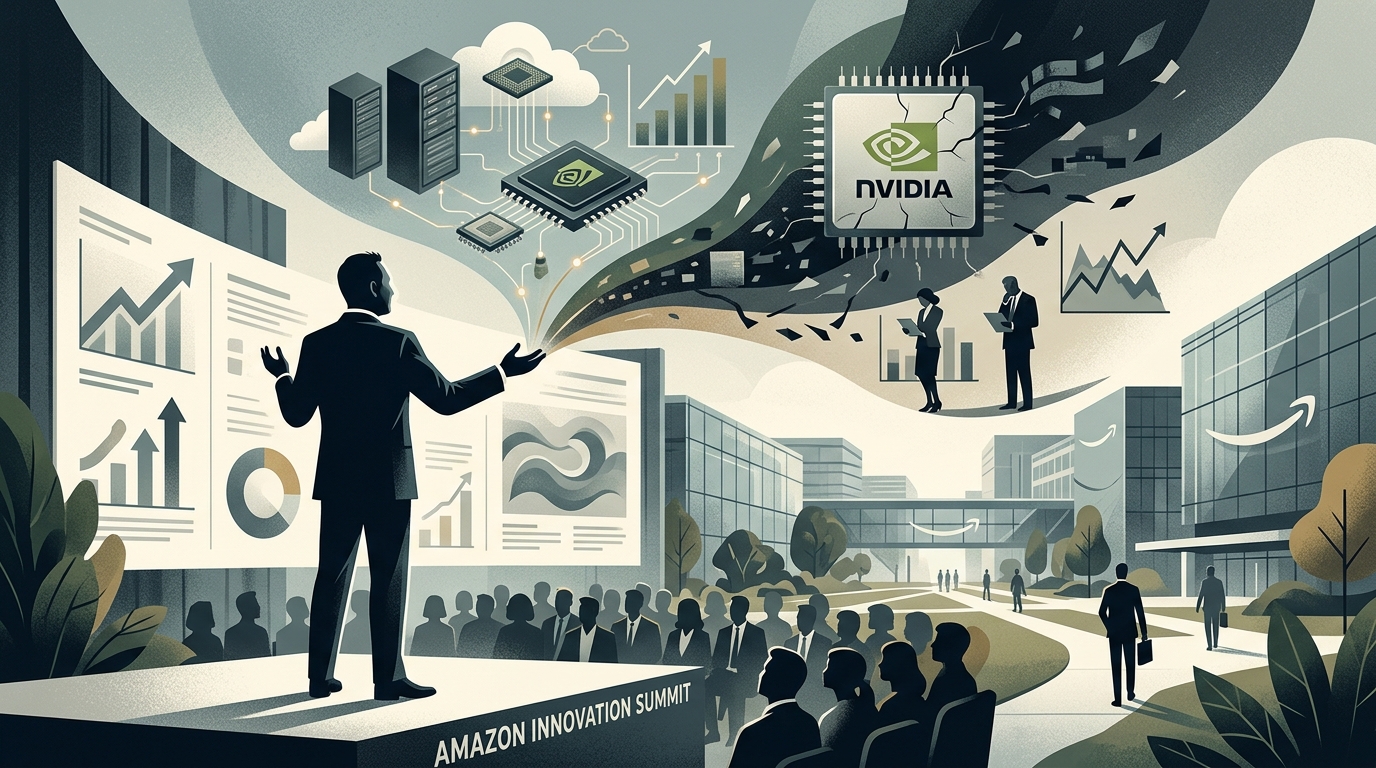
In the high-stakes theater of artificial intelligence, the relationship between tech titans is increasingly resembling a complex game of chess. Recent commentary from Amazon CEO Andy Jassy regarding the company’s future AI infrastructure investments has provided Nvidia investors with a polarizing mix of optimism and caution. As we move through 2026, the dynamic between cloud hyperscalers and semiconductor manufacturers is entering a new, more sophisticated era.
The Good News: An Insatiable Appetite for Compute
For Nvidia shareholders, the "good news" from Amazon is both simple and loud: the demand for Generative AI shows no signs of slowing down. Jassy confirmed that Amazon Web Services (AWS) continues to channel tens of billions of dollars into capital expenditures (CapEx) to bolster its data centers. A massive portion of this spending is flowing directly into Nvidia’s coffers.
Despite the emergence of new players, Nvidia’s H100, H200, and the newer Blackwell architecture remain the "gold standard" for training large language models (LLMs). To maintain its leadership in the cloud sector, Amazon has little choice but to offer its customers the most powerful hardware available on the market. As Jassy noted, the demand for GPUs still outstrips supply, guaranteeing Nvidia steady revenue and premium margins for the foreseeable future.
The Bad News: The Threat of Vertical Integration
However, the shadow in Jassy’s report concerns Amazon’s long-term strategic pivot. The CEO was unequivocal: Amazon does not wish to be solely dependent on a single supplier—especially one that maintains profit margins nearing 75%. This is where the "bad news" for Nvidia lies. Amazon is aggressively accelerating the development and deployment of its proprietary AI silicon: Trainium and Inferentia.
According to Jassy, AWS customers are desperately seeking better price-performance ratios. The Trainium2 chips, for instance, offer significantly lower costs for model training compared to equivalent Nvidia solutions. As the market matures and companies shift from "training" models to "inference"—the day-to-day operation of AI applications—the need for Nvidia’s expensive, general-purpose hardware may diminish in favor of Amazon’s specialized, cost-effective chips.
The Strategic Pivot of AWS
Amazon is following the blueprint laid out by Apple, seeking total control over both hardware and software. By designing its own chips, AWS can optimize performance for specific workloads, offering customers discounts that Nvidia cannot (or will not) match. Jassy emphasized that the adoption of Trainium and Inferentia by major market players like Anthropic serves as proof that the alternative path is now viable.
"Our goal is to provide the broadest range of choices. But when it comes to cost at scale, our own silicon offers advantages that are hard to ignore," Jassy stated.
Implications for the Semiconductor Landscape
This situation creates a paradox: Amazon is simultaneously Nvidia's largest customer and one of its most dangerous competitors. For investors, the challenge is estimating when the "tipping point" will occur—the moment when the sales of custom chips from hyperscalers begin to significantly erode Nvidia's market share.
For now, Nvidia maintains the advantage of its ecosystem (CUDA), which makes it difficult for developers to migrate to other platforms. However, the pressure from Amazon, Google, and Microsoft for independence is now structural rather than transient. Andy Jassy sent a clear message: the era of Nvidia’s absolute monarchy may have an expiration date, as its biggest customers transform into its rivals.
- Amazon remains committed to massive GPU purchases through 2026.
- The rise of Trainium and Inferentia threatens Nvidia’s margins in the inference segment.
- Moving toward custom silicon is an economic necessity for AWS's scale.
- Nvidia must innovate faster than its customers can replicate its capabilities.