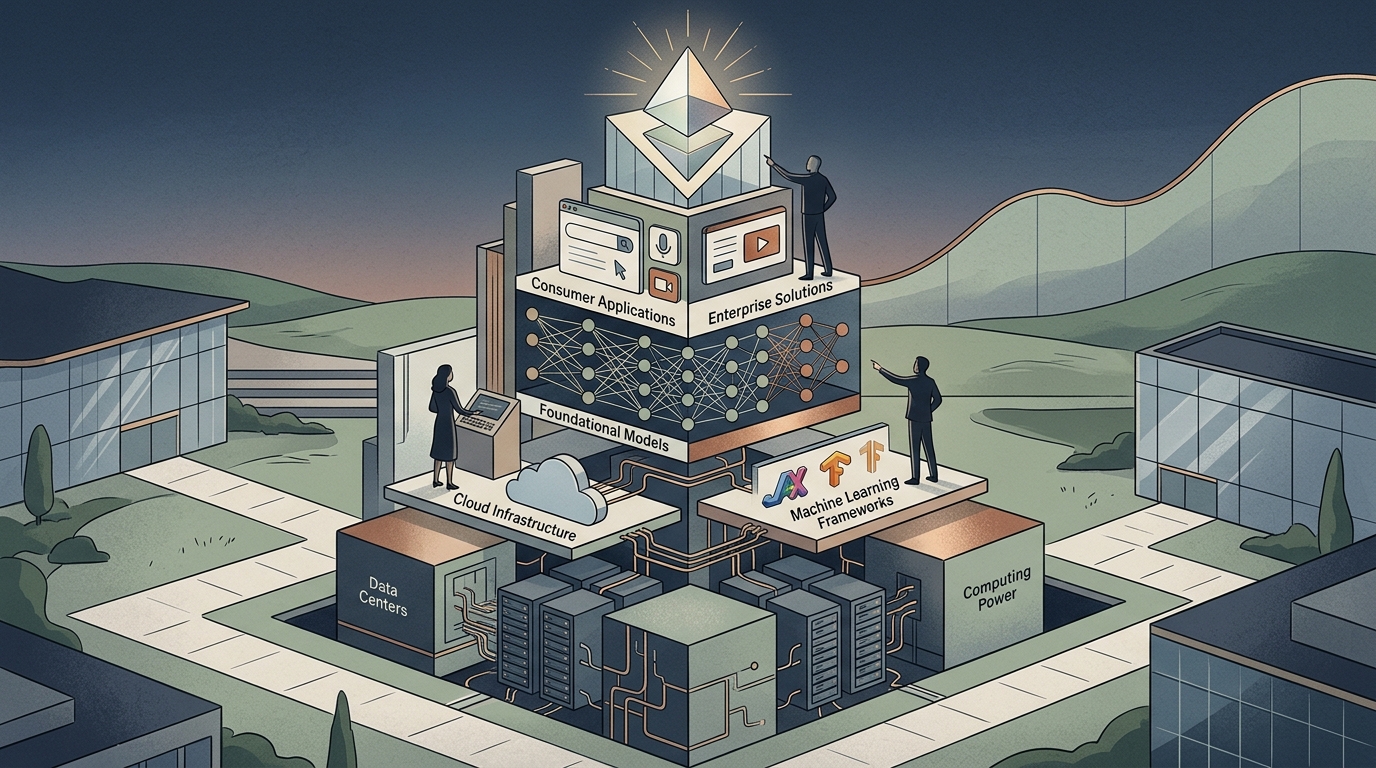
Alphabet's staggering 160% stock rally over the past year is more than just a financial milestone; it is a profound validation of the company's strategy to own the 'full stack' of artificial intelligence. In an era where the race for AI supremacy has taken on the dimensions of a geopolitical struggle, Google's parent company has demonstrated that vertical integration is the ultimate key to sustainability and profitability in the digital age.
Vertical Integration as a Competitive Moat
When we discuss the AI 'stack,' we refer to three fundamental layers: hardware (silicon), cloud infrastructure, and software/models. Alphabet is among a handful of global entities that command a leading presence in all three. By leveraging its proprietary Tensor Processing Units (TPUs), Google has significantly reduced its reliance on third-party vendors like Nvidia. This internal hardware capability allows for massive cost savings and model training speeds that many competitors struggle to match.
This strategy enables Alphabet to manage costs at a time when computational power is becoming increasingly scarce and expensive. Wall Street analysts point out that the company's ability to optimize its flagship Gemini models directly onto its custom silicon creates a 'virtuous cycle' of efficiency, which translates directly into superior operating margins compared to those who must pay the 'Nvidia tax.'
From Gemini to Search: Deep Integration
Despite initial market skepticism and early PR stumbles during the first generative AI launches, Alphabet has successfully pivoted. The integration of Gemini into the core of its product suite has been swift. The Search Generative Experience (SGE) has fundamentally altered how billions of users interact with the web. Rather than a simple list of blue links, Google now provides synthesized, AI-driven answers while simultaneously evolving its multi-billion dollar advertising machine.
- TPU v5p: Google's latest custom chips offer twice the performance-per-dollar compared to the previous generation, securing a hardware edge.
- Google Cloud Growth: The cloud division has seen accelerated growth as enterprises flock to Google’s infrastructure to build and deploy their own AI applications.
- YouTube AI: New generative tools for creators are driving engagement and maintaining YouTube's position as the world's leading video platform.
Regulatory Hurdles and the Road Ahead
However, owning the entire stack brings intense regulatory scrutiny. The U.S. Department of Justice (DOJ) and the European Commission are closely monitoring Alphabet’s moves, concerned that controlling both the infrastructure and the end-user applications could lead to anti-competitive behavior. The company must navigate a delicate balance between aggressive innovation and compliance with antitrust laws in an environment that is increasingly hostile toward Big Tech consolidation.
"Alphabet isn't just building AI; they are building the factory, the raw materials, and the retail storefront of AI simultaneously," noted a senior technology analyst.
In conclusion, the 160% rally reflects a market consensus that Alphabet is the best-positioned company to capitalize on the AI revolution over the long term. With its own silicon, the massive data moats of YouTube and Search, and a global cloud footprint, Alphabet is not merely participating in the AI era—it is architecting it.