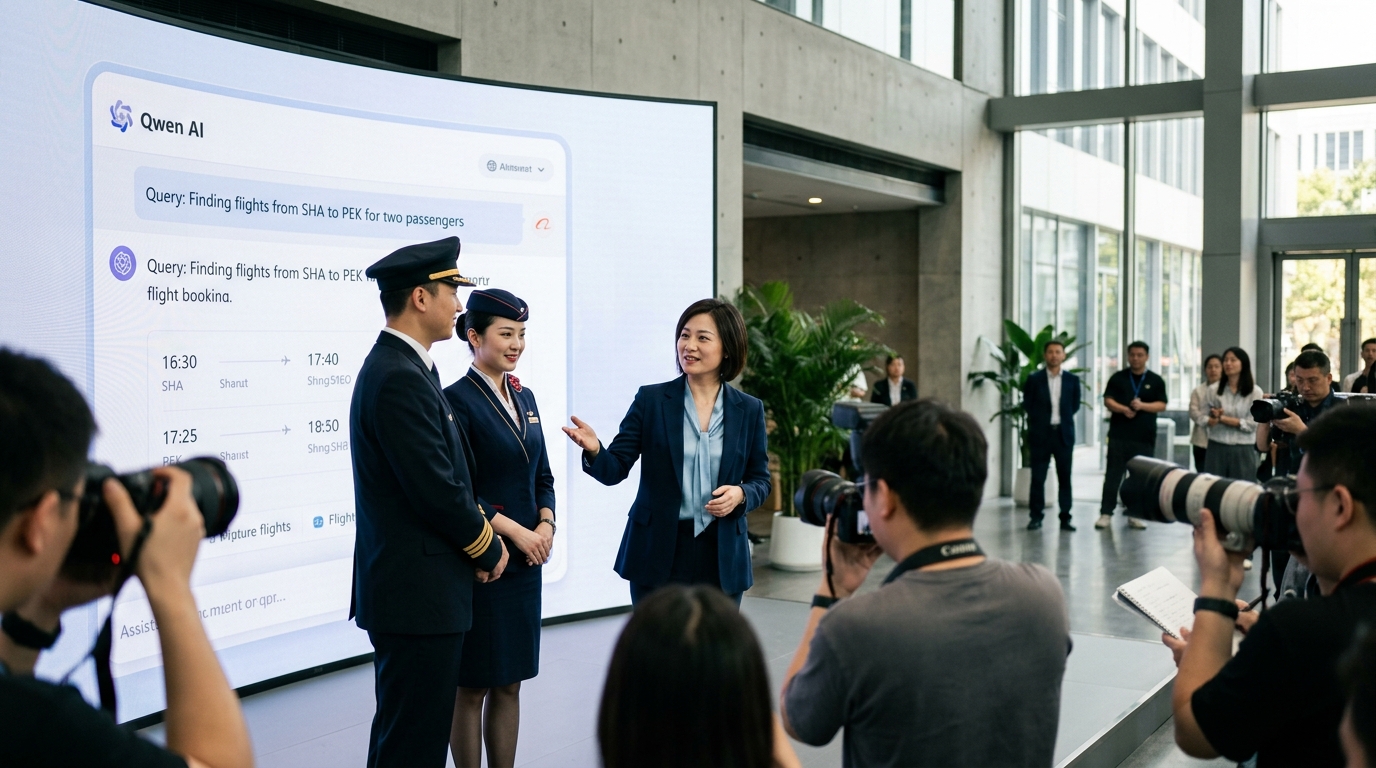
In a move that signals the transition from the era of informational chatbots to the age of 'action agents,' Chinese tech giant Alibaba has announced the full integration of its Qwen AI model into China Eastern Airlines' systems. This development is not merely a technical upgrade but a radical shift in how consumers interact with transportation services, turning a complex process of searching and payment into a simple, natural conversation.
From Theory to Practice: How the System Works
The partnership between Alibaba Cloud and China Eastern Airlines allows the Qwen model (also known as Tongyi Qianwen) to access real-time flight data, seat availability, and pricing systems directly. Users can now type or speak commands such as: 'Find me the cheapest flight to Shanghai next Friday and book a window seat,' and the AI takes over to complete the entire process, including identity verification and payment via the Alipay ecosystem.
The key to this technology lies in Qwen's ability to understand context and manage ambiguities. Unlike traditional booking systems that require users to fill out multiple fields in forms, Alibaba's AI can process complex requests, suggest alternatives in case of delays, and automatically apply loyalty program discounts.
Competition in the Chinese AI Market
This move by Alibaba comes during a period of intense competition within China. With Baidu promoting Ernie Bot and Tencent integrating Hunyuan into WeChat, Alibaba needed to demonstrate the practical value of its own models. Focusing on vertical markets, such as aviation, shows a strategic pivot toward profitability and utility, moving beyond mere displays of technological prowess.
- Alibaba Strategy: Integrating AI into existing infrastructures of large corporations (Enterprise AI).
- Baidu Strategy: Focusing on search and autonomous driving.
- Tencent Strategy: Social networking and payment ecosystems.
China Eastern Airlines, for its part, seeks to reduce the operational costs of its customer service centers. According to market analysts, automating bookings via AI can reduce the cost per transaction by up to 40%, while simultaneously increasing customer satisfaction through speed of response.
Challenges and Ethics
Despite the excitement, integrating AI into critical infrastructure like aviation raises security questions. What happens if the AI suffers from 'hallucinations' and confirms a reservation that doesn't exist? Alibaba claims to have implemented multiple layers of verification and 'human-in-the-loop' protocols to ensure the accuracy of transactions.
"Artificial intelligence is no longer just a tool for writing text, but the driving force of the service economy," stated an Alibaba Cloud executive during the presentation.
Furthermore, the issue of personal data protection remains central. In China, the regulatory framework for AI is stringent, requiring companies to ensure their models align with state guidelines on data security and social stability.
The Future of Travel
This collaboration is just the beginning. It is expected that soon AI will be able to manage an entire travel itinerary—from booking hotels and cars to visa issuance and restaurant recommendations—all within a single chat interface. Alibaba seems to be winning the bet on 'functional AI,' turning Qwen into an indispensable digital assistant for the modern traveler.