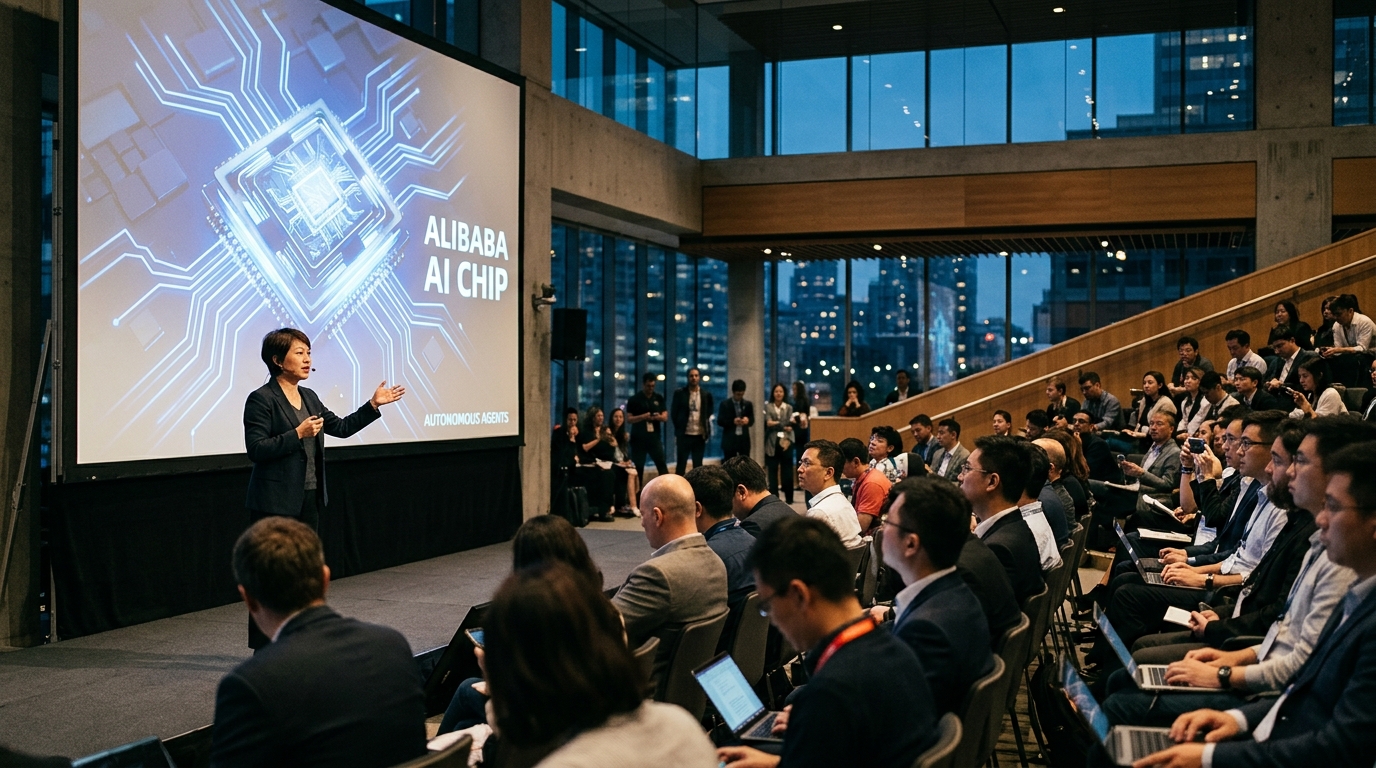
In the heart of a technological cold war reshaping the global economy, Chinese giant Alibaba has made a strategic move. The unveiling of a new, specialized AI chip designed exclusively to power "agent" software is not merely a technical upgrade; it is a declaration of sovereignty in an era where access to Nvidia’s processing power remains restricted by US sanctions.
The Shift from Chatbots to Autonomous Agents
Until recently, the AI conversation centered on Large Language Models (LLMs) that answer questions. However, 2026 marks the rise of AI Agents: systems that go beyond generating text to executing complex tasks autonomously—from supply chain management to software engineering and real-time business decision-making.
These agents require a different computational architecture. Unlike traditional model training, agentic workflows rely on continuous feedback loops and heavy inference workloads. Alibaba’s new chip, part of the Hanguang family, is optimized for low latency and high performance-per-watt, allowing agents to "think" and act faster than ever while significantly reducing operational costs for enterprises.
Geopolitical Self-Sufficiency and the Nvidia Shadow
Alibaba’s move comes at a critical juncture. With the US continuously tightening export controls on advanced semiconductors to China, the need for domestic solutions has become a matter of national survival. Alibaba Cloud, the backbone of China’s digital economy, can no longer rely on the hope of securing the latest Blackwell series chips from the West.
"Hardware autonomy is the only path to software hegemony," note industry analysts in Beijing.
The new chip is manufactured using advanced methods that suggest China is finding ways to bypass lithography equipment restrictions, likely through close collaboration with SMIC. This creates a new ecosystem where the AI model (such as Alibaba’s Qwen) and the hardware (the new chip) are perfectly synchronized, offering a vertical integration reminiscent of Apple’s strategy.
Economic Implications and the Cloud Market
For investors, this news has a dual interpretation. On one hand, developing proprietary silicon requires massive capital expenditure (CapEx). On the other, successful integration could skyrocket Alibaba Cloud’s profit margins by eliminating the "Nvidia premium." Furthermore, the ability to offer "Agent-as-a-Service" at lower price points than Western competitors (AWS, Azure) could attract clients from Southeast Asia and the Middle East—regions where China is aggressively expanding its digital footprint.
- Reduction of AI operational costs by up to 40% for large enterprises.
- Strengthening Alibaba’s position in the global Cloud Computing market.
- Creation of a closed ecosystem that increases vendor lock-in through hardware-software optimization.
In conclusion, Alibaba’s new chip is not just a piece of silicon. It is the foundation upon which the next phase of automation will be built. As AI Agents begin to take on roles that previously required human intervention, the company that controls the hardware powering them effectively controls the rules of the game in the global economy.