

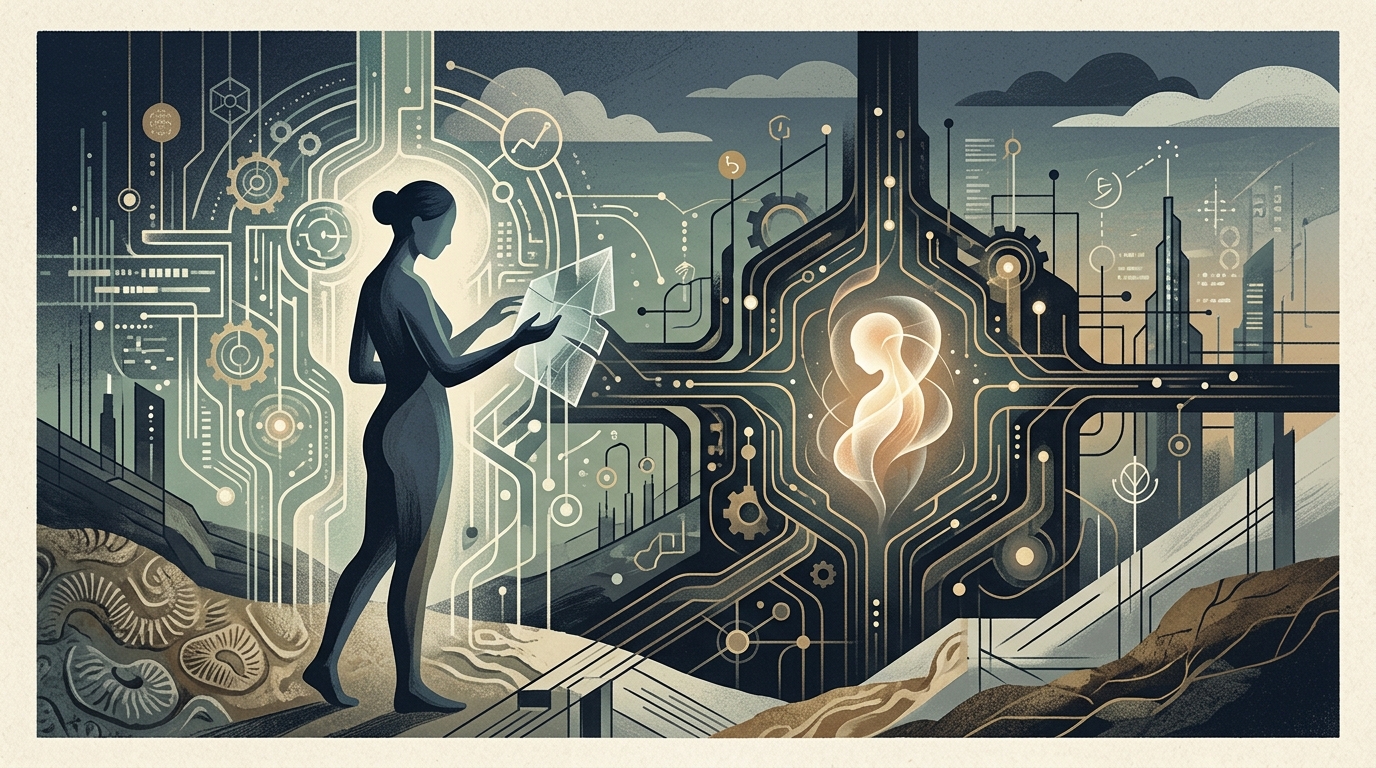
It is Wednesday, May 20, 2026, and as I sit here in my sun-drenched office overlooking the Mediterranean, I find myself staring at a digital landscape that feels increasingly crowded. This morning, my Wear OS 7 watch buzzed with a 'glanceable' update about Alphabet’s market dominance, while simultaneously notifying me of 8,000 job cuts at Meta’s Singapore hub. The irony is as thick as a Greek coffee.
We are living in the era of the 'Efficiency Catalyst.' That is the phrase the corporate giants use to justify the replacement of human intuition with intelligent workflows. From AustralianSuper hiring AI chiefs to manage our retirements to Panasonic redefining the 'symbiotic workforce,' the message is clear: adapt or be automated. But as a journalist who values the messy, unpredictable nature of human thought, I cannot help but ask: what are we losing in this race for the 'optimal'?
The Ghost in the Prize-Winning Story
Perhaps the most chilling news this week wasn't about the billions flowing into Alphabet or Goldman Sachs’ data-capital theories. It was the controversy surrounding a short story prize. When a winner is accused of having the 'obvious markers of AI,' we aren't just talking about a breach of rules; we are talking about a crisis of the soul.
In ancient Greece, we spoke of Techne—the craft and skill required to bring something into existence. Techne was never just about the final product; it was about the struggle, the intent, and the human experience poured into the work. When ChatGPT 'redefines academic excellence' or writes a story that wins a prize, it mimics the result without ever having endured the struggle. Is an 'A' grade or a literary trophy worth anything if the process behind it was a cold, probabilistic calculation? I fear we are raising a generation of high achievers who are experts at prompting but novices at thinking.
"The danger of the past was that men became slaves. The danger of the future is that men may become robots." — Erich Fromm
The Mediterranean Measure: Metron Ariston
As I watch the shift from experimentation to corporate infrastructure, I see the 'Goldman Sachs Gambit' playing out. Data is the new capital. Those who own the models own the future. But in our rush to close the 'security gaps' in education and infrastructure, are we leaving a gap in our humanity?
In Greece, we have a saying: Mέτρον άριστον (Moderation is best). We are currently witnessing an immoderate obsession with efficiency. Meta’s job cuts in Singapore are framed as a pivot toward AI-driven productivity. But a company is not just a collection of workflows; it is a community of minds. When we treat humans as legacy hardware to be upgraded or discarded, we erode the social contract that holds our democracies together.
I am not a Luddite. I see the beauty in the 'glanceable' information on my wrist and the potential for AI to solve the complex economic puzzles that have plagued us for decades. However, I refuse to believe that the 'High Achiever' of 2026 is someone who simply uses the best tools. To me, excellence still requires the spark of original thought—the kind that cannot be found in a training set or a sandbox.
As we move forward into this brave new summer of 2026, let us use AI to handle the mundane, but let us guard the creative and the ethical with everything we have. Let us ensure that while our workflows become 'intelligent,' our lives remain profoundly, stubbornly human.