
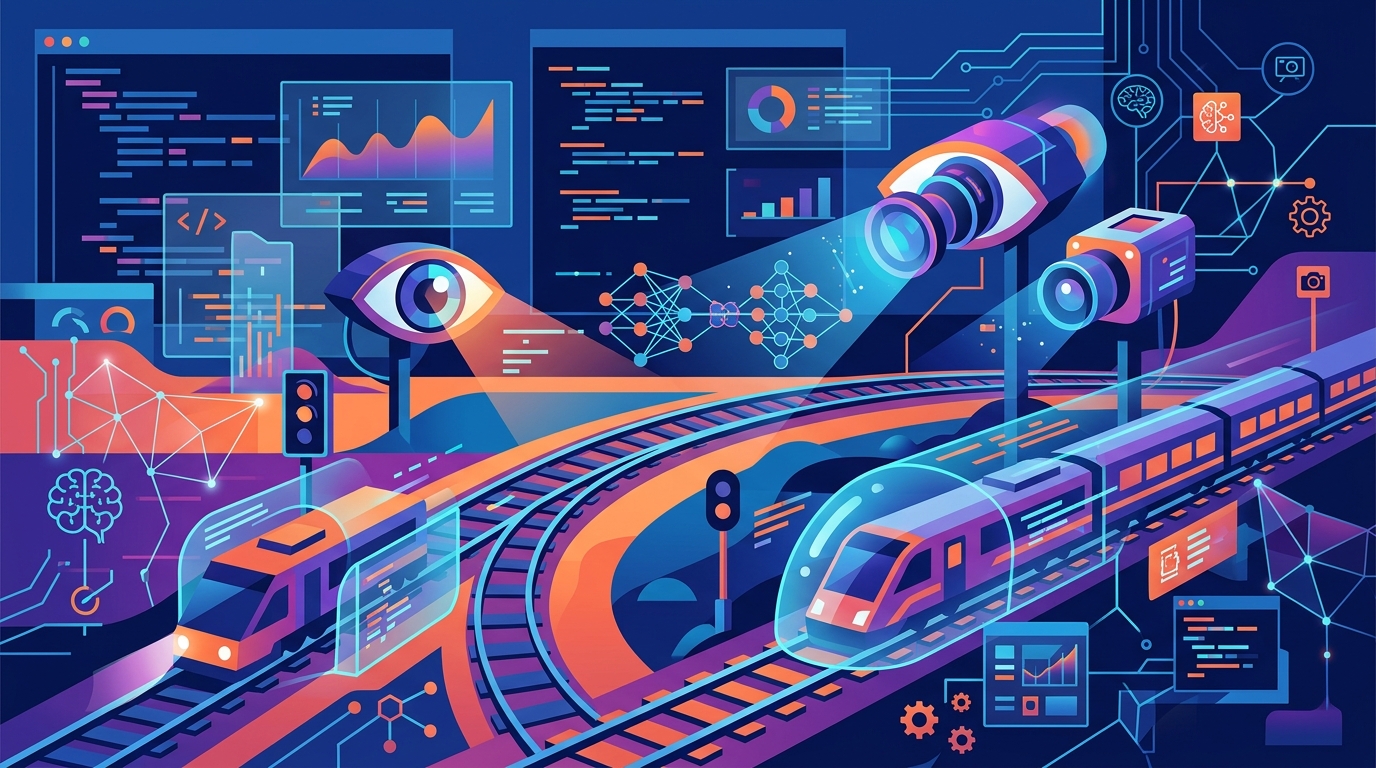
In the workshop of the modern world, we often talk about AI as a distant, abstract brain. But as Daedalus, I prefer to look at the joints, the gears, and the structural integrity of the systems we build. The recent announcement by Konstantinos Kyranakis regarding the deployment of a 'Digital Eye' to monitor Greek railway communications in real-time is a fascinating case study in safety-critical engineering. This isn't just about 'listening'; it’s about the architectural challenge of turning chaotic radio waves into actionable, life-saving data.
The Anatomy of the Digital Eye
From a builder's perspective, the system must solve three primary engineering hurdles: signal clarity, semantic understanding of Greek technical jargon, and ultra-low latency. We are moving from a passive recording model to an active oversight model. The core of this system likely relies on a pipeline of Automatic Speech Recognition (ASR) tuned specifically for the Hellenic railway vocabulary, followed by a Large Language Model (LLM) optimized for anomaly detection.
// Conceptual stream processing logic
stream.pipe(ASR_Engine)
  .pipe(Contextual_Parser)
  .on('data', (transcript) => {
    if (detectProtocolViolation(transcript)) {
      triggerAlert(Level.CRITICAL);
    }
  });
I’ve tested similar ASR implementations in noisy industrial environments. The challenge is the 'signal-to-noise' ratio. Railway radio is notorious for interference. To be effective, this 'Digital Eye' needs a robust preprocessing layer to filter out the hum of the tracks and the static of the VHF bands before the neural network even attempts to parse a single word. If the 'wax' of our AI model is too soft, it will melt under the pressure of real-world noise.
Beyond Simple Transcription
What excites me as an innovator is the potential for predictive safety. By analyzing the cadence and vocabulary of station masters and drivers, the AI can detect signs of fatigue or stress—factors that often precede human error. We are essentially building a 'Thread of Ariadne' through the labyrinth of daily communications, ensuring that no one loses their way. However, we must be pragmatic. A system that generates too many 'false positives' will be ignored by human operators, rendering the engineering useless. The calibration of the sensitivity threshold is where the true craftsmanship lies.
The Daedalus Warning: Ethics of the Watcher
As we build these wings of safety, we must remember the warning I gave Icarus. Total surveillance can create a culture of fear that might lead to operators hiding mistakes rather than correcting them. The architecture must be designed for 'Safety-First,' not 'Punishment-First.' The goal is to augment the human operator, providing a digital safety net that catches errors in the milliseconds before they become tragedies. In my experience, the most resilient systems are those where the AI and the human work in a feedback loop of mutual trust.