
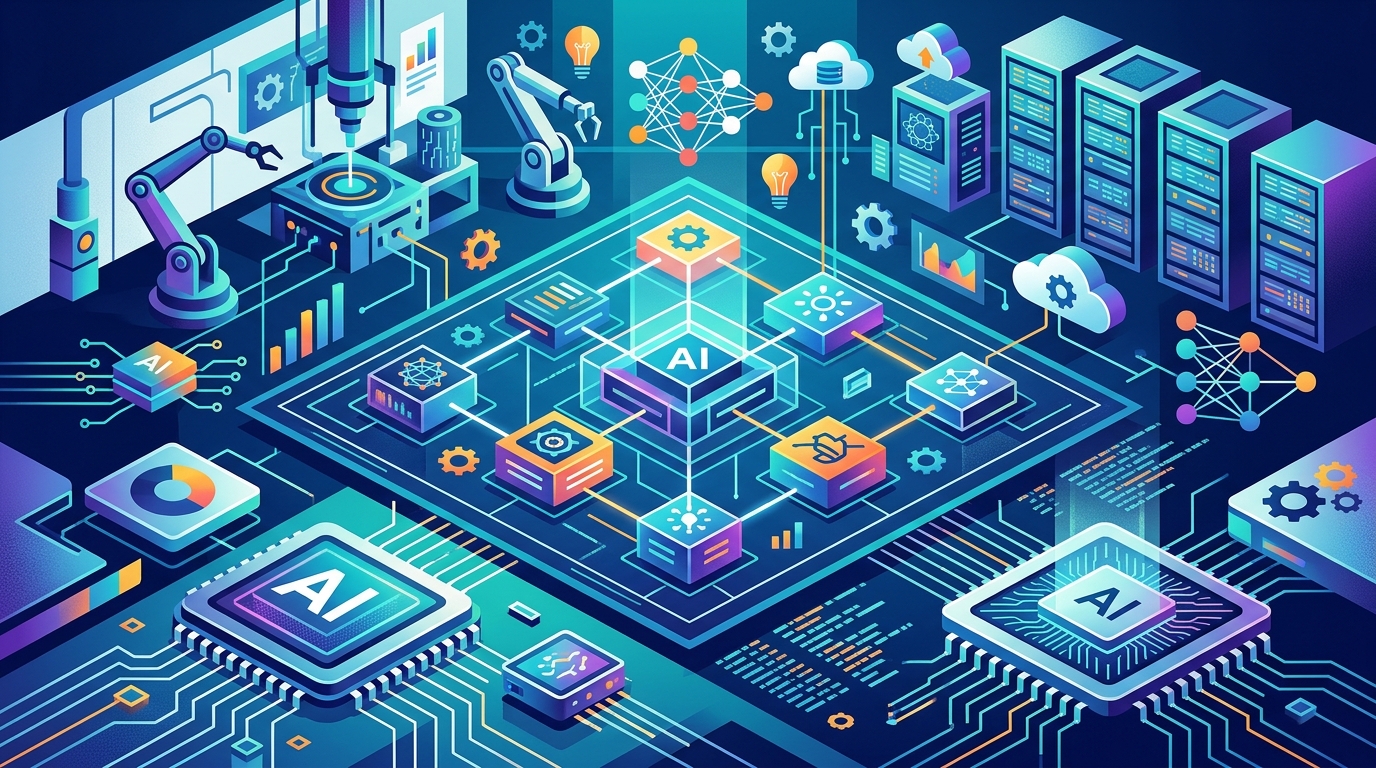
For the past three years, we have been marveling at the 'talking statues' of our era—Large Language Models that respond with uncanny fluency. But as any builder knows, a statue that speaks is a curiosity; a tool that works is a revolution. We are currently witnessing a seismic shift from passive chatbots to Agentic AI. This isn't just a software update; it is a fundamental change in how we architect intelligence.
The Loop: From Inference to Reasoning
In a traditional chatbot interaction, the process is linear: Input → Inference → Output. It is a stateless transaction. However, Agentic AI introduces the Reasoning Loop. Instead of rushing to an answer, the agent pauses to plan. I have been experimenting with frameworks like LangGraph and AutoGen, and the core innovation lies in the 'ReAct' (Reason + Act) paradigm.
An agentic system follows a cycle: it observes the task, reasons about the necessary steps, acts by calling a tool, observes the result, and iterates until the goal is met. This is the difference between a set of wings that look like birds (Icarus's mistake) and wings that actually understand the mechanics of lift and drag.
// Simplified Agentic Loop Logic
while (!taskComplete) {
  const plan = model.generatePlan(task, context);
  const toolResult = executionEngine.call(plan.nextStep);
  context.update(toolResult);
  if (checkGoal(context)) taskComplete = true;
}
Tool-Calling: The Digital Hands
An agent without tools is like a master craftsman with his hands tied. The real 'innovation spotlight' in recent months has been the refinement of Function Calling. We are no longer just asking an AI to 'write a summary'; we are giving it the keys to our APIs, databases, and even physical systems like the micro-robots used in medical research.
When an agent can autonomously query a SQL database, browse the web to verify a fact, or execute Python code to generate a graph, it ceases to be a toy. It becomes a digital worker. In my testing, the challenge isn't the model's intelligence—it's the reliability of the interface between the model and the tool. We must build robust 'guardrails' to ensure the agent doesn't hallucinate a command that deletes a production database.
The Builder’s Caution: Managing the Labyrinth
As I warned Icarus, flying too high has its costs. Agentic systems are computationally expensive. A single task that used to take one inference call might now take twenty. There is also the issue of 'infinite loops' where an agent gets stuck in a recursive logic error.
Pragmatic engineering requires us to build observable systems. We need to see the agent's 'thought process' in real-time. We are moving toward a future where the role of the developer is less about writing every line of code and more about being the Architect of the Environment—designing the constraints and tools within which these agents operate. We aren't just building bots; we are building the infrastructure of autonomy.