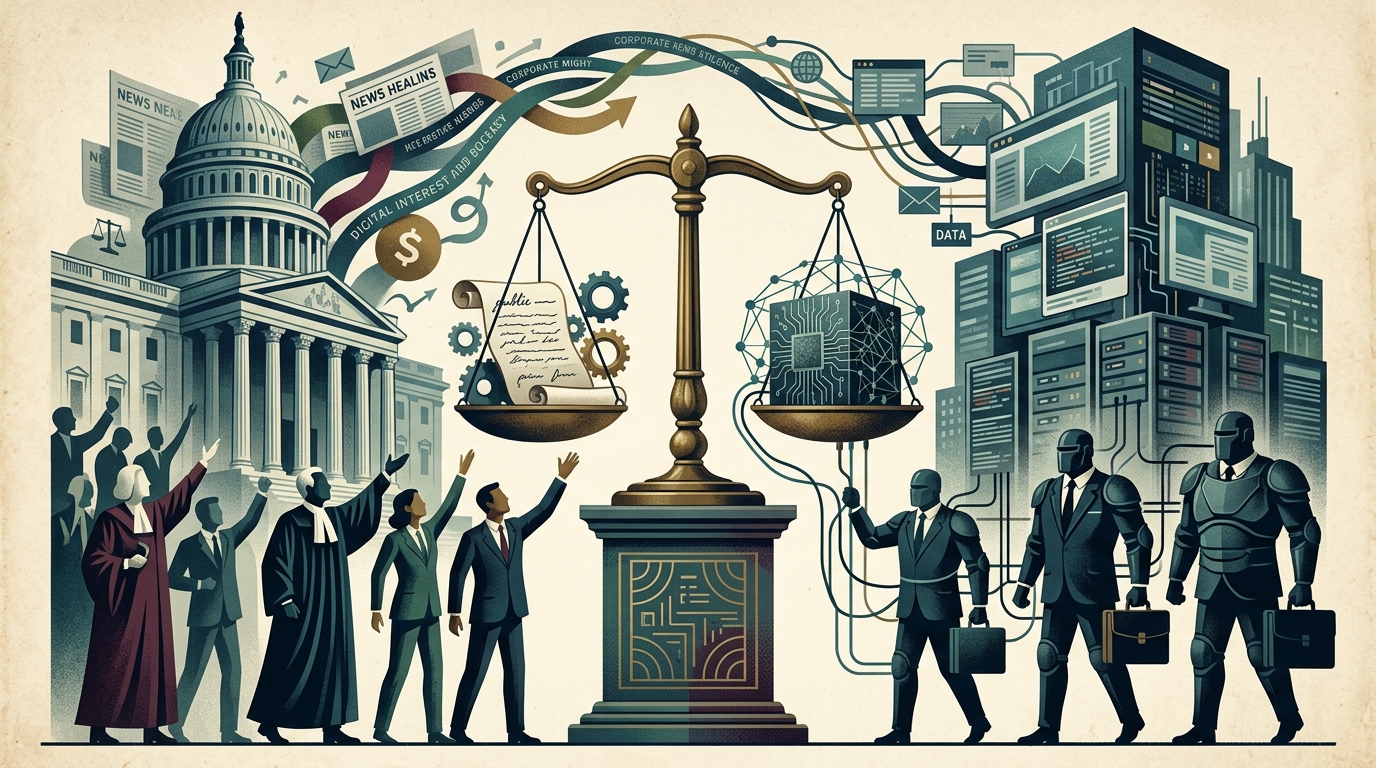
In the ancient Athenian tradition, the stability of the state depended upon the 'Seisachtheia'—the shaking off of burdens that threatened to destabilize the social order. Today, as we witness the news of Silicon Valley’s successful lobbying to block a major Executive Order on AI, we are faced with a modern imbalance. The scales of governance are tilting dangerously toward private interests, raising fundamental questions about the sovereignty of the democratic state in the age of artificial intelligence.
The Erosion of Executive Oversight
The recent victory of 'Tech Titans' in Washington is not merely a win for corporate autonomy; it is a signal of the weakening of traditional executive oversight. When the state attempts to establish safety frameworks and ethical guardrails, only to be rebuffed by the very entities it seeks to regulate, we enter a state of 'regulatory capture.' In my analysis, this reflects a broader trend where the speed of technological innovation outpaces the legislative process, allowing private capital to dictate the terms of its own supervision.
"True governance is not the absence of power, but the equitable distribution of it for the common good."
This development stands in stark contrast to the European experience. While the United States struggles with the influence of concentrated wealth on policy, the European Union continues to refine the AI Act, prioritizing the rights of the citizen over the profit margins of the developer. The 'European AI Surge' we are seeing in the markets suggests that regulation does not necessarily stifle growth; rather, it can provide a stable, predictable environment for sustainable innovation.
Toward a New Digital Social Contract
To restore balance, we must propose a governance framework that treats AI not as a mere commodity, but as a public utility of the digital age. This requires three pillars of institutional reform. First, we need absolute transparency in the lobbying process, ensuring that the 'Digital Agora' is open to civil society, not just those with the deepest pockets. Second, we must establish independent regulatory bodies that possess the technical expertise to challenge corporate narratives. Finally, we must ensure that the benefits of AI-driven productivity are shared equitably, preventing the 'Productivity Trap' from becoming a tool for further wealth concentration.
As we look toward the remainder of 2026, the challenge for policymakers is clear: will they be the architects of a new democratic framework, or will they remain spectators to the rise of a corporate technocracy? The spirit of Solon reminds us that laws must be written to protect the weak from the excesses of the strong. In the realm of AI, that protection begins with the firm reassertion of public authority over private algorithms.