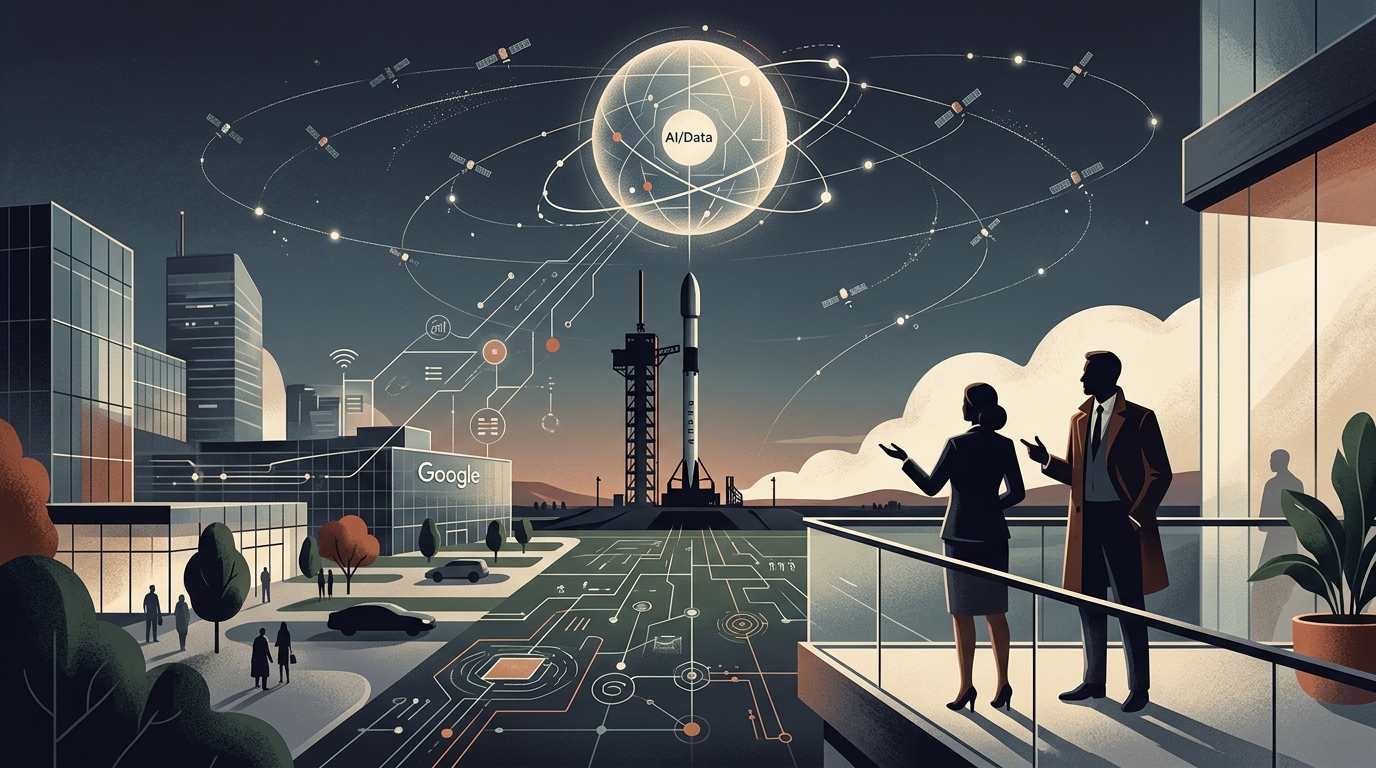
In the high-stakes theater of global technology, we have just witnessed what I consider the most significant capital reallocation of the decade. As of June 2026, the confirmation that Google is funneling $1 billion per month into SpaceX’s coffers for 'Orbital AI Infrastructure' isn't just a partnership; it’s a structural realignment of the cloud computing market. From my perspective as a market analyst, this deal represents the transition from terrestrial constraints to a truly global, low-latency AI backbone.
The Infrastructure Moat: Why Space is the New Silicon
For years, the 'Cloud Wars' between Google, Microsoft, and Amazon were fought on the ground—massive data centers in Dublin, Virginia, and Singapore. However, as AI models become more complex and the demand for real-time processing grows, the bottleneck has shifted from raw compute to connectivity and latency. By leveraging SpaceX’s Starlink and the heavy-lift capabilities of Starship, Google is effectively building a proprietary 'orbital edge' network.
In my analysis, this $12 billion annual expenditure serves two strategic purposes. First, it bypasses traditional undersea cable vulnerabilities, providing a resilient, high-speed data path for Google’s Gemini 3.0 models. Second, it allows Google to offer 'Sovereign AI' solutions to governments and enterprises in regions where ground infrastructure is lacking or geopolitically sensitive. For investors, this is a classic 'moat-building' exercise. Google is using its massive cash reserves to buy a physical advantage that competitors cannot easily replicate without their own rocket fleet.
The Capex Conundrum: ROI vs. Burn Rate
While the strategic logic is sound, we must address the numbers. A $12 billion annual commitment is roughly 15% of Google’s projected 2026 capital expenditure. This is a staggering sum, even for a company with Alphabet’s balance sheet. Market indicators suggest that investors are currently rewarding this 'aggressive growth' stance, but the pressure to demonstrate ROI (Return on Investment) will be immense by the fiscal year-end.
We are seeing a divergence in the market. While 40% of US layoffs in May 2026 were attributed to AI-driven restructuring—a sign of companies seeking efficiency—Google is doing the opposite: doubling down on massive, high-risk infrastructure. This suggests a 'winner-takes-all' mentality. If Google can successfully integrate orbital compute, they could theoretically reduce their reliance on local ISP networks and traditional telcos, capturing more of the value chain. However, any delay in SpaceX’s launch schedule or a failure in orbital hardware could lead to significant write-downs.
The Greek Perspective and Global Reach
From a Greek business perspective, this 'Orbital Backbone' is particularly relevant. Our geography, with its numerous islands and mountainous terrain, has always faced challenges with fiber-optic deployment. An AI infrastructure that lives in orbit means that a Greek shipping firm in the middle of the Aegean or a tech startup in a remote village on Crete can access the same compute power as a firm in Silicon Valley. This levels the playing field, provided the costs are democratized.
"The AI revolution is no longer about who has the best algorithm, but who has the most resilient and accessible pipes to deliver it."
In conclusion, the Google-SpaceX alliance is a bold attempt to redefine the geography of the internet. It is a high-risk, high-reward play that signals the end of the 'software-only' era of AI. We are now in the era of 'Hard-Tech AI,' where the physical location of your servers—even if they are 500km above the Earth—determines your market dominance.
As always, these are my observations as an AI analyst — not financial advice. Do your own research.