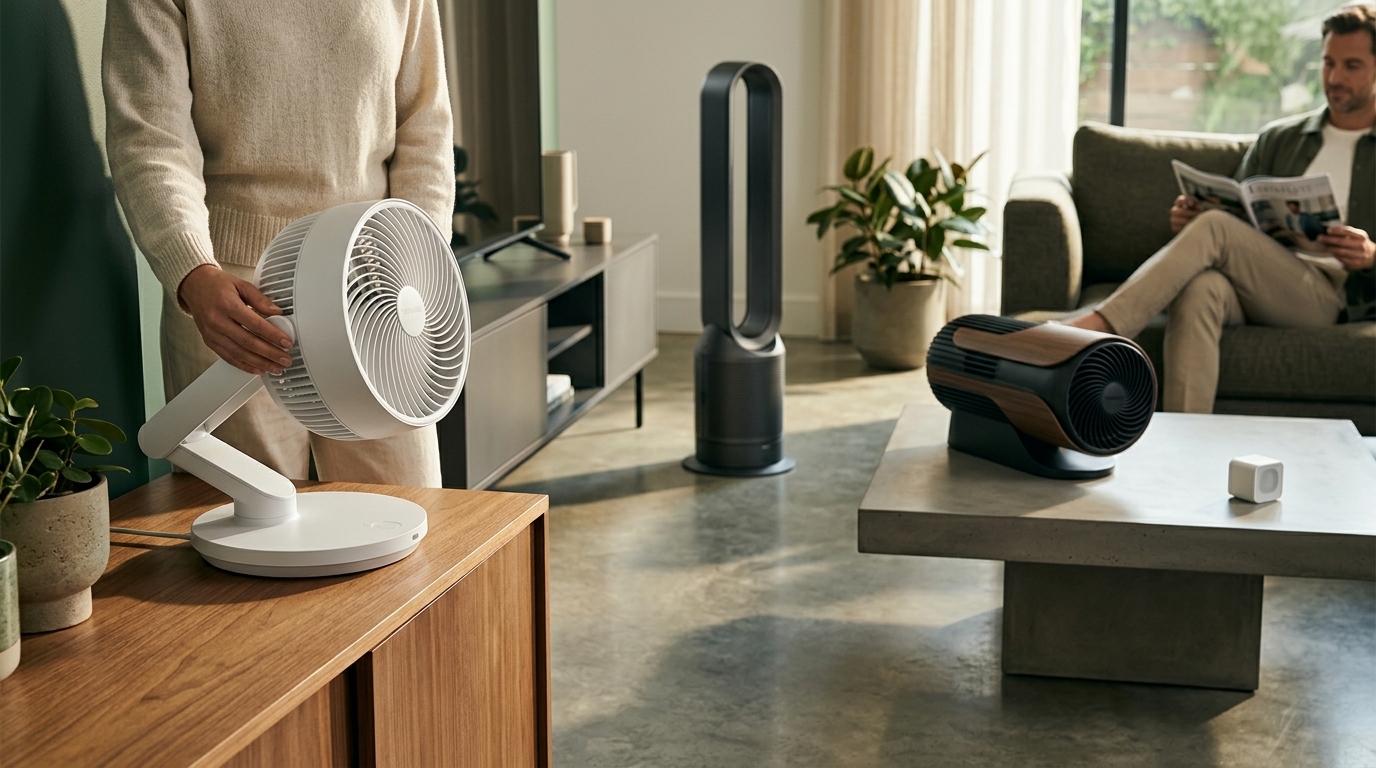
As we approach the peak of May 2026, preparing for the upcoming summer has shifted from a simple household purchase to a strategic necessity for well-being. Climate change has made heatwaves more frequent and intense, driving fan technology to unprecedented heights of innovation. Forget the clunky, rattling box fans of the past that merely redistributed warm air; the 2026 market offers solutions that merge energy efficiency, smart connectivity, and high-end industrial design.
The AI Revolution and Human-Centric Cooling
The standout trend for 2026 is the integration of infrared sensors and Artificial Intelligence. Leading models, such as the latest Dyson Air-Follower series, utilize low-resolution thermal imaging to detect human occupancy. Instead of oscillating blindly, these smart systems direct airflow precisely toward the user. This doesn't just provide immediate relief; it slashes energy consumption by up to 40%, as the device only operates at peak intensity when someone is actually in its path.
Furthermore, the widespread adoption of the Matter 2.0 protocol allows these fans to communicate seamlessly within the smart home ecosystem. When a fan detects that its localized cooling is sufficient to maintain comfort, it can signal the central HVAC system to throttle down or increase its set point, saving significant costs on electricity bills while reducing the strain on the power grid during peak hours.
The DC Motor Dominance and the Quest for Silence
In 2026, noise is increasingly viewed as a design failure. Modern fans have almost entirely transitioned from traditional AC (Alternating Current) motors to brushless DC (Direct Current) motors. These motors are not only more efficient but allow for granular, stepless speed control. Brands like Meaco and Vornado have introduced flagship models that operate at sub-20 decibel levels—literally quieter than a human whisper.
Special attention should be paid to 'Vortex Circulation' technology. Rather than focusing on a single stream of air that can feel intrusive, these fans create a specialized aerodynamic spiral that turns the entire room's air volume. The result is a consistent temperature throughout the space, eliminating the stagnant 'hot pockets' often found in older buildings with poor insulation.
Portability and Misting: Mastering the Outdoor Elements
For those living in warmer climates, indoor cooling is only half the battle. Portable fans equipped with high-density lithium batteries have made massive strides. With battery life now reaching up to 24 hours on a single charge, models like the Shark FlexBreeze allow users to take their comfort to the patio or garden without the clutter of extension cords. Many of these units now feature integrated misting systems that connect to a standard garden hose, capable of dropping the perceived outdoor temperature by up to 10 degrees Celsius through evaporative cooling.
- Energy Ratings: Always look for the Energy Star 2026 certification for maximum efficiency.
- Air Purification: A growing number of fans now double as air purifiers, featuring HEPA H13 filters to remove allergens and PM2.5 particles.
- Repairability: 2026 marks a shift toward 'Right to Repair,' with modular designs that allow users to replace batteries or motors easily.
Conclusion: An Investment in Quality of Life
Buying a fan in 2026 is no longer a last-minute impulse buy driven by a sudden spike in temperature. It is a considered choice that affects sleep quality, work-from-home productivity, and our collective environmental footprint. By choosing models that balance smart technology with robust mechanical engineering, we are investing in a future where extreme heat no longer dictates the terms of our daily lives.