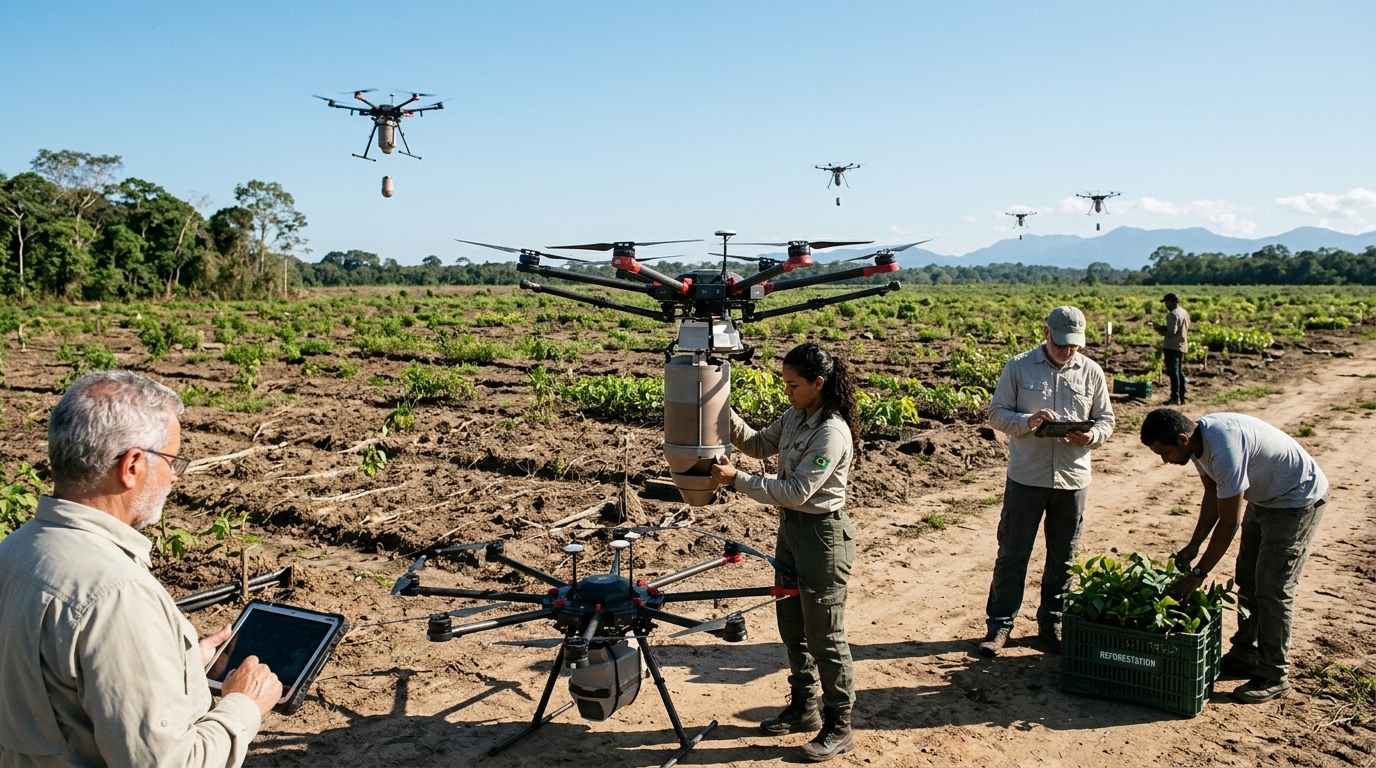
The climate crisis is no longer a distant threat but a pressing reality that demands solutions at a speed and scale that traditional manual labor simply cannot match. Each year, the planet loses approximately 15 billion trees due to deforestation, agricultural expansion, and devastating wildfires. While manual reforestation is invaluable, it is a slow, arduous, and often dangerous process for workers navigating rugged terrain. This is where cutting-edge technology steps in, pivoting NASA’s space-exploration expertise toward the restoration of Earth’s biosphere.
A NASA Legacy at the Service of the Environment
The initiative, spearheaded by former NASA engineers, is built on the premise that reforestation should be approached as a high-precision engineering problem. Utilizing technologies originally developed for planetary mapping, the team has engineered drones equipped with LiDAR sensors and multispectral imaging cameras. These drones don't merely fly over a landscape; they analyze it down to the centimeter, identifying soil quality, moisture levels, and existing vegetation to determine the optimal planting sites.
The process is divided into two distinct phases. In the first phase, a mapping drone scans the area to create a high-resolution 3D terrain model. In the second phase, a swarm of autonomous planting drones takes over. These specialized UAVs are equipped with pneumatic firing systems that 'shoot' custom-designed seed pods directly into the ground with enough force to penetrate the surface, ensuring the seed achieves the necessary soil contact for germination.
The Anatomy of a Seed Pod: More Than Just Seeds
The secret to success lies not only in the drone hardware but in the complex composition of the seed pod itself. Each capsule is a miniature ecosystem. It contains not just the tree seed, but a proprietary blend of nutrients, biochar, and beneficial mycorrhizal fungi that help the growing roots absorb water and minerals more effectively. This protective casing shields the seed from birds and rodents while providing the essential resources needed to survive the critical first weeks of life.
- Speed: A single drone can plant up to 40,000 trees per day, a feat that would take a human crew weeks to accomplish.
- Accessibility: Drones can reach steep slopes and remote parts of the Amazon that are virtually inaccessible on foot.
- Precision: AI-driven deployment ensures that trees are spaced correctly to allow for optimal growth without resource competition.
The Amazon and California: Two Fronts, One Mission
In the Amazon, the focus is on restoring biodiversity in areas illegally cleared for cattle ranching. Here, the challenge is planting a wide variety of species to avoid the pitfalls of monocultures. The drones are programmed to deploy different seed varieties based on the specific microclimate of each patch of land, mimicking the natural regeneration of the rainforest.
In California, the primary adversary is the increasing frequency and intensity of wildfires. Post-fire landscapes are often unstable, and natural regeneration can take decades. Drones allow for immediate intervention before the first winter rains, stabilizing the soil and giving the forest a 'jumpstart' on recovery. The goal of 40 million trees per year is just the beginning as the technology scales to cover even vaster territories.
Challenges and Ethical Considerations
Despite the technological enthusiasm, aerial reforestation is not without its critics. Many ecologists warn that 'planting trees' is not the same as 'restoring a forest.' A forest is a complex web of interactions between plants, animals, fungi, and microbes. Drone technology, if applied without deep ecological insight, risks creating 'green deserts'—vast stands of same-age, same-species trees that lack true ecological value.
Furthermore, there is the question of survival rates. While manual planting allows a worker to carefully place a sapling, aerial deployment relies on statistical probability. Industry leaders are constantly iterating on seed pod materials to increase germination rates from the current 50-70% to levels that make the method economically and environmentally unassailable.
The Future: Industrializing Restoration
The use of drones in reforestation represents a broader trend: the industrialization of environmental restoration. In a world where destruction happens on an industrial scale, regeneration must match that pace. Linking this technology to carbon credit markets provides the necessary financial incentive for corporations to invest in large-scale reforestation, transforming environmental protection from a cost center into a profitable and sustainable enterprise. NASA’s legacy, once focused on the stars, has returned to its roots, offering a beacon of hope for the future of our planet.