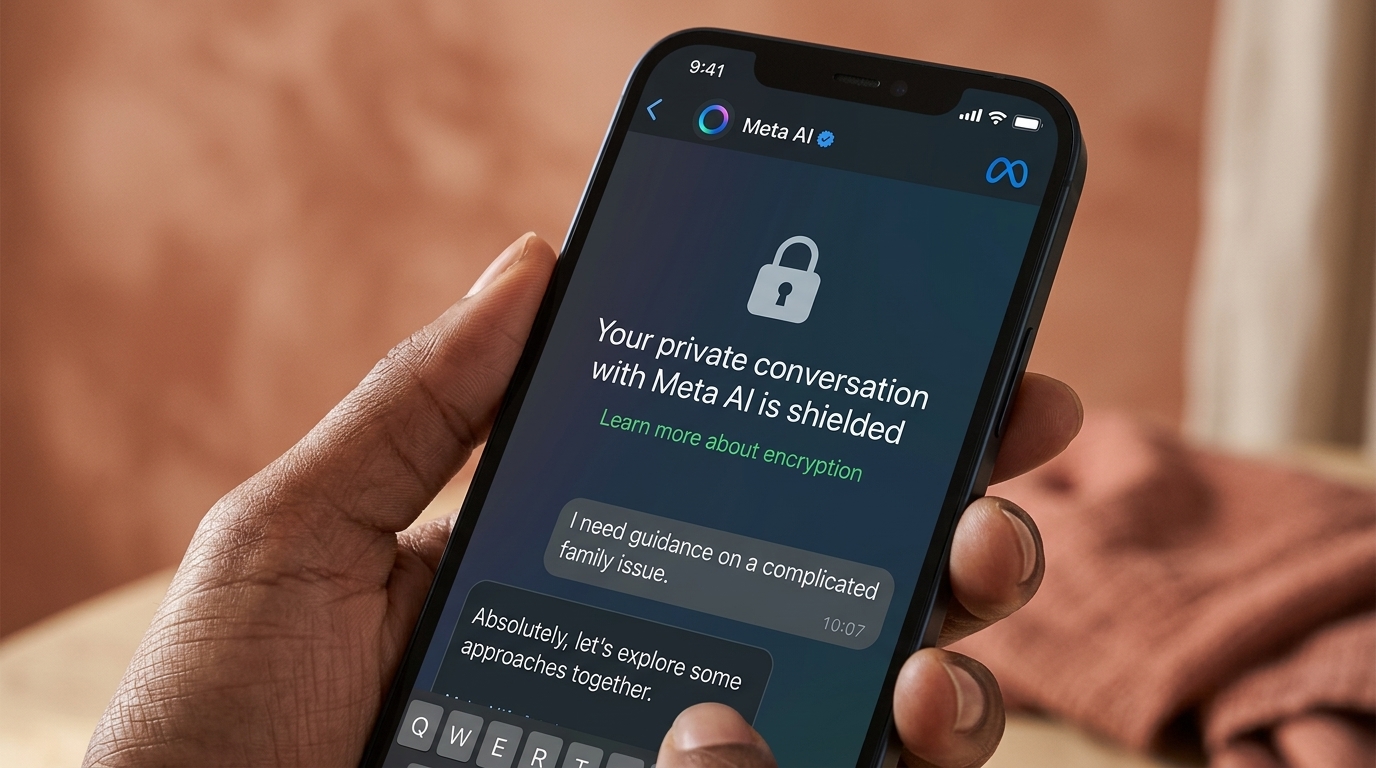
In a move designed to redefine the relationship between users and Large Language Models (LLMs), Meta has officially announced the launch of "Incognito Chat" for Meta AI. This new feature, set to be integrated across WhatsApp, Messenger, and Instagram, allows users to interact with artificial intelligence without leaving a digital footprint, ensuring that their queries and responses remain invisible even to the company itself.
The announcement comes at a pivotal moment for the tech giant, as pressure from European Union regulators and consumer concerns over data processing have reached historic highs. Incognito Chat is not merely a "hidden" mode; it represents a fundamental shift in the architecture of how Meta AI handles information.
The Technology Behind the Anonymity
According to Meta's official newsroom, Incognito Chat is built on two primary pillars: end-to-end encryption (E2EE) and ephemeral data processing. When a user toggles the "Incognito" mode, the session is completely decoupled from their user profile. The data exchanged is not used to train future iterations of the Llama models, nor is it stored on Meta's servers once the conversation ends.
"We understand that for AI to become a truly personal assistant, users must feel safe sharing their most private thoughts and questions," said Mark Zuckerberg. The technology utilizes "Zero-Knowledge Proofs," a cryptographic method that allows the system to verify and process a request without knowing the identity of the sender or linking the content to the user's broader digital history.
The Trade-off: Personalization vs. Privacy
A significant question arises regarding the utility of the AI. Artificial intelligence thrives on context. The more a model knows about a user's habits, preferences, and past interactions, the more relevant its responses become. In Incognito Mode, Meta AI is stripped of this "memory." Each conversation starts from scratch, which may make the assistant less effective for complex, multi-day tasks that require historical continuity.
- Real-time end-to-end encryption for all AI queries.
- Automatic history deletion upon closing the chat window.
- Zero data utilization for ad targeting or model training.
- One-tap toggle between standard and incognito modes.
This concession in efficiency is a price Meta seems willing to pay to regain market trust. In a landscape where Apple Intelligence promises "Private Cloud Compute," Meta had little choice but to present an equally robust privacy alternative to remain competitive.
Geopolitical and Regulatory Implications
This move is also interpreted as a strategic maneuver against the EU AI Act. European regulators have been vocal about their reservations regarding how American tech firms harvest data from millions of citizens. By providing a full anonymity option, Meta aligns itself with "Privacy by Design" requirements, potentially smoothing the path for deeper penetration of its AI tools within the European market.
"Privacy is not a feature; it is the foundation of the next phase of computing," Meta’s report states.
However, skeptics point to Meta’s checkered past regarding data management. The challenge will be to prove through independent audits that Incognito Chat actually delivers on its promises and isn't just a sophisticated marketing veneer to pacify the public. The technical implementation must be transparent to satisfy the high standards of digital rights advocates.
The Future of Anonymous AI Interactions
As we head toward 2027, anonymity in AI is poised to become the new industry standard. Users are increasingly unwilling to trade their privacy for the mere convenience of a digital assistant. Meta’s Incognito Chat is a significant first step, but the road to full trust is long. The success of this feature will depend on whether users prioritize security over the hyper-personalization offered by Meta AI’s standard mode.