The art of documentary filmmaking has always rested on an unspoken pact between the creator and the audience: what you see is a record of reality. However, as we move through 2026, this pact is being radically renegotiated. The recent release of a project by an Australian filmmaker, who utilized advanced generative AI tools to visualize events that were physically impossible to film, marks a watershed moment for the cinematic industry. This documentary, which takes us 'into the spider’s lair,' is not just a film; it is an experiment in what constitutes 'truth' in the digital age.
The Challenge of the Invisible
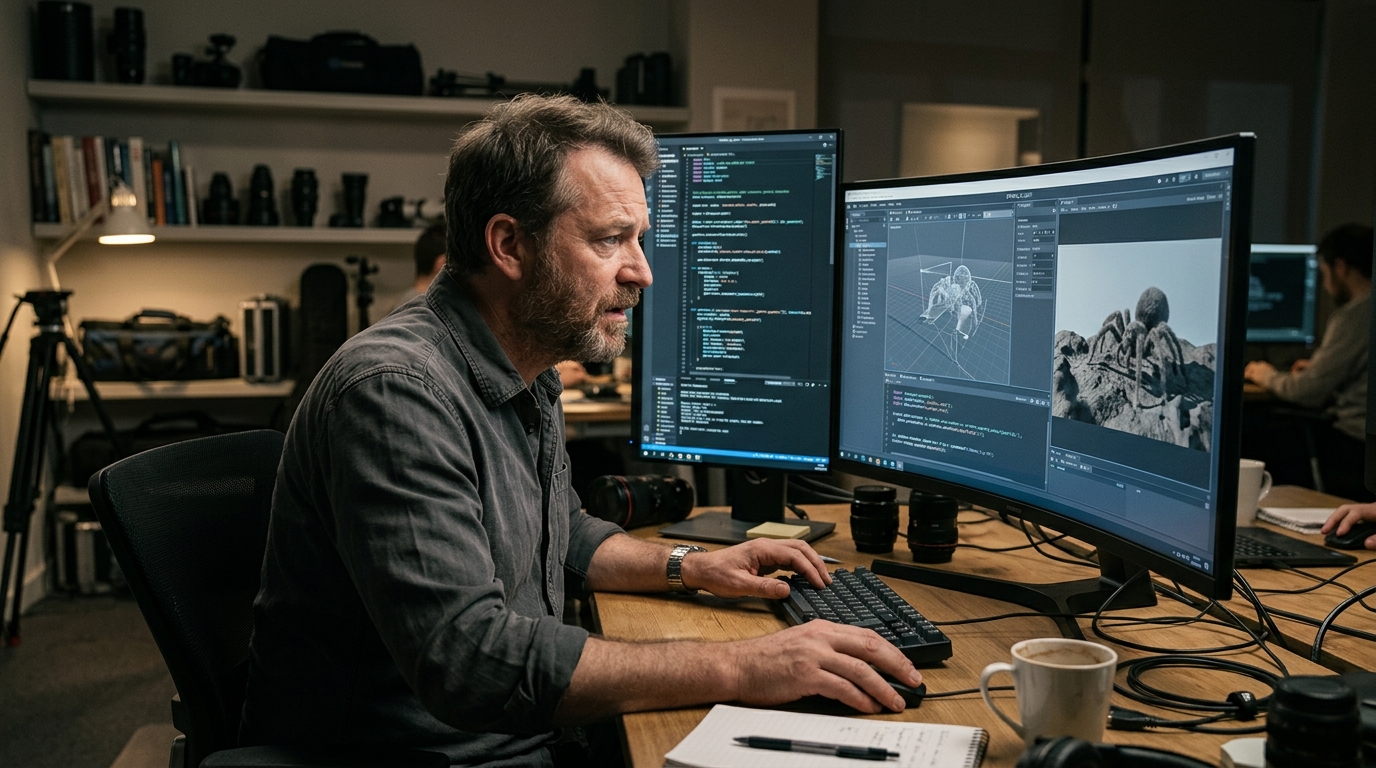
For decades, documentary filmmakers have faced the same fundamental obstacle: how to tell stories that occurred in the past, in locations where cameras were absent, or under conditions that made filming dangerous or impossible. Traditionally, the solution was re-enactments with actors, which often felt staged and detached from the raw authenticity of the subject. This Australian filmmaker chose a different path. By employing next-generation video generation models, they reconstructed visual data based on testimonies, audio recordings, and historical archives, creating scenes that appear as authentic footage but are entirely synthetic.
The technology used went far beyond simple visual effects. It involved a deep integration of neural networks capable of understanding the physics of light, human kinetics, and material textures. The result is a visual experience that 'fills the gaps' of history, allowing the viewer to step into environments that have long been destroyed or into moments where the presence of a film crew would have altered the outcome of events. This approach raises a provocative question: if the emotional impact is genuine, does it matter if the pixels are manufactured?
The Ethics of Synthetic Reality
The use of AI in documentaries is not without its detractors. Many traditionalists argue that the introduction of synthetic imagery dilutes the essence of the genre. "Documentary is the art of observation, not construction," skeptics point out. However, the Australian director counters that AI serves as a 'new lens' that grants access to truths that would otherwise remain obscured. In the case of 'The Spider’s Lair,' AI was used to visualize the internal dynamics and clandestine meetings of a reclusive group, based on hundreds of hours of interviews.
- Ethical Labeling: Every AI-generated scene carries a specific digital signature or watermark.
- Source Transparency: The data sets that trained the AI are accessible for journalistic verification.
- Emotional Accuracy: The priority is placed on faithfully translating the lived experience of witnesses.
This new form of 'hybrid documentary' demands a fresh ethical framework. It is no longer enough to state that AI was used; the *why* and *how* must be transparent. The industry is moving toward adopting standards that ensure technology is not used to falsify history, but rather to deepen our collective understanding of it.
The Future of Storytelling
As we advance further into 2026, the case of this Australian filmmaker will likely become the rule rather than the exception. The reduction in production costs through AI allows independent creators to envision epic-scale projects that previously required multi-million dollar budgets. Furthermore, the possibility of personalized storytelling—where a documentary can adapt its depth and focus based on the viewer's prior knowledge—is now on the horizon.
"Artificial intelligence does not replace the director; it allows them to become the architect of memories that humanity forgot to record," the filmmaker states.
In conclusion, 'The Spider’s Lair' is not just a technological triumph but a victory for human creativity. It demonstrates that AI, when wielded with vision and ethical responsibility, can expand the boundaries of what we consider possible in cinema, offering us a more complete picture of our world—even its darkest, most inaccessible corners.