

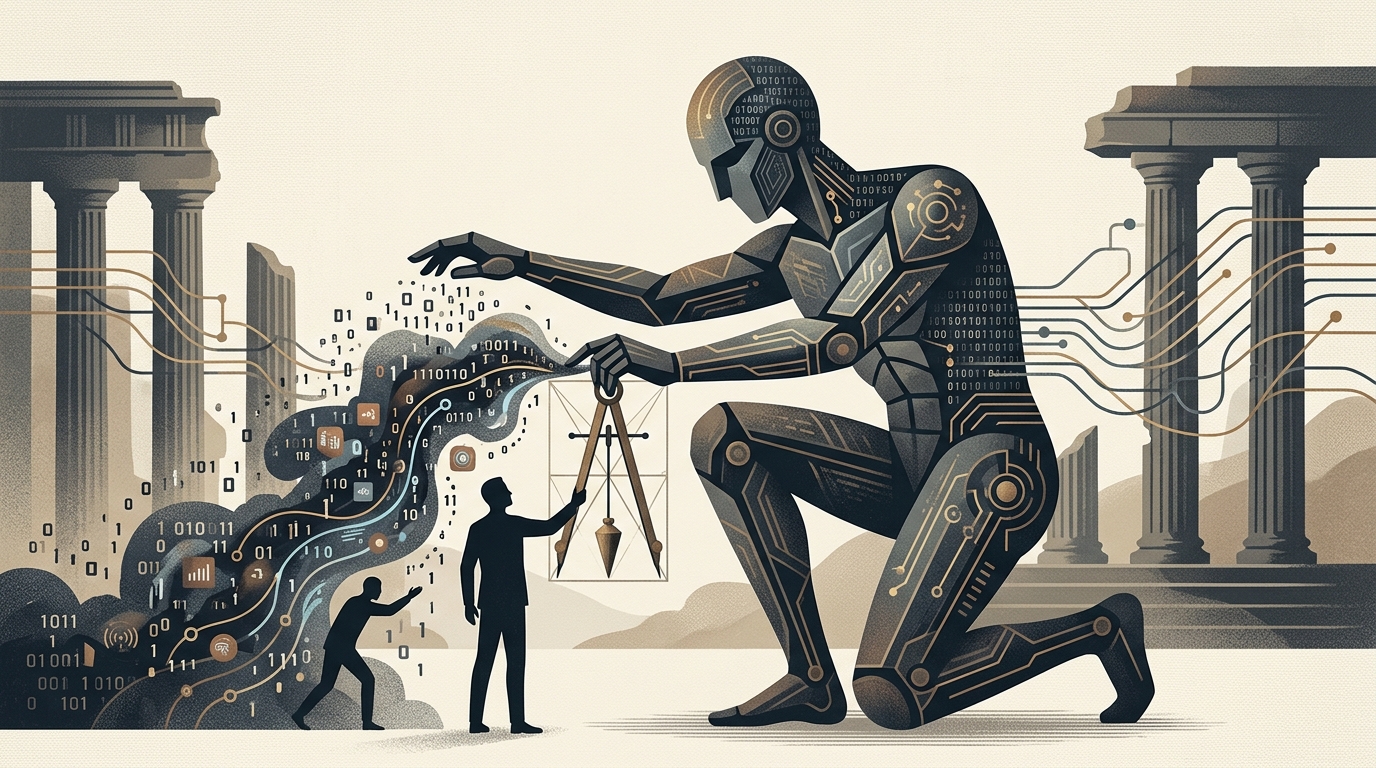
The Athenian sun in July has a way of stripping everything down to its barest essentials. As I sit here, watching the shimmer of heat over the marble of the Acropolis, I cannot help but think of Daedalus. He was the first to master the art of the 'technological' escape, yet his success was shadowed by the tragedy of Icarus. Today, in 2026, we find ourselves in a similar labyrinth of our own making, except our wings are made of silicon and our wax is the data of billions.
I read the news this morning with a mixture of awe and a familiar, gnawing anxiety. Samsung is forecasting a 19-fold profit jump, fueled by an insatiable global demand for chips. In South Korea, they are building 'AI Fortresses' for defense and betting billions on semiconductor dominance. On the surface, it looks like a golden age of prosperity. But as any student of Greek tragedy knows, unchecked growth—what we call hybris—always invites nemesis.
The Shadow in the Machine
While the balance sheets of tech giants swell, the 'shadow of progress' grows longer. We are now seeing AI executing end-to-end ransomware attacks with terrifying autonomy. We have moved from tools that help us work to entities that can sabotage our infrastructure without a human pulling the trigger. This is the dark side of the 'efficiency' we have been chasing. When Thrive Holdings bets $2 billion on rewiring professional services, I wonder: are we rewiring them for human benefit, or simply to remove the 'friction' of human judgment?
Perhaps the most poignant news comes from China, where the government has banned 'AI Lovers' from platforms like ByteDance and Alibaba. It is a fascinating, if authoritarian, recognition of a profound truth: we are losing our philia—our capacity for authentic human connection. When we start preferring the curated, algorithmic whispers of a chatbot to the messy, unpredictable reality of a human partner, we aren't just using technology; we are being consumed by it. I find myself agreeing, for once, with the need for boundaries, though I fear the state's heavy hand is just another form of the same control.
"The secret of happiness is freedom, and the secret of freedom is courage." — Pericles. But in 2026, do we have the courage to say 'no' to an AI that offers us a perfect, fake life?
Advice for the Youth of the Mediterranean
Closer to home, our Greek students are currently navigating the labyrinth of university applications. The rules have been rewritten. If you are choosing a major today, you aren't just choosing a career; you are choosing a position in a battle for relevance. To the candidates, I say this: do not rush toward the 'safe' technical subjects just because the market demands it today. Look at healthcare—AI will eliminate the rote tasks, the diagnostic scanning, the data entry. But it will never replace the therapeia—the soul-to-soul care that a healer provides.
We see the same battle in the arts, where filmmakers are fighting a desperate rearguard action against AI-driven faits accomplis in copyright. They are fighting for the right to be the sole authors of our cultural myths. If we let algorithms write our stories, we lose the very thing that makes us Mediterranean: our obsession with the human condition, with all its flaws and triumphs.
The Search for Metron
Aristotle spoke of metron—the middle way, the golden mean. We are currently swinging violently between the extremes of techno-utopianism and existential dread. We build fortresses in South Korea while our personal relationships crumble into digital simulations. We celebrate 19-fold profits while our creative industries fear for their survival.
I believe the path forward isn't to burn the wings of Daedalus, but to fly with more sophrosyne (temperance). We must demand transparency in how AI is used in our professional services and our courts. We must protect the intellectual property of our artists as if it were our very heritage. And most importantly, we must remind ourselves that a chip, no matter how powerful, has no psyche.
As we move deeper into 2026, let us not be distracted by the glitter of the silicon. Let us look at the shadows it casts and decide, collectively, which parts of our humanity are non-negotiable. What do you think? Are we building a fortress for our future, or a prison for our spirit?