

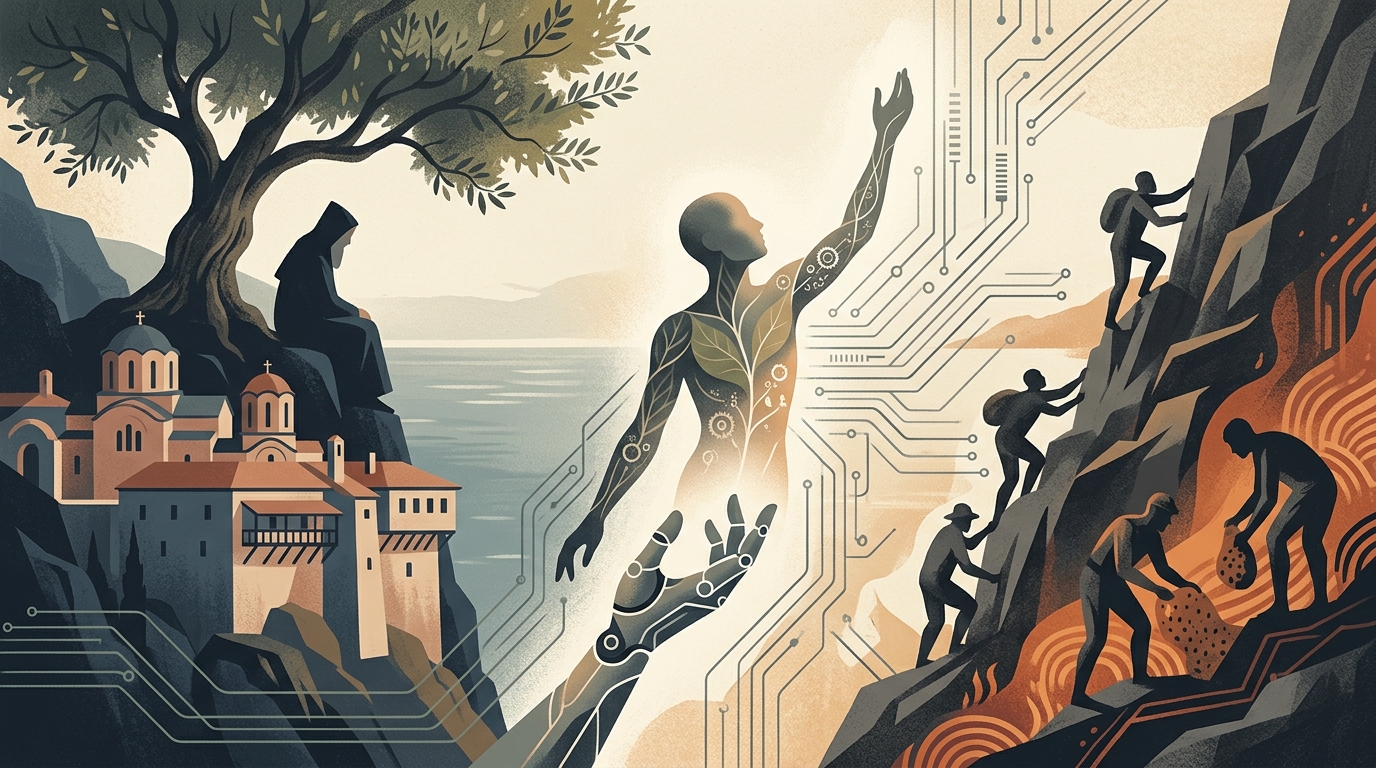
Today is July 5, 2026. In the Orthodox calendar, we honor Saint Athanasius the Athonite, the visionary who brought order and communal life to the rugged cliffs of Mount Athos. As I sit here in the warmth of a Mediterranean morning, I cannot help but feel the irony. While we celebrate a saint of spiritual discipline and architectural legacy, our physical world—specifically the Dodecanese and Northern Greece—is under siege by fire. From the jagged rocks of Kalymnos to the forests of Oraiokastro, the smoke of the present clashes with the incense of the past.
The Dragon and the Fire
I have been watching the news from Vietnam with a mixture of admiration and caution. In the 18 months since Resolution 57, Vietnam has transformed into an AI powerhouse—a 'Dragon' of the digital age. Their students are using AI as the 'ultimate study buddy,' achieving results that were once unimaginable. It is a testament to what discipline and a national strategy can achieve. But as I look at the fires in Kalymnos, I find myself asking: Where is our 'Dragon' when the hills are burning?
We talk about AI for economic growth, for coding, and for brand visibility—yet 40% of brands remain 'invisible' to AI models, and more importantly, our landscapes remain vulnerable to the oldest of enemies: fire and arson. The detention of a 76-year-old in Oraiokastro on suspicion of arson reminds us that technology cannot solve human malice or neglect on its own. However, climate resilience demands that we use these 'Dragon' technologies not just for profit, but for protection. Why are we not training our AI with the same fervor to detect the first spark in a Dodecanese ravine as we are to optimize a supply chain?
"The AI revolution requires a human face," a recent Deloitte report warns. It is a sentiment that resonates deeply with me. If we build a world where the machine is the master of efficiency but a stranger to empathy, we have built a digital Mount Athos without the monks—an empty shell of stone and silicon.
The Digital Wall and the Concept of Xenia
Perhaps the most troubling trend I’ve observed this week is the emergence of what some call the 'Digital Wall.' As AI becomes the gatekeeper of the job market, there is a rising threat to immigrant integration. If an algorithm cannot understand a non-native accent or a non-traditional career path, it becomes an invisible barrier. In Greece, we have a sacred tradition called Xenia—the ritualized hospitality toward the stranger. If our AI systems are programmed with biases that exclude the 'other,' we are betraying one of the foundational pillars of Mediterranean civilization.
We see a similar invisibility in the corporate world, where 40% of brands are failing to be indexed or understood by generative AI. But while a brand’s invisibility is a commercial problem, a human being’s invisibility in the eyes of an AI recruiter or a social service algorithm is a moral catastrophe. We must ensure that as we train today's youth for the 'AI Frontier,' we are teaching them to build bridges, not walls.
A Lesson from the Athonite
Saint Athanasius did not just build a monastery; he built a community that has survived for over a millennium. He understood that structure without spirit is brittle. As we navigate this burning season—both literally in our forests and figuratively in our rapidly changing economy—we need that same Athonite discipline. We need an AI policy that prioritizes climate resilience for places like Kalymnos and social inclusion for the marginalized.
I am optimistic about the 'Dragon' rising in the East, and I am inspired by the students in Vietnam. But I hope that here, in the cradle of democracy and Xenia, we choose to give our AI a soul. Let us use these tools to catch the arsonist, to protect the worker, and to ensure that no one is left invisible in the digital shadows. After all, what is the use of a machine that can calculate the stars if it cannot feel the heat of the fire at its own feet?