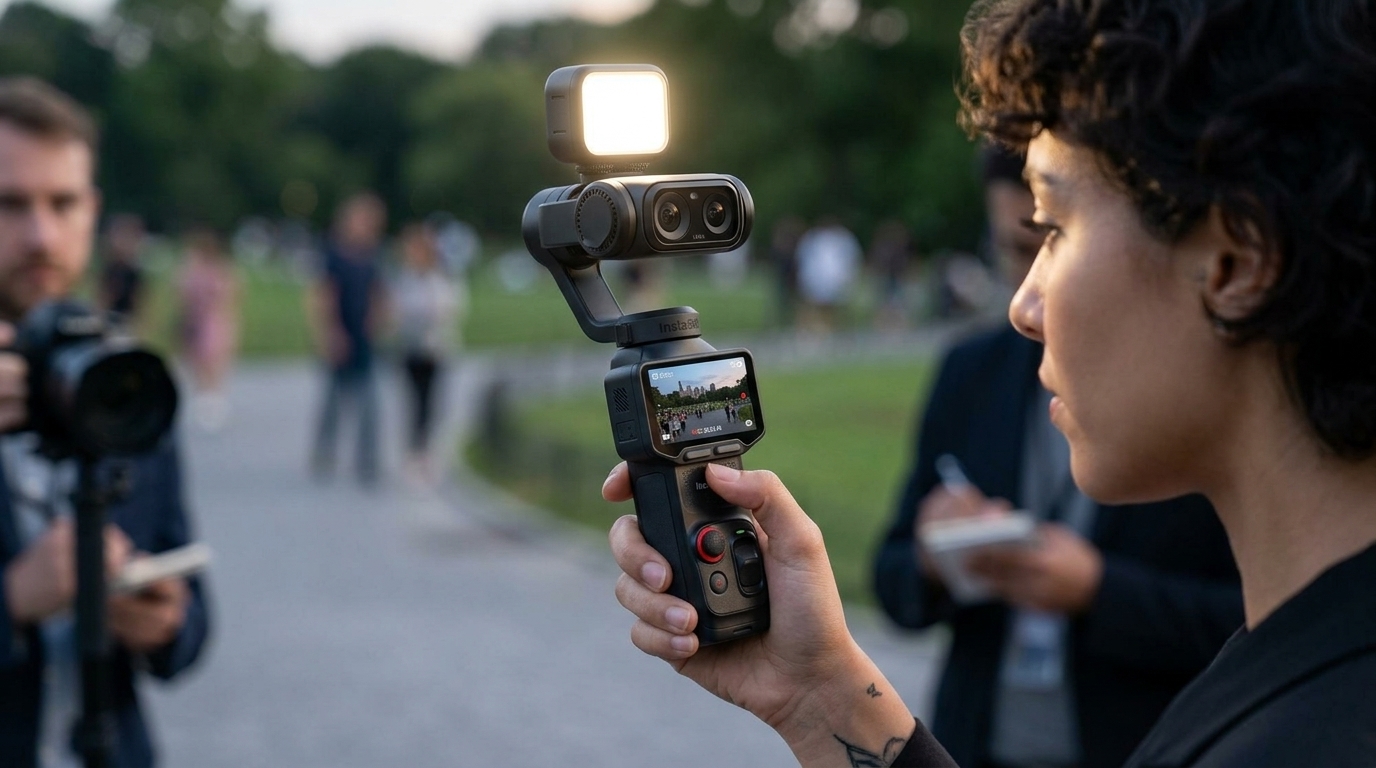
The digital imaging industry is witnessing a pivotal moment as Insta360 officially announces the availability of the Luna Ultra in the US and European markets. Following months of strategic teasers and a high-profile, albeit secretive, debut at NAB 2026 this past April, the company's new flagship is no longer a prototype. It is a commercial powerhouse aimed at redefining the concept of "professional results in your pocket."
The Luna Ultra is more than just an iteration of its predecessors; it is a bold challenge to DJI’s long-standing dominance in the handheld gimbal market. By integrating a dual 8K camera system atop a sophisticated 3-axis mechanical stabilizer, the device delivers image quality that, until recently, required bulky rigs and five-figure investments. The ongoing partnership with Leica ensures that the optics deliver a level of color science and dynamic range that pushes the limits of small-form-factor sensors.
Dual-Lens Mastery and the 8K Frontier
The defining characteristic of the Luna Ultra is its unique sensor architecture. It features two 1-inch sensors—one paired with a wide-angle lens and the other with a dedicated telephoto lens—capable of capturing 8K video at 60fps. This ability to switch between focal lengths without sacrificing resolution is a feature professional creators have long demanded. Leica’s influence is evident in the lens design, which minimizes chromatic aberration and maintains edge-to-edge sharpness even in challenging lighting conditions.
Beyond zooming, the dual-lens setup facilitates "Stereoscopic Fusion." This technology merges data from both sensors to create enhanced depth maps, enabling the capture of high-fidelity spatial video compatible with the latest VR and AR headsets. This strategic move suggests that Insta360 is looking beyond the traditional vlogging community, positioning the Luna Ultra as a primary tool for the burgeoning spatial computing ecosystem.
The AI Backbone: Aion Gen 2 Processor
At the core of the Luna Ultra lies the "Aion Gen 2" AI processor. Handling the immense data throughput required for 8K stabilization and real-time encoding is a monumental task, which Insta360 has addressed through specialized neural networks. The Deep Track 4.0 system allows the camera to lock onto and follow subjects with surgical precision, maintaining the lock even when the subject is momentarily obscured or moves erratically.
Furthermore, AI serves as an on-board director. The "Auto-Frame" feature analyzes 8K footage to suggest the most compelling compositions, allowing users to export multiple aspect ratios (vertical for social media, horizontal for cinematic platforms) from a single take while maintaining 4K clarity in every crop. The device’s ability to employ machine learning for temporal noise reduction in low-light environments ensures that the Luna Ultra is not just a passive recorder but an intelligent imaging assistant.
Market Disruption and Geopolitical Context
The US launch of the Luna Ultra occurs against a backdrop of increasing scrutiny regarding Chinese technology firms. While DJI has faced significant headwinds due to US regulatory pressures and security concerns, Insta360 has navigated the landscape with a focus on data transparency and consumer-centric software. Priced at $999, the Luna Ultra sits in the premium segment, yet its value proposition compared to traditional mirrorless setups is formidable.
The central question remains: Is the market ready for 8K? While 4K remains the standard for consumption, the flexibility of 8K in post-production—allowing for lossless cropping and reframing—is a game-changer for solo creators. The Luna Ultra is not merely a gadget; it is the vanguard of a new era where AI and optical excellence converge in a device that fits in the palm of a hand.
- Dual 1-inch sensors supporting 8K/60fps video capture.
- Advanced 3-axis mechanical gimbal for cinematic stability.
- Aion Gen 2 AI processor for real-time tracking and editing.
- Leica-engineered optics for superior color and clarity.
- Native support for Spatial Video and 3D content creation.