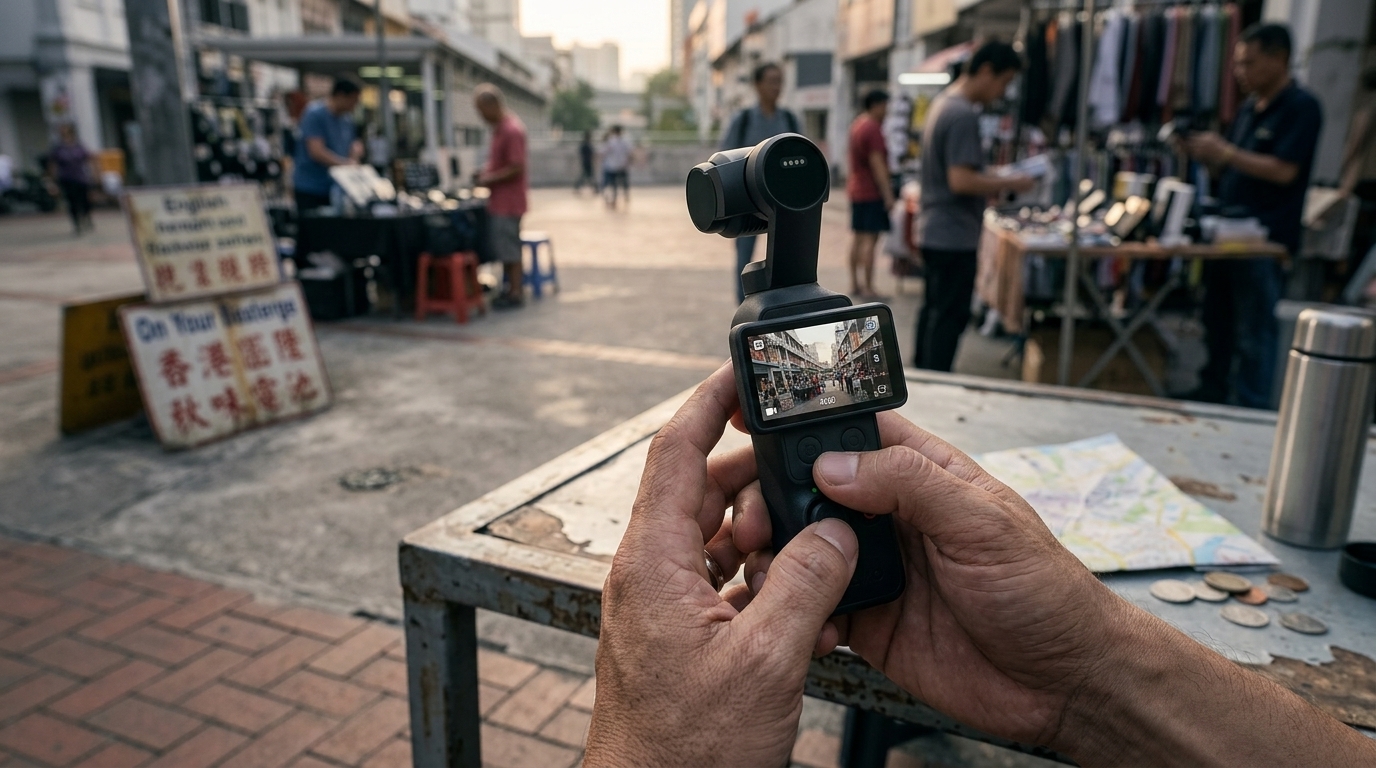
The evolution of DJI’s Osmo Pocket series represents one of the most impressive hardware success stories of the last decade. From the experimental first model to the dominant Pocket 3, the company has effectively eliminated the need for bulky gimbals, offering cinematic stability in a device the size of a lighter. With the release of the Osmo Pocket 4, DJI appears to have reached the zenith of its engineering prowess, delivering a device that is superior in every technical department. However, the headline is not just its technological superiority, but the fact that this device has become the "forbidden fruit" for the United States market.
Technical Mastery: A Sensor That Defines the Category
The Osmo Pocket 4 does not reinvent the form factor; instead, it perfects the content. At the heart of the device lies an upgraded 1-inch CMOS sensor, which now supports native 5.2K resolution at 60fps and 4K at 120fps for stunning slow motion. The dynamic range has been significantly expanded, allowing content creators to capture detail in high-contrast environments that previously required professional cinema cameras.
The most significant improvement, however, is found in light management and noise reduction during night shots. Thanks to new AI algorithms embedded in the image processor, the Pocket 4 can "clean" footage in real-time, offering a clarity that rivals mirrorless cameras of much greater cost and bulk. The three-axis stabilization, DJI's hallmark, remains industry-leading, making even a sprint look like a smooth dolly shot.
Artificial Intelligence and Ease of Use
The ActiveTrack 7.0 software is the spearhead of the new model. The camera doesn't just follow a face; it understands body movement, predicts direction, and maintains framing even if the subject is momentarily obscured by an obstacle. For the solo content creator, the Pocket 4 acts as an invisible cinematographer that never tires. Furthermore, the integration of Wi-Fi 7 allows for the instantaneous transfer of massive video files to smartphones, slashing the time between capture and social media publication.
- 1-inch sensor with significantly improved low-light performance.
- 10-bit D-Log M support for professional-grade color grading.
- 2.2-inch rotatable OLED screen with increased peak brightness.
- Triple-microphone array with AI-driven noise cancellation.
The Geopolitical Paradox: A Divided Market
Despite its technological laurels, the launch of the Osmo Pocket 4 is marred by its absence from US shelves. Following in the footsteps of the company’s recent drones, DJI has chosen—or been forced by legislative pressure—not to officially release the device in the American market. This is a direct consequence of the escalating tension between Washington and Beijing regarding data security and the protection of domestic industry.
"Technology is no longer neutral. Every pixel captured by a Chinese camera is now viewed by some as a potential national security threat," notes an industry analyst.
This development creates a strange dynamic: American vloggers, who perhaps constitute the largest segment of the market, are forced to turn to less capable alternatives or seek the device through gray market imports, often without warranty. DJI, on the other hand, is demonstrating that it can survive and innovate even without access to the world's largest economy, focusing its growth on Europe and Asia.
Conclusion: The Future of Portable Recording
The Osmo Pocket 4 is undoubtedly the best camera in its class. It is a tool that democratizes high production value, allowing anyone to create content that looks professional. However, the story of the Pocket 4 is also a warning about the future of technology. When geopolitical rivalries obstruct innovation, the ultimate losers are the users. For those in regions where the device is available, the upgrade is almost mandatory. For the rest, it remains a symbol of an era where technology is being partitioned by new digital and political walls.