The climate crisis is no longer a theoretical threat but a stark reality transforming the Mediterranean landscape into a tinderbox ready to ignite. In this volatile environment, traditional firefighting and civil protection methods often prove insufficient against "mega-fires" that generate their own microclimates. Enter OroraTech, a Munich-based startup that has successfully merged aerospace engineering with artificial intelligence, offering a solution that starts in orbit to protect the ground below.
The CubeSat Revolution and Thermal Intelligence
At the core of OroraTech's innovation lies the development and launch of nanosatellites (CubeSats) equipped with advanced thermal infrared sensors. Unlike large, traditional meteorological satellites situated in geostationary orbit thousands of kilometers away, OroraTech’s nanosatellites operate in Low Earth Orbit (LEO). This proximity allows them to detect fire outbreaks with significantly higher precision and, crucially, much faster than legacy systems.
The system does not merely rely on imagery; it is a sophisticated data processing engine. Utilizing AI algorithms that run directly on the satellite (edge computing), the system can distinguish a genuine wildfire from solar glint or industrial heat sources. This drastically reduces false alarms, enabling authorities to mobilize within minutes of an ignition—a window of time that often determines whether a fire can be contained or becomes a disaster.
Greece as a Strategic Case Study: The "Aegis" Program
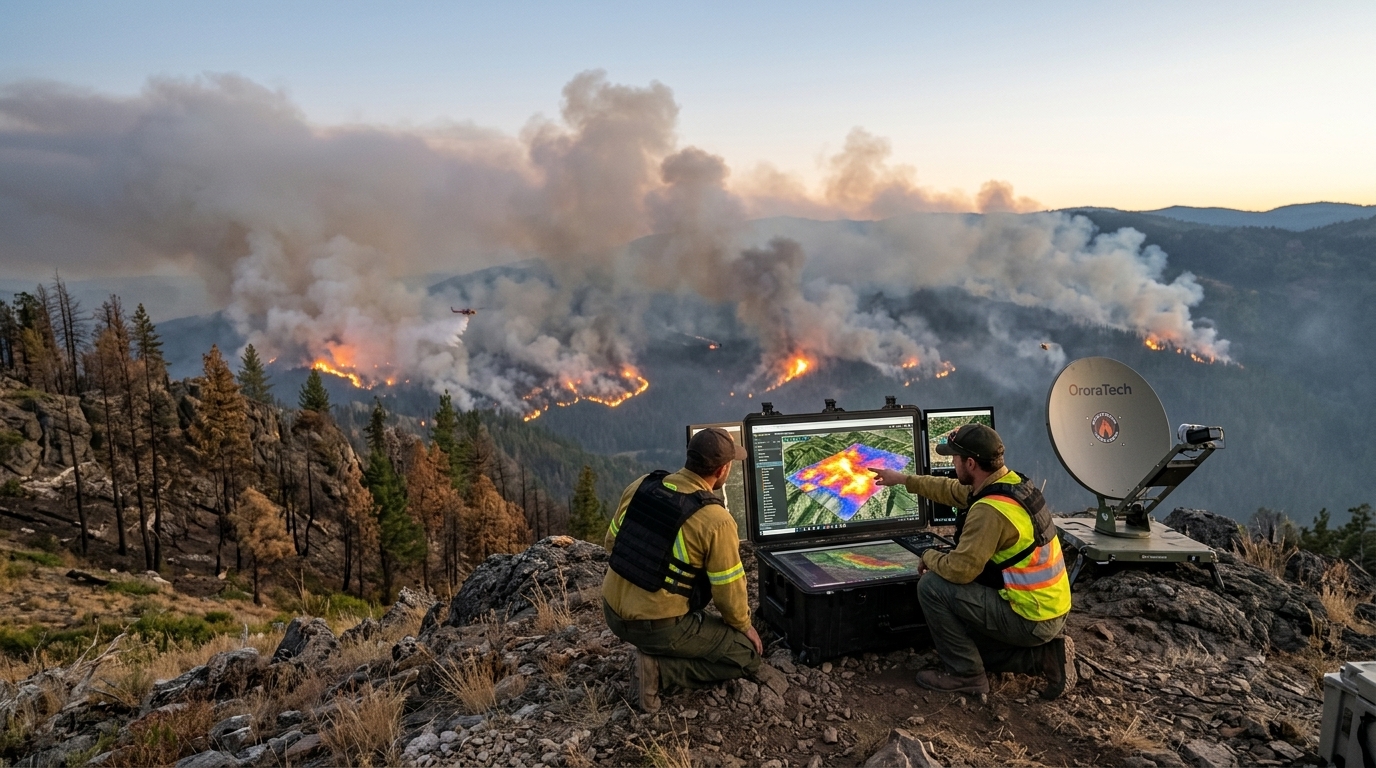
For Greece, collaborating with companies like OroraTech is not a luxury but a national necessity. Under the "Aegis" program, the Ministry of Climate Crisis and Civil Protection has invested heavily in integrating satellite data into its operational core. OroraTech provides the Greek government with access to its Wildfire Solution platform, which fuses data from over 20 third-party satellites with its own proprietary orbital data.
Over the past few years, the use of these tools has allowed Greek operational analysts to maintain a real-time "eye in the sky," a capability that was virtually non-existent a decade ago. The ability to see the fire's progression through thick smoke—thanks to thermal imaging—provides a strategic advantage for community evacuations and the tactical positioning of ground forces at critical choke points.
From Suppression to Prediction: The Future of Management
The next frontier for OroraTech and global civil protection is the transition from simple detection to predictive analytics. By combining thermal data with information on fuel moisture levels, wind speed, and topography, AI can now predict with impressive accuracy where a fire will spread in the coming hours.
- Real-time Detection: Spotting ignitions even in remote, inaccessible mountainous regions.
- Progression Monitoring: Continuous updates on intensity and rate of spread.
- Risk Assessment: Dynamic maps indicating high-risk zones before a fire even starts.
The economic dimension is equally compelling. The cost of prevention and early intervention is a fraction of what is required for disaster recovery, victim compensation, and reforestation. OroraTech demonstrates that investment in space technology has a direct, measurable impact on citizen safety and the preservation of natural capital.
"Technology does not replace the firefighter on the ground; it gives them the eyes they need to avoid fighting an unequal battle against the unknown," company executives state.
In conclusion, OroraTech serves as a prime example of how "deep tech" can provide solutions to humanity's existential challenges. As the planet warms, the need for these "eyes in the sky" will become increasingly urgent, making space technology an indispensable component of national defense against climate change.