The history of technology rarely offers second chances, let alone third or fourth ones. Yet, the name Commodore refuses to fade from collective memory. Today, June 16, 2026, we stand before one of the most paradoxical yet charming revivals in the history of consumer electronics. Christian Simpson, the man behind the Peri Fractic channel and new owner of the Commodore remains, isn't just trying to sell nostalgia; he's attempting to rewrite history.
An Alternate History of Technology
When Simpson acquired the rights to Commodore in 2025, his strategy was clear and radical: to continue product development from the point where the original company collapsed in the mid-90s. This means that the company's new product, the flip phone dubbed "Callback," wasn't designed as a competitor to the iPhone 17, but as the natural evolution Commodore would have had if it had survived into the mobile era.
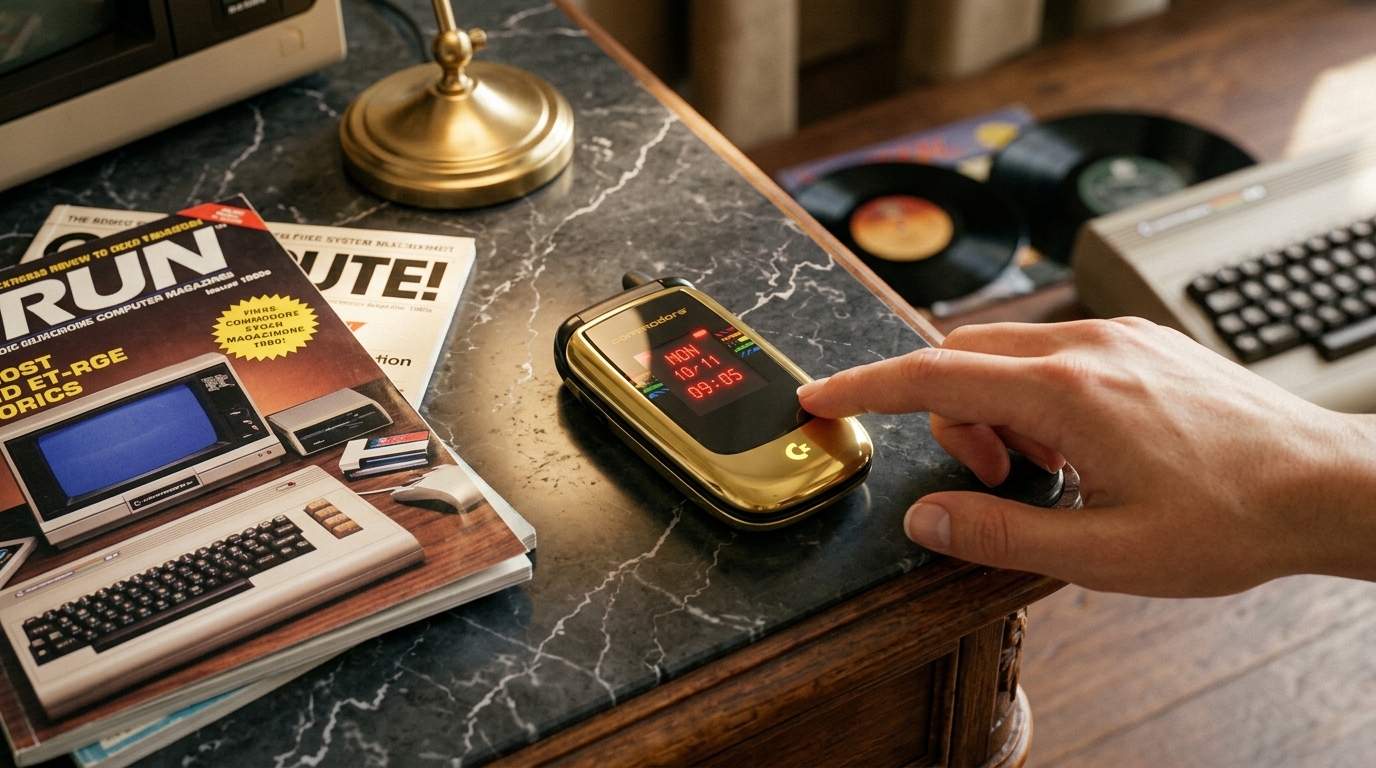
The Callback is a flip phone that exudes the aesthetic of the Commodore 64 and the Amiga. With its characteristic "80s plastic" beige color, the iconic "chicken head" logo, and physical buttons that offer the satisfying tactile feedback of vintage keyboards, the device targets a very specific market: those tired of the tyranny of the touchscreen and endless notifications.
The Rise of Minimalist Phones and the Commodore Edge
This move is no accident. In 2026, the "digital detox" trend has reached the proportions of a movement. Gen Z, the generation that grew up with a smartphone in hand, is increasingly turning to "dumbphones" to regain control of their attention. Commodore enters this market with an advantage that low-cost Chinese manufacturers lack: cultural heritage.
- Design: A folding mechanism with durability reminiscent of old-school industrial standards.
- Software: A text-based operating system echoing Commodore BASIC, but with modern 5G capabilities and encrypted communication.
- User Experience: Focus on calls and texts, with minimal social media apps operating in a "restricted mode."
According to Simpson, the device is not just a communication tool, but a "functional piece of art." The Commodore of 2026 wants to be the alternative voice in a world dominated by algorithmic content consumption.
Challenges and Business Risks
Despite the excitement of retro-enthusiasts, Commodore faces a mountain of challenges. The mobile phone market is extremely saturated, and profit margins for small manufacturers are razor-thin. Furthermore, using a brand name that has passed through so many hands and seen so many failed revival attempts in the past (from Android tablets to low-quality gaming PCs) carries the risk of brand dilution.
"We aren't just selling a phone. We are selling the idea that technology can be personal, tangible, and above all, ours," Simpson stated during the press conference.
The success of the Callback will depend on whether it can convince the public that returning to the past is actually a step toward a healthier future. If Commodore manages to blend reliability with nostalgia, we might see a new era where our "tools" don't control us but serve us the way a C64 did in 1982.
Conclusion: Is the Future Analog?
The Commodore of 2026 is an experiment. It is proof that technological progress is not a straight line, but a cycle. As users seek ways to disconnect without losing touch, devices like the Callback offer a middle ground. We may not see Commodore threatening Samsung, but we are certainly seeing the birth of a new category: "conscious technology" that honors its roots.