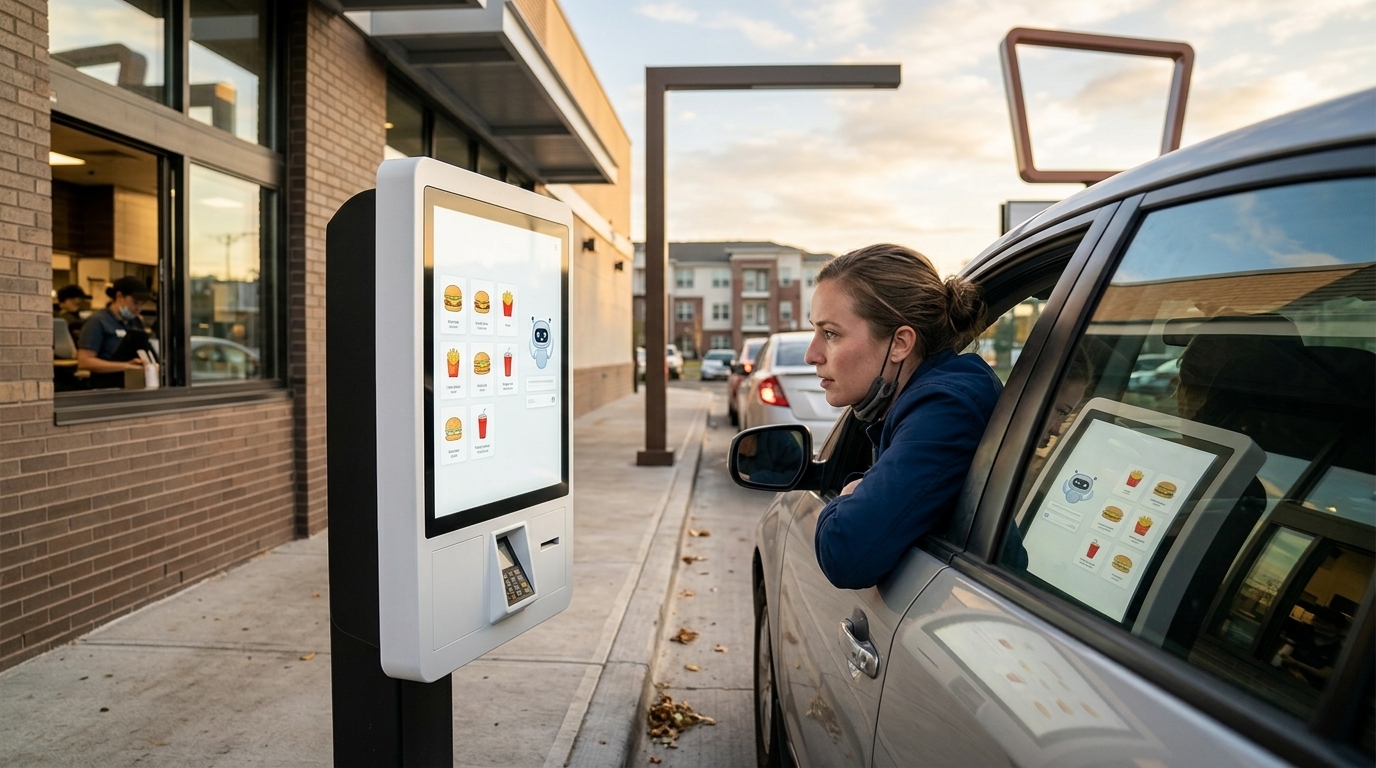
The scene is becoming increasingly familiar: you pull up to a fast-food drive-thru, ready to order a meal, but the voice greeting you doesn't belong to a tired teenager working a summer job. It belongs to an algorithm. This transition, which began tentatively a few years ago, has evolved into one of the most critical fronts in the Artificial Intelligence (AI) revolution. While McDonald's recent decision to end its partnership with IBM for its proprietary AI drive-thru system made headlines, the takeaway isn't that the technology failed, but that we are in a phase of strategic realignment before mass adoption.
The McDonald’s Experiment and Lessons from Friction
In 2021, McDonald's announced its partnership with IBM with great fanfare, aiming to automate ordering across hundreds of locations. However, by the summer of 2024, the company pulled the plug. Viral social media videos showing the AI adding hundreds of dollars worth of McNuggets or confusing ice cream with bacon orders generated laughs and skepticism. Yet, the industry is not retreating. Wendy’s, Carl’s Jr., and Hardee’s are doubling down on solutions from Google and specialized AI providers like Presto.
The McDonald's-IBM fallout wasn't a technological defeat; it was a tactical pivot. The accuracy of these systems often hits a wall due to external factors: engine noise, diverse regional accents, and even children shouting in the backseat. The challenge for developers in 2026 is no longer just speech recognition—it's context comprehension. The ability of a chatbot to discern whether a customer is correcting a previous item or simply thinking out loud is the 'holy grail' of voice interfaces.
Economic Rationalism and Labor Disruption
Why do corporations persist despite these initial hurdles? The answer lies in the balance sheet. With rising minimum wages and chronic labor shortages in the hospitality sector globally, the cost of operating a human-staffed drive-thru is climbing. An AI system doesn't suffer from fatigue, doesn't require benefits, and, theoretically, can upsell with far more consistency than a human employee.
- Reduction in wait times by an average of 15-20 seconds per car.
- Consistent application of upselling strategies (e.g., "Would you like to size up?").
- Reallocation of human staff to food preparation rather than order taking.
However, the social impact is profound. Entry-level service jobs have traditionally been the gateway to the labor market for young people. As these roles become automated, a gap in skills and employment opportunities emerges. AI is not merely "assisting" the worker; in many cases, it is making them redundant. What we see today at the drive-thru is the blueprint for what will soon happen at supermarket checkouts, hotel receptions, and customer service centers.
Beyond Fast Food: The Interface of the Future
The drive-thru is the perfect laboratory for voice AI because the transactions are structured and bounded. There is a specific menu and a clear objective. If the technology is perfected there, its expansion into other sectors is inevitable. We are already seeing banks use similar systems for voice-based customer identification and hospitals experimenting with AI for appointment scheduling.
"We aren't just automating an order; we are training the public to converse with machines as a matter of course," says a retail technology executive.
The challenge for the future remains human connection. In a world where most of our daily transactions will be mediated by algorithms, human interaction may become a luxury good. Drive-thrus are just the start of a journey toward a "frictionless economy," where speed and efficiency reign supreme, perhaps at the expense of the human experience.