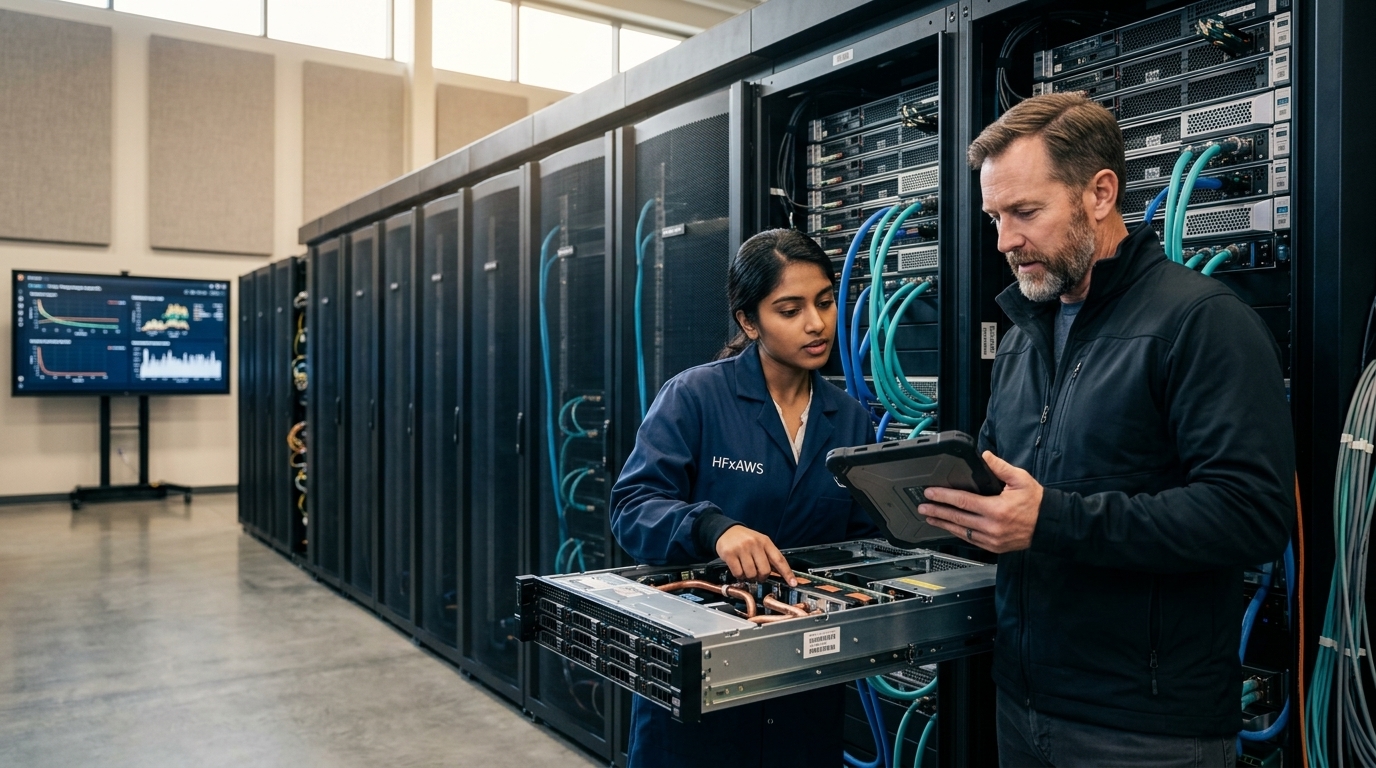
The era of experimental Artificial Intelligence has definitively yielded to the age of industrialized model production. As Foundation Models (FMs) grow increasingly complex, the demand for robust, scalable, and cost-effective infrastructure has become paramount. In this context, the collaboration between Amazon Web Services (AWS) and Hugging Face stands as a central pillar of the ecosystem, providing the "building blocks" that enable organizations of all sizes to train and deploy models with billions of parameters.
The Architecture of Scale: From Silicon to Software
Training a model like Llama 3 or Mistral is no longer a matter of a few GPUs in a local server. It requires an orchestrated effort across thousands of accelerators. AWS has invested heavily in its own specialized hardware, with Trainium and Inferentia chips serving as the answer to NVIDIA's market dominance. Trainium is purpose-built for deep learning training, offering high performance at a lower cost, while Inferentia focuses on low-latency throughput during production inference.
However, hardware alone is insufficient. Amazon SageMaker acts as the central orchestrator. With services like SageMaker HyperPod, developers can manage clusters of thousands of accelerators with automated fault recovery. This is critical; in training runs that last weeks, the failure of a single chip could jeopardize the entire process without the right management software in place.
The Hugging Face Bridge
Hugging Face serves as the vital link between the open-source community and the raw power of the cloud. Through Deep Learning Containers (DLCs) and specialized libraries like the Hugging Face Estimator for SageMaker, the process of moving a model from the research stage to production has been dramatically simplified. These libraries integrate advanced techniques such as Fully Sharded Data Parallel (FSDP) and DeepSpeed, which allow model weights to be distributed across multiple processors, overcoming the limitations of individual GPU memory.
- Ease of Access: Thousands of pre-trained models are available for immediate deployment on AWS.
- Optimization: Specialized scripts that automatically tune parameters for Amazon’s custom silicon.
- Security: The ability to train in isolated environments (VPC) ensuring the protection of proprietary data.
Inference: The Challenge of Real-World Deployment
Post-training, the focus shifts to the challenge of inference. This is where costs can skyrocket if the model is not properly optimized. Utilizing Hugging Face’s Text Generation Inference (TGI) framework in conjunction with AWS Inf2 instances can reduce cost-per-query by up to 50%. This is achieved through techniques like continuous batching and PagedAttention, which maximize the utilization of system resources and minimize idle time.
"The democratization of AI is not just about access to code, but about access to the infrastructure that makes that code useful in the real economy," industry analysts suggest.
Conclusion: Towards a Verticalized Future
AWS's strategy of offering a full stack — from its own silicon up to the application layer with Amazon Bedrock — demonstrates that infrastructure control is the key to AI market dominance. The partnership with Hugging Face ensures that this infrastructure remains developer-friendly, mitigating the risk of total vendor lock-in by supporting open standards. For enterprises, these building blocks represent a faster time-to-market and the ability to construct solutions that are both powerful and economically sustainable.