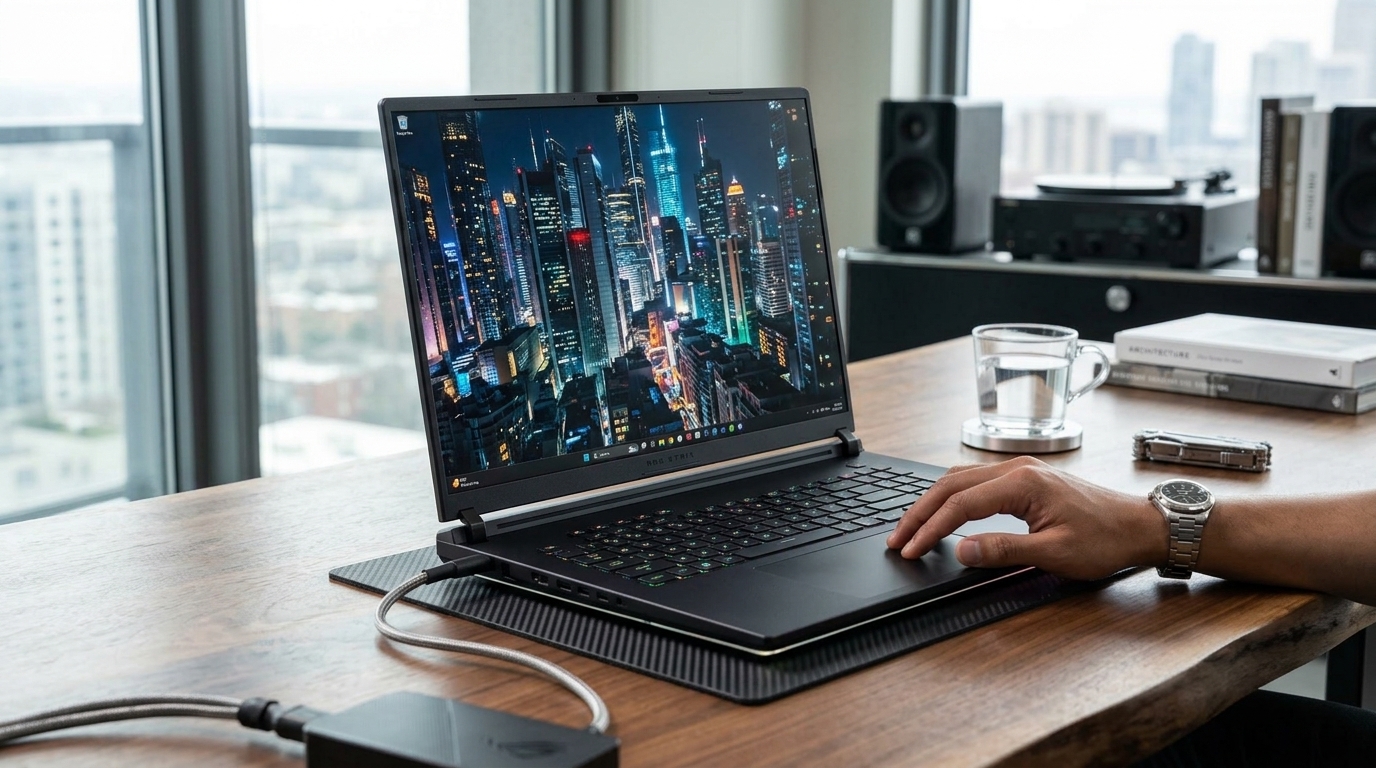
The history of display technology is a constant battle against the imperfections of human perception. From the bulky CRT monitors that dominated the end of the last century to today's ultra-thin OLED and Mini-LED surfaces, the goal has remained the same: to reproduce an image that feels as natural as reality itself. However, the transition to the digital era of LCDs brought with it a curse that old-school gamers remember well: motion blur. Today, in mid-2026, Asus seems to be offering a solution that isn't just an improvement, but a revelation—albeit at a price that induces vertigo.
The Return to Clarity: What is ELMB?
The centerpiece of the new Asus ROG Strix Scar 18, recently tested in pre-production form, is its ELMB (Extreme Low Motion Blur) technology. To appreciate its significance, one must understand how modern displays function. Most LCD and OLED screens use a "sample-and-hold" method, where each frame remains illuminated until replaced by the next. This creates an illusion of blur in the human brain as our eyes attempt to track movement across a series of static images.
Asus employs a highly sophisticated version of Black Frame Insertion (BFI). Essentially, the monitor strobes the backlight in perfect synchronization with the refresh rate, inserting "blackness" between frames. This "cleanses" the image on the retina, providing a level of sharpness reminiscent of the glory days of CRTs, but with the resolution and brightness of 2026. The result is jarring: objects moving at breakneck speeds across the screen remain so sharp that you can read text on them without straining.
Mini-LED and the Brightness Challenge
The major drawback of motion blur reduction technologies in the past was the loss of brightness. When you turn off the light for half the time (to insert that black frame), the screen appears dim. This is where the Scar 18 breaks new ground. By utilizing a latest-generation Mini-LED panel with thousands of local dimming zones, Asus has managed to overcome this hurdle. The display is so inherently bright that even with ELMB engaged, the image remains vibrant and punchy, exceeding 1000 nits in HDR content.
This synergy of hardware and software creates what many are calling the "promised land of PC gaming." It’s not just about frames per second (FPS). You can have 240Hz, but if the display has a slow response time, the motion will look "smeary." The Scar 18 eliminates this phenomenon, making any other screen without similar technology look outdated and flawed to the user's eyes.
The Social Dimension of Digital Luxury
However, we cannot ignore the elephant in the room: the cost. The Asus ROG Strix Scar 18 is not aimed at the average consumer. It is a power projection tool, a status symbol for the elite of gamers and content creators. In an era where global economic pressure is palpable, the existence of a laptop that costs as much as a used car raises questions about the trajectory of technology. Will visual perfection remain a privilege for the few?
History teaches us that such innovations eventually trickle down to more affordable models. But for now, the experience offered by the Scar 18 is a lonely peak. It is proof that technology can solve problems we didn't even realize were bothering us so much—until the moment we saw the solution with our own eyes.
Conclusion and Future Outlook
The Scar 18 is a triumph of engineering. It manages to combine the raw power of 2026-era processors with a display that redefines the concept of motion. For those who can afford it, it is a gateway to a new dimension of visual experience. For the rest of us, it is a promise of what will be considered standard on our screens five or ten years from now. Motion blur, a side effect of the digital revolution, finally seems to be heading toward the dustbin of history.
- ELMB technology provides unprecedented motion clarity.
- The Mini-LED panel ensures high brightness despite backlight strobing.
- The user experience makes conventional screens feel inferior.
- Cost remains the primary barrier to widespread adoption.