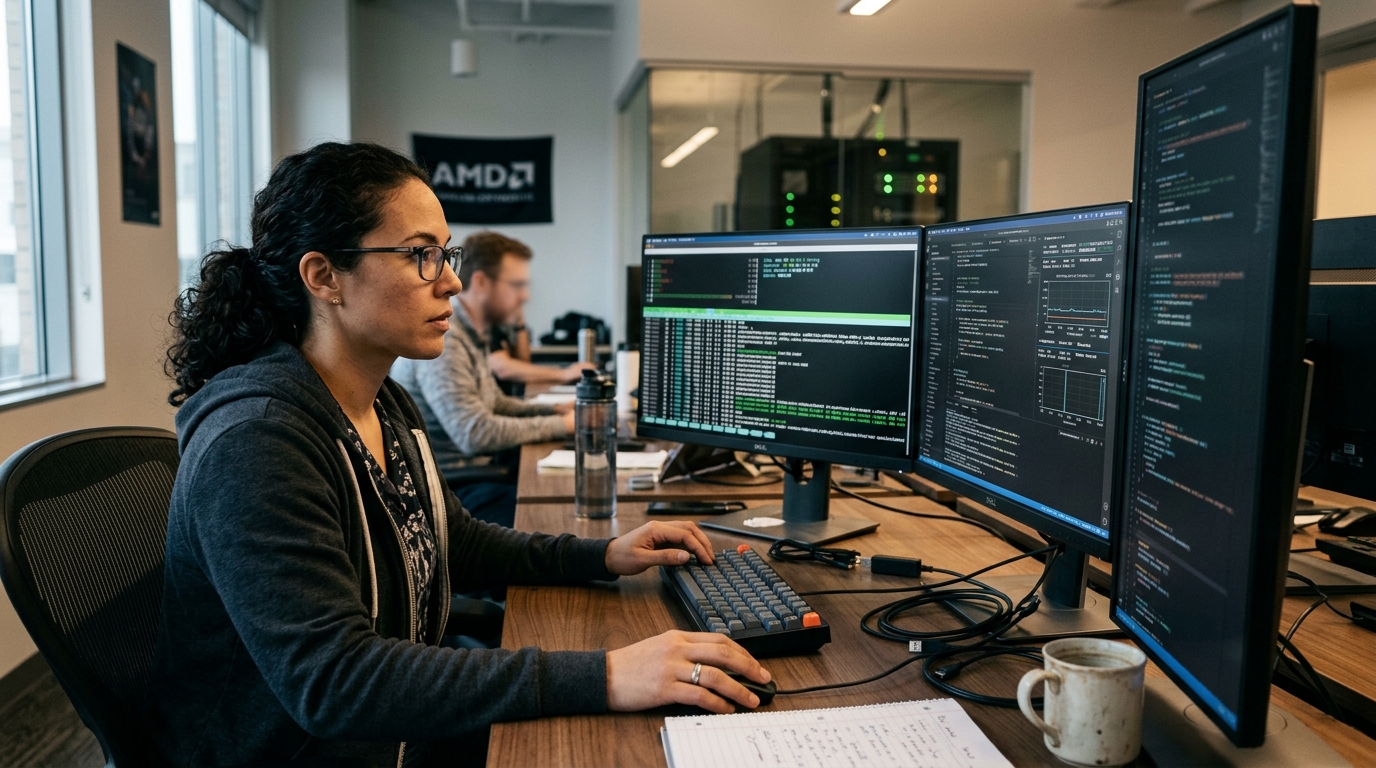
In the rapidly evolving landscape of AI computational infrastructure, AMD appears to have found the master key to unlocking peak performance for leading open-source models. The recent announcement of the vLLM-ATOM plugin marks a critical turning point in the company's quest to dethrone NVIDIA from its data center pedestal. By focusing on landmark models such as DeepSeek-R1, Kimi-K2, and gpt-oss-120B, AMD is not just offering more raw power, but a more intelligent management of resources through the Instinct MI350 and the upcoming MI400 architectures.
The ATOM Technology: Beyond Raw Power
The vLLM-ATOM plugin is far more than a software update; it is a profound optimization of how Instinct accelerators communicate with Large Language Models (LLMs). ATOM technology focuses on low-bit quantization, allowing massive parameter models to run with a significantly reduced memory footprint without sacrificing output accuracy. This is achieved through dynamic weight adjustment in real-time, leveraging the high-performance Matrix Cores of the MI350 series.
- INT4 and FP8 optimization for maximum data throughput.
- Reduction in latency during real-time text generation.
- Full compatibility with the ROCm ecosystem, AMD's direct answer to NVIDIA's CUDA.
AMD’s strategic choice to prioritize DeepSeek-R1 support is particularly astute. DeepSeek-R1 has emerged as a global phenomenon due to its ability to deliver GPT-4 level performance at a fraction of the training cost. With the vLLM-ATOM plugin, AMD positions the Instinct MI350 as the most attractive platform for running this model, providing the viable alternative that enterprises have been desperately seeking.
Instinct MI350 and MI400: Answering the Blackwell Challenge
While NVIDIA pushes its Blackwell architecture, AMD is responding with an aggressive multi-year roadmap. The Instinct MI350, built on the CDNA 3 architecture, is designed to bridge the gap, offering massive HBM3e memory capacity. However, the true "heavy hitter" is the MI400, expected to redefine the market in 2026. The integration of vLLM-ATOM ensures that the software stack will be ready to exploit every teraflop of these new chips from day one.
"Software optimization is the new battlefield. AMD is no longer content with just building good hardware; they are building an ecosystem where open source thrives better than anywhere else," industry analysts noted.
This move also carries significant geopolitical weight. Models like Kimi-K2 and DeepSeek originate from China, a market where access to NVIDIA chips is heavily constrained by US export controls. AMD, while subject to similar restrictions, seems to be positioning itself as the technological partner that understands the needs of the global open-source community, offering tools that make high-end AI accessible to a broader range of players.
The Future of Inference Economics
The cost of inference remains the single largest hurdle for widespread AI adoption. vLLM-ATOM reduces this cost drastically. For an enterprise running gpt-oss-120B, using an MI350 with the new plugin could mean up to a 40% improvement in price-to-performance ratio compared to previous solutions. This is not merely a technical victory; it is an economic necessity in a market demanding financial sustainability.
In conclusion, AMD’s vLLM-ATOM proves that the battle for AI supremacy will not be decided solely in semiconductor fabrication plants, but in the lines of code that allow these chips to "think" faster and cheaper. The era where NVIDIA was the only choice for serious AI inference appears to be reaching its twilight.