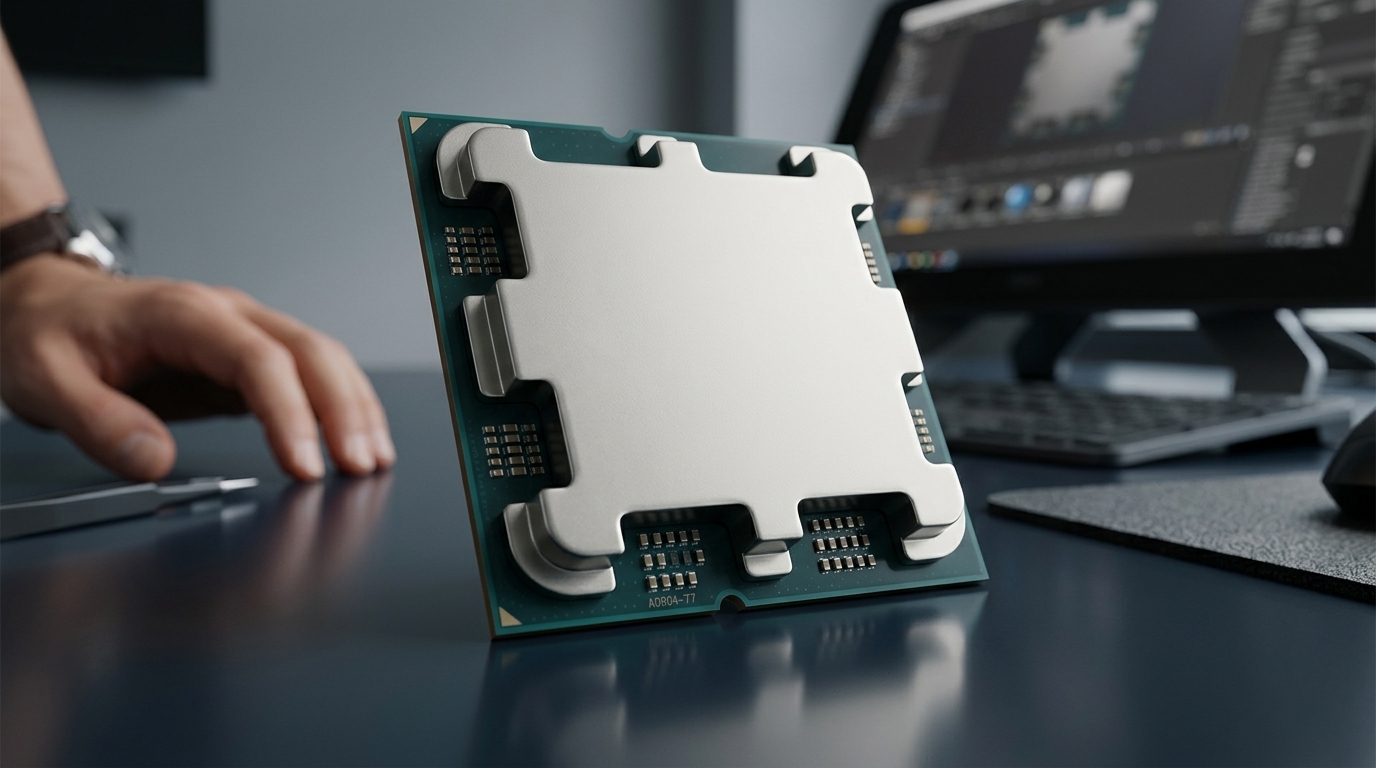
The history of processor technology often follows a linear path: innovations typically debut in high-end supercomputing centers and gradually trickle down to consumers. However, in AMD's case, the trajectory has been reversed. 3D V-Cache technology, which established Ryzen processors as the undisputed kings of the gaming world, is now making a massive leap into the corporate and professional workstation arena through the Ryzen PRO 9000 series. This is a strategic move that doesn't just change the hardware; it redefines our expectations of a high-performance office computer.
The Architecture of Speed: Understanding 3D V-Cache
To grasp the significance of this evolution, one must look deep into the silicon. 3D V-Cache technology allows AMD to stack additional layers of L3 cache vertically atop the processor die. Unlike the traditional method where memory is placed adjacent to the cores, vertical stacking enables massive memory capacities without increasing the chip's physical footprint. In the Ryzen PRO 9000 series, this means applications have near-instantaneous access to a vast pool of data, dramatically reducing the latency caused by fetching information from the main RAM.
While gamers embraced this technology for eliminating micro-stutters and boosting frame rates, professionals will value it for different reasons. The Zen 5 architecture, which forms the backbone of the 9000 series, already offers substantial improvements in Instructions Per Cycle (IPC). By combining this raw power with 3D V-Cache, AMD is targeting specific high-demand sectors: architecture, engineering, software development, and scientific research.
From Gaming to Scientific Simulation
Why does an engineer need a processor originally designed to run Elden Ring? The answer lies in the algorithms. Applications such as Computational Fluid Dynamics (CFD), Finite Element Analysis (FEA), and weather simulation rely on massive datasets that must be processed continuously. When these datasets fit within the processor's L3 cache, task completion times can drop from hours to mere minutes.
- Software Development: Compiling large codebases benefits significantly from a large cache, as it minimizes the need to access system memory, which is orders of magnitude slower.
- CAD/CAM: Designing complex 3D models becomes fluid, with significantly less stuttering during real-time manipulation and rendering.
- Artificial Intelligence: While GPUs dominate training, data preprocessing and certain types of local inference are notably accelerated by AMD's large-cache architecture.
"The integration of 3D V-Cache into the PRO lineup is not just a spec bump; it's a declaration that the boundaries between consumer-grade and professional-grade power have effectively collapsed," market analysts observe.
Security and Manageability: The 'PRO' Hallmark
A workstation processor cannot merely be fast; it must be resilient and secure. The Ryzen PRO 9000 series includes AMD PRO Technologies, a comprehensive suite of security and management features. AMD Memory Guard provides full, real-time system memory encryption, protecting against physical attacks if a device is stolen. Furthermore, advanced remote management capabilities allow IT departments to patch, update, and troubleshoot systems without needing physical access to the machine.
This dual-pronged approach—gaming-grade performance paired with enterprise-grade security—puts Intel in a challenging position. Intel has traditionally maintained a strict separation between its Core and Xeon lines. AMD’s move to bring its flagship technology to the mainstream professional market forces the competition to reconsider their strategy for entry-to-mid-level workstations.
Market Implications and Strategic Shift
AMD’s move comes at a time when businesses are seeking to maximize productivity without investing in prohibitively expensive server-grade processors. The Ryzen PRO 9000 series offers a middle ground. It allows small creative studios or independent developers to access performance levels that, until recently, required systems costing tens of thousands of dollars.
In conclusion, the arrival of 3D V-Cache in professional workstations marks the end of an era where "gaming" hardware was viewed as less serious. Today, speed is the ultimate currency in the information economy, and AMD has just minted a very powerful new coin. The democratization of high-performance computing is no longer a goal; it is a reality sitting on the professional's desk.