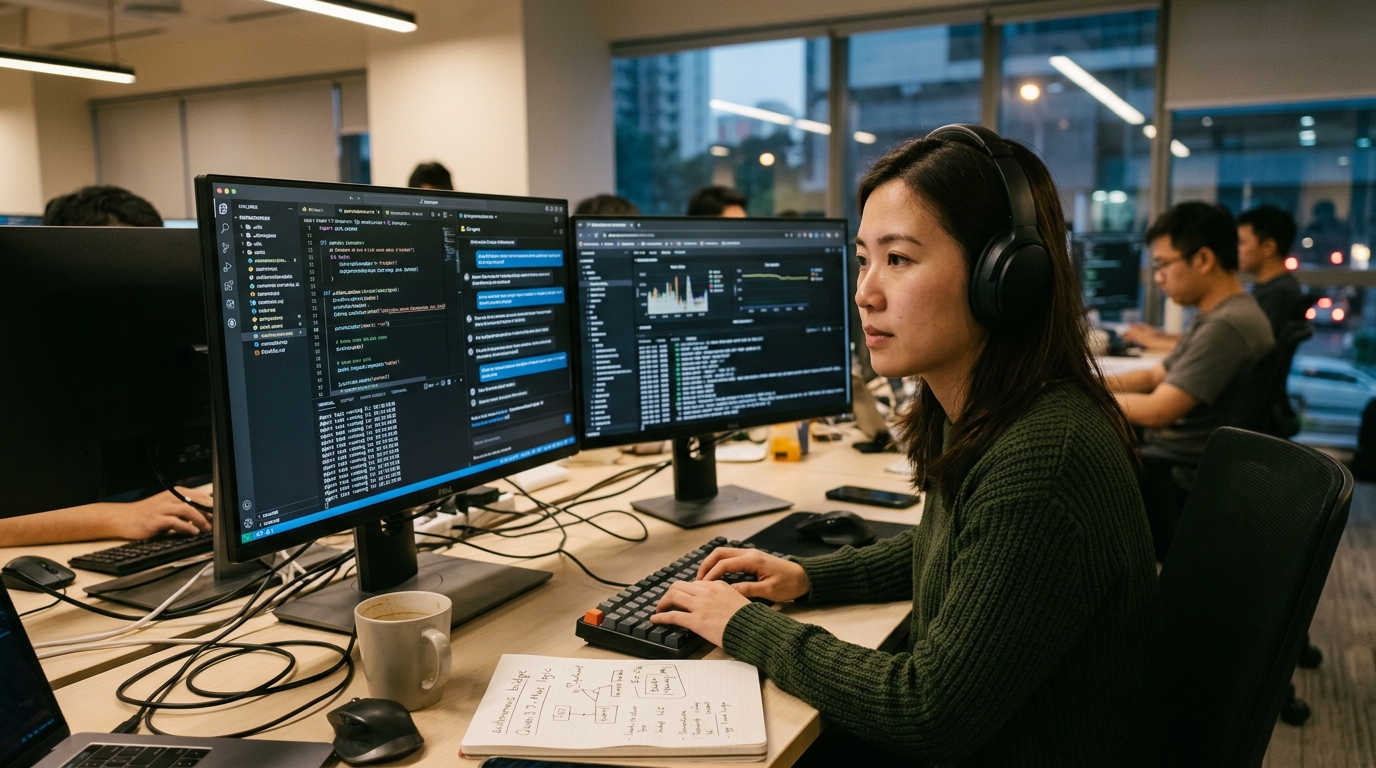
The artificial intelligence industry is no longer merely in the era of large language models; it has fully transitioned into the "agent era." In this new paradigm, Alibaba Cloud has made a strategic move with the introduction of Qwen3.7-Max. This is a proprietary model that goes beyond simple text or code generation, boasting the ability to operate autonomously for up to 35 continuous hours, executing complex tasks, self-correcting errors, and interacting with external tools such as Anthropic's Claude Code.
The Shift from Response to Autonomous Action
Until recently, AI interaction was largely linear: a user provided a prompt, and the model returned a response. Qwen3.7-Max shatters this pattern. The capacity for 35-hour autonomous operation means the model can take on an entire software development project or a complex data analysis and work on it without human intervention for nearly two full days. During this period, the system utilizes "chain-of-thought" reasoning to plan its next steps, test solutions in sandbox environments, and pivot its strategy when encountering obstacles.
This long-term autonomy addresses one of the primary issues with current AI: task drift. Alibaba appears to have optimized the Qwen architecture to maintain context and the end goal over extended periods, avoiding the "hallucinatory" loops that often plague less sophisticated models. The "Max" designation is no coincidence; the model aims directly at the top of the market, competing with OpenAI’s o1 and Anthropic’s Claude 3.5 Sonnet.
The Surprise of Compatibility: Claude Code as a Harness
Perhaps the most intriguing element of the announcement is the support for external "harnesses" or operational frameworks, most notably Anthropic's Claude Code. Claude Code is a command-line interface (CLI) tool that allows AI to write, test, and execute code directly on a developer's system. The fact that a Chinese model like Qwen can integrate with an American tool like Anthropic’s highlights a growing trend toward the standardization of AI agents.
- Interoperability: Developers can use the familiar interfaces of Claude while leveraging the computational power and specialized knowledge of Qwen.
- Flexibility: It allows enterprises to swap models based on cost or performance without overhauling their entire infrastructure.
- Global Reach: Alibaba is positioning itself as a global player that is not afraid to indirectly collaborate with the Western ecosystem.
Geopolitical and Economic Significance
Within the context of the US-China technological rivalry, Qwen3.7-Max is a statement of power. While American firms dominate foundational model innovation, Alibaba is proving that China can offer solutions that are equally intelligent and perhaps more resilient in terms of productivity. The focus on AI Agents indicates that the battle is moving from who has the largest model to who has the most useful tool for the global economy.
"We are not just building an AI that talks, but a digital collaborator that can pull a 35-hour shift without a break," market analysts note.
For businesses, this translates into a dramatic reduction in time-to-market. Imagine a scenario where on a Friday afternoon, you instruct Qwen3.7-Max to upgrade an entire database schema and fix bugs in the legacy code. By Sunday morning, the model will have completed the task, having tested thousands of iterations and arrived at the optimal solution, all within the Claude Code environment.
Challenges and Ethical Considerations
Of course, 35-hour autonomy raises significant safety questions. How can we be certain that an agent operating autonomously for such a long duration won't make erroneous decisions that could compromise critical infrastructure? Alibaba claims to have integrated multiple safety guardrails and checkpoints, but the ultimate responsibility remains with the human supervisor. Furthermore, the reliance on proprietary models means users are locked into Alibaba's ecosystem, a departure from the open-source Qwen versions seen in the past.
In conclusion, Qwen3.7-Max is not just a version upgrade. It is the entry into a new phase where artificial intelligence gains the "stamina" and execution capability that approaches, and in some technical tasks exceeds, human persistence.