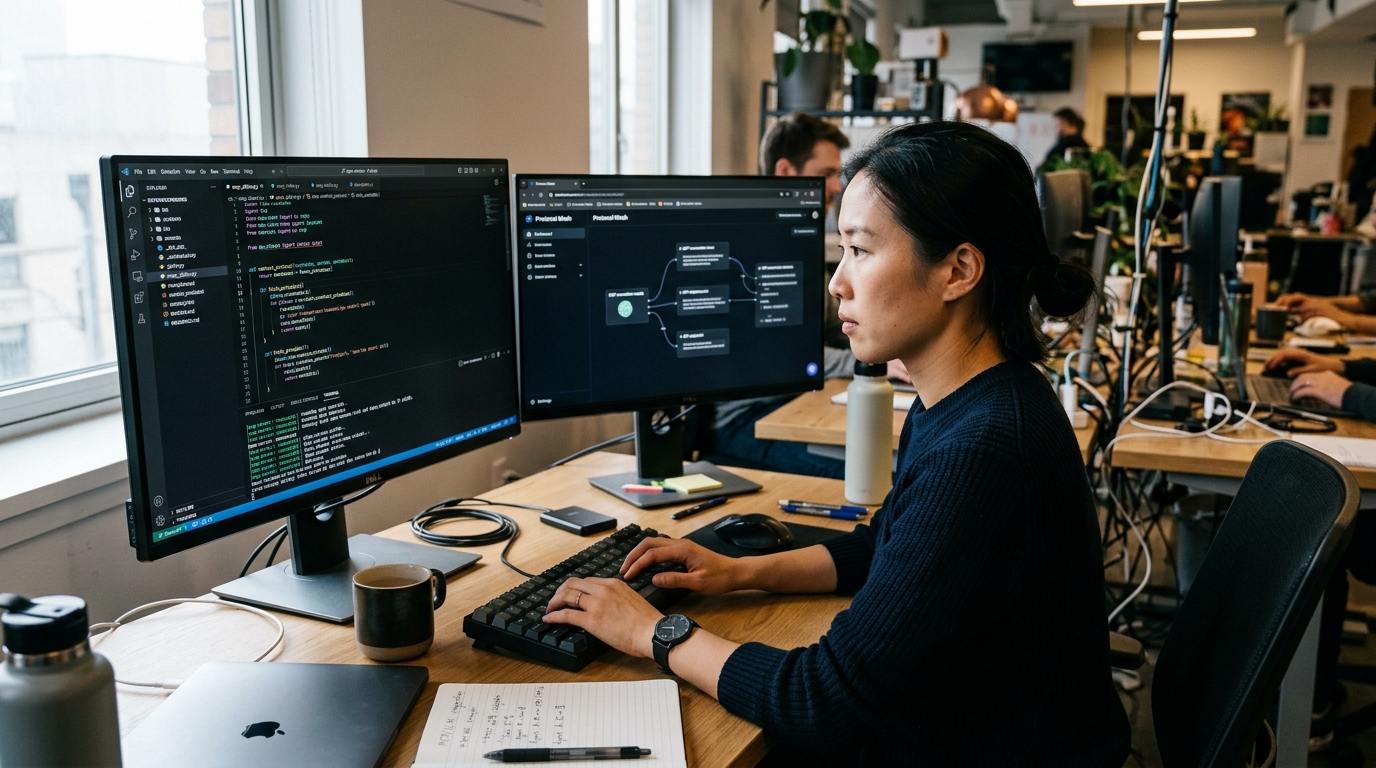
In the rapidly evolving world of engineering and industrial design, Artificial Intelligence (AI) is no longer an exotic addition but an essential productivity tool. However, until recently, the use of AI was limited by a significant hurdle: the difficulty of accessing local data, code repositories, and specialized design tools in a secure and standardized way. The introduction of the Model Context Protocol (MCP) by Anthropic is set to change this landscape, promising to bridge the gap between Large Language Models (LLMs) and the data ecosystems of engineers.
What is MCP and Why Should Engineers Care?
The Model Context Protocol (MCP) is an open standard that allows developers and engineers to create secure connections between AI models and their data sources. Think of it as a "USB port" for artificial intelligence. Before MCP, if an engineer wanted to use AI to analyze a complex set of CAD files or a GitHub repository, they had to either upload the files manually or build custom, often fragile integrations.
With MCP, the process is radically simplified. The protocol allows a "Server" (which has access to the data) to communicate directly with a "Client" (the AI application, such as Claude Desktop). This means that the AI can now "see" the local file system, read databases, interact with Slack or Google Drive, and execute commands in development environments, all without the need for constant manual intervention.
Revolutionizing the Design Workflow
For design engineers, the implementation of MCP means a dramatic reduction in "dead time" spent managing information. Imagine an engineer working on a new component. By using an MCP server connected to the company's PLM (Product Lifecycle Management) system, the AI can automatically retrieve material specifications, failure history data from previous models, and current supplier costs.
- Automated Documentation: AI can draft technical reports by pulling data directly from simulation tools.
- Code and Design Review: Real-time bug detection in large software repositories or complex electronic designs.
- Centralized Knowledge: The ability to query the AI about anything regarding a project, with the certainty that it has access to the most recent version of the files.
- Tool Orchestration: Using natural language to trigger actions across different software packages (e.g., "Run a stress test on this assembly and summarize the results").
Open Standards vs. Walled Gardens
One of the most significant aspects of MCP is its open nature. Unlike approaches by other companies that try to lock users into their own "ecosystems" of tools, MCP allows anyone to create a server. This encourages the engineering community to develop specialized servers for specific industrial tools like AutoCAD, SolidWorks, or MATLAB.
This democratization of data access is crucial. Engineers often work with heterogeneous systems that don't communicate well with each other. MCP acts as the "common denominator," allowing AI to function as the orchestrator of these tools. The ability to switch AI models (LLMs) without having to rewrite all your integrations is a massive advantage for ensuring the future-proofing of technology investments.
Security and Implementation Challenges
Of course, connecting an AI to sensitive corporate data raises serious security questions. MCP addresses this issue by giving control to the user. Servers run locally or in controlled environments, and the AI requests permission for each access. However, organizations will need to establish strict data governance protocols. Who has access to which MCP servers? How do we ensure that data is not used to train the AI providers' future models?
Furthermore, there is the challenge of the "illusion of knowledge." The fact that an AI has access to all the files of a project does not necessarily mean it understands the full context in the same way an experienced engineer does. Critical thinking and human oversight remain irreplaceable, especially in fields where life safety depends on the accuracy of calculations.
Conclusion: The Future of AI-Augmented Engineering
The Model Context Protocol is not just a technical specification; it is a statement about how we will work in the future. For the engineer, AI is transformed from a smart assistant into a fully informed partner that knows the team's tools, data, and processes. As more MCP servers become available, we will see an explosion of innovation in how we design, test, and manufacture products, making the process faster, more accurate, and ultimately, more creative.