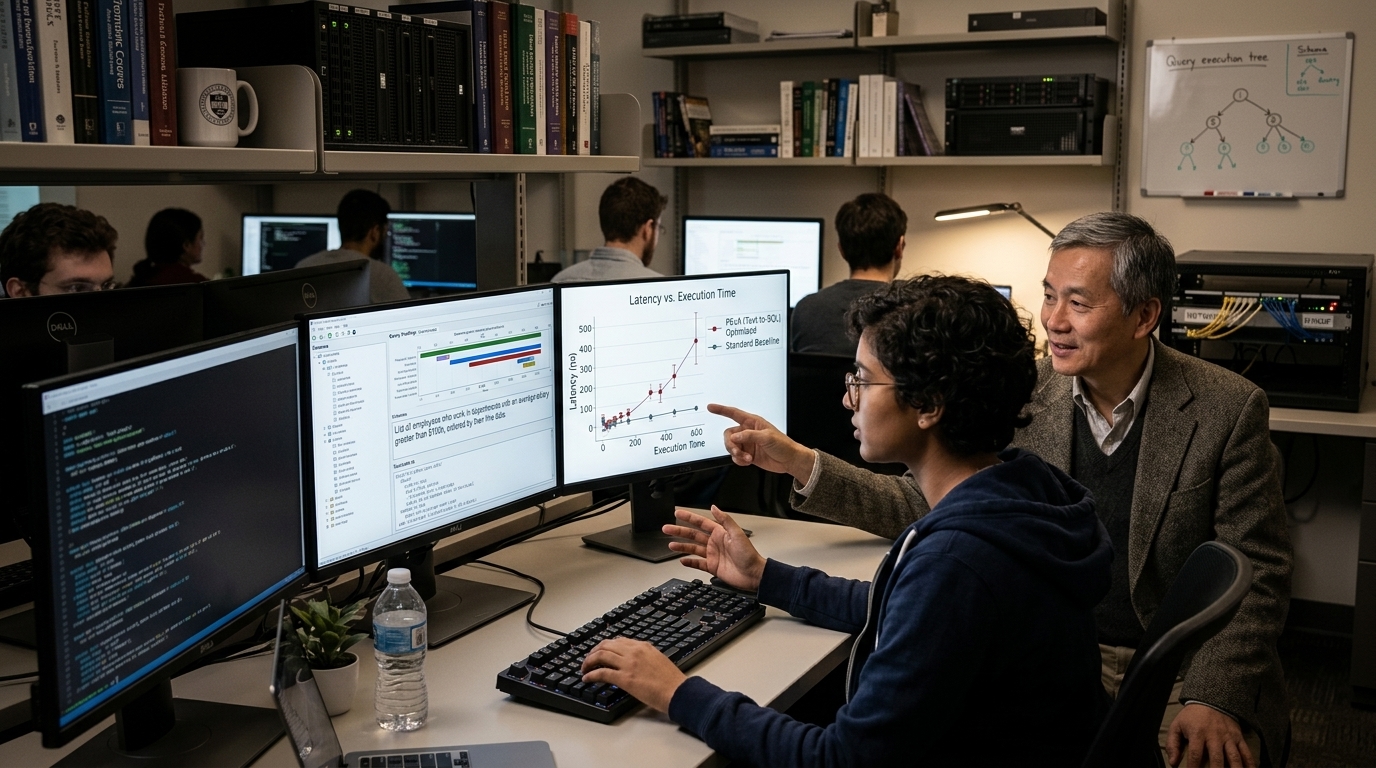
In the evolving landscape of data management, the bridge between natural language and Structured Query Language (SQL) has long been considered the 'Holy Grail' of human-computer interaction. As we move through 2026, the capability of Large Language Models (LLMs) to translate a business executive's query into a complex database command has improved dramatically, yet a critical hurdle remained: the trade-off between latency and performance. The new research paper, "PExA: Parallel Exploration Agent for Complex Text-to-SQL," aims to shatter this barrier.
The Agent's Dilemma: Speed vs. Accuracy
To date, LLM-based agents for Text-to-SQL generation have faced a persistent bottleneck. Simple 'single-pass' approaches are incredibly fast but often stumble when confronted with complex database schemas involving dozens of tables and intricate foreign key relationships. Conversely, sophisticated multi-step agents that employ self-correction and iterative reasoning achieve high accuracy but introduce significant latency, making them impractical for real-time applications.
PExA (Parallel Exploration Agent) introduces a radical paradigm shift. Instead of following a linear chain of thought, the system reformulates SQL generation through the lens of software test coverage. This approach allows the agent to explore multiple potential query paths simultaneously, evaluating which one best 'covers' the logical requirements of the original natural language prompt. By parallelizing the exploration, PExA achieves the accuracy of complex agents with the speed of simpler ones.
The Methodology of Parallel Exploration
The core of PExA lies in its branching capability. When a user submits a question, the agent does not merely attempt to guess the single correct answer. Instead, it generates a set of working hypotheses. These hypotheses are processed in parallel, utilizing techniques reminiscent of unit testing in traditional software development. The system verifies if the generated SQL is syntactically correct, if the referenced tables exist within the schema, and if the applied filters align with the query's semantics.
- Hypothesis Branching: Creating multiple versions of the SQL query based on different interpretations of the prompt.
- Coverage Criteria: Using metrics to ensure the query addresses all parameters set by the user.
- Pruning and Selection: A central controller selects the optimal result from the parallel paths, drastically reducing the time that serial error correction would require.
Implications for Enterprise and Data Analytics
The significance of PExA extends far beyond academic benchmarks like Spider or Bird-SQL. For modern enterprises relying on massive data warehouses—such as Snowflake, BigQuery, or Databricks—speed in information retrieval is a competitive necessity. If an analyst can receive an answer to a complex query in 2 seconds instead of 20, the entire decision-making workflow is transformed. Furthermore, reducing failed queries translates to less wasted compute and lower cloud infrastructure costs.
A New Era of Reliable Code Generation
PExA demonstrates that the future of AI lies not just in larger models, but in smarter workflow architectures. By combining parallel processing with the rigorous logic of software engineering, PExA transforms LLMs from 'probabilistic engines' into reliable tools for code generation. We are entering an era where the democratization of data is no longer a buzzword but a technical reality, as AI becomes a swift and capable translator of human intent into digital execution.