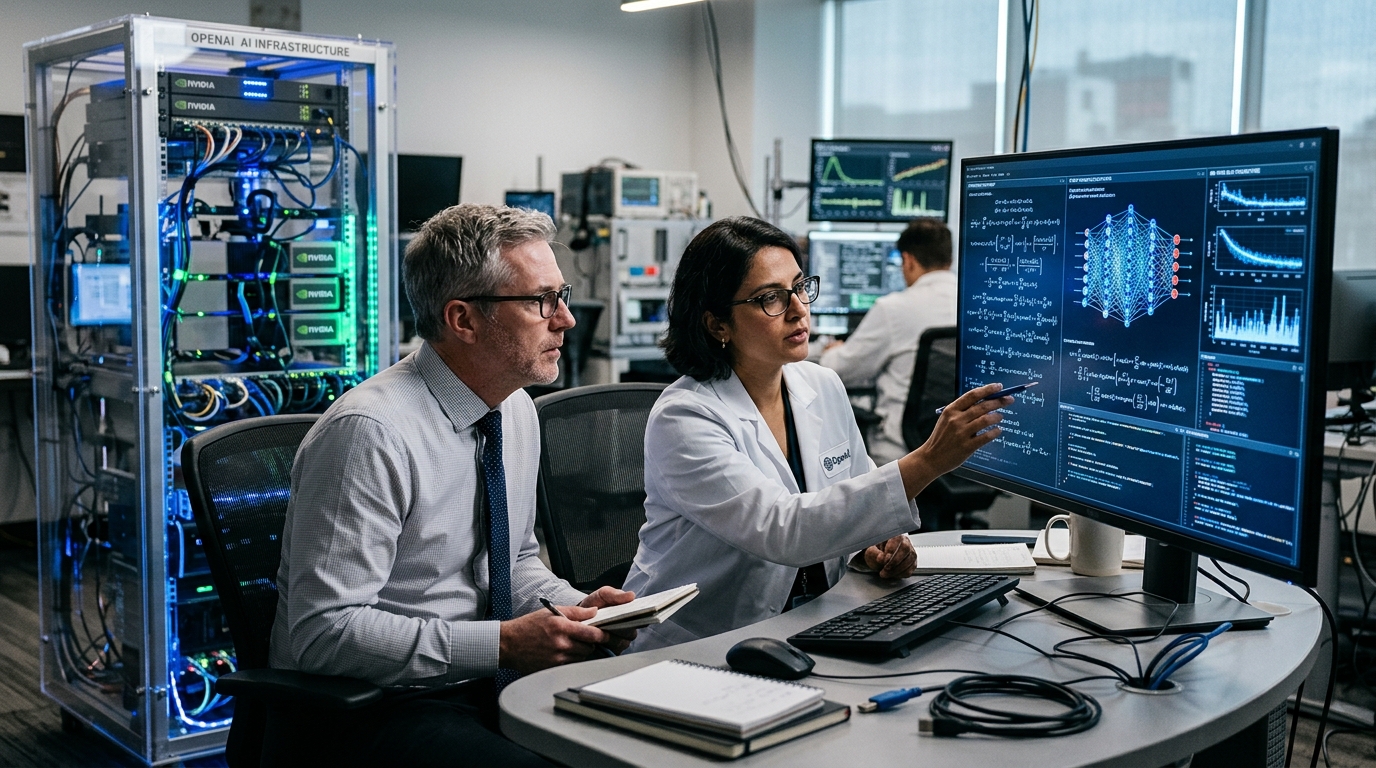
The history of mathematics is punctuated by elegant hypotheses that, despite their apparent simplicity, have resisted the efforts of the world's finest minds for decades. But where human intuition meets its limits, artificial intelligence appears to be forging new paths. Recently, OpenAI announced that one of its advanced reasoning models, o1, successfully refuted a mathematical hypothesis that had stood for nearly 80 years. This achievement is not merely a victory for computational power; it is evidence that AI is transitioning from simple language processing to substantive scientific discovery.
Chronicle of a Mathematical Challenge
The specific hypothesis, belonging to the fields of combinatorics and graph theory, was first formulated in the mid-1940s. For eight decades, mathematicians attempted either to prove its universal validity or to find a "counterexample"—a case where the theory fails. The difficulty lay in the fact that the number of possible combinations to be examined was so vast that even the most powerful supercomputers of the past were unable to navigate them without specific direction.
OpenAI's model did not employ a "brute force" method. Instead, it utilized "chain-of-thought" capabilities to narrow the search space, simulating the way a mathematician approaches a problem: testing logical paths, discarding dead ends, and refining strategy in real-time. The result was the identification of an extremely complex structure that acts as a counterexample, definitively proving the original hypothesis wrong.
From GPT-4 to o1: The Shift to Reasoning
For years, criticism of Large Language Models (LLMs) focused on the idea that they are "stochastic parrots"—systems that predict the next word without understanding the underlying logic. The refutation of this mathematical hypothesis changes the narrative. The o1 series models are trained with reinforcement learning to "think" before they respond. This internal checking process allows the AI to correct its mistakes and follow the multi-layered reasoning required in pure mathematics.
- Systematic Search: The ability to navigate abstract parameter spaces that exceed human perception.
- Verifiability: The counterexample produced by the AI can be independently verified by human mathematicians, making the discovery indisputable.
- Synergy: Using AI as a "research assistant" that takes on the grueling task of testing edge cases.
Implications for the Scientific Method
This development marks a fundamental shift in how scientific research will be conducted in the future. It is no longer just about the mathematical community. An AI's ability to overturn established theories can be applied in biology to identify new protein structures, in physics to analyze quantum phenomena, and in chemistry to design materials with specific properties.
"We are not just looking at a new tool, but a new type of collaborator that does not tire, is not biased by tradition, and can see patterns where the human mind sees only chaos," noted an OpenAI researcher.
However, this success also raises questions. If AI can solve problems that we cannot, will we reach a point where it produces proofs that the human mind cannot even comprehend? The "black box" of understanding remains a challenge, as verifying a result is often much easier than understanding *why* that result holds true.
Conclusion: The Future of Human Intellect
Refuting an 80-year-old hypothesis is only the beginning. As AI models become more specialized in logic and reasoning, our relationship with knowledge will be transformed. The role of the scientist is shifting from performing calculations to formulating the right questions. In the 21st century, the greatest virtue will not be the ability to memorize or calculate quickly, but the creative imagination that will guide silicon toward the next great secrets of the universe.