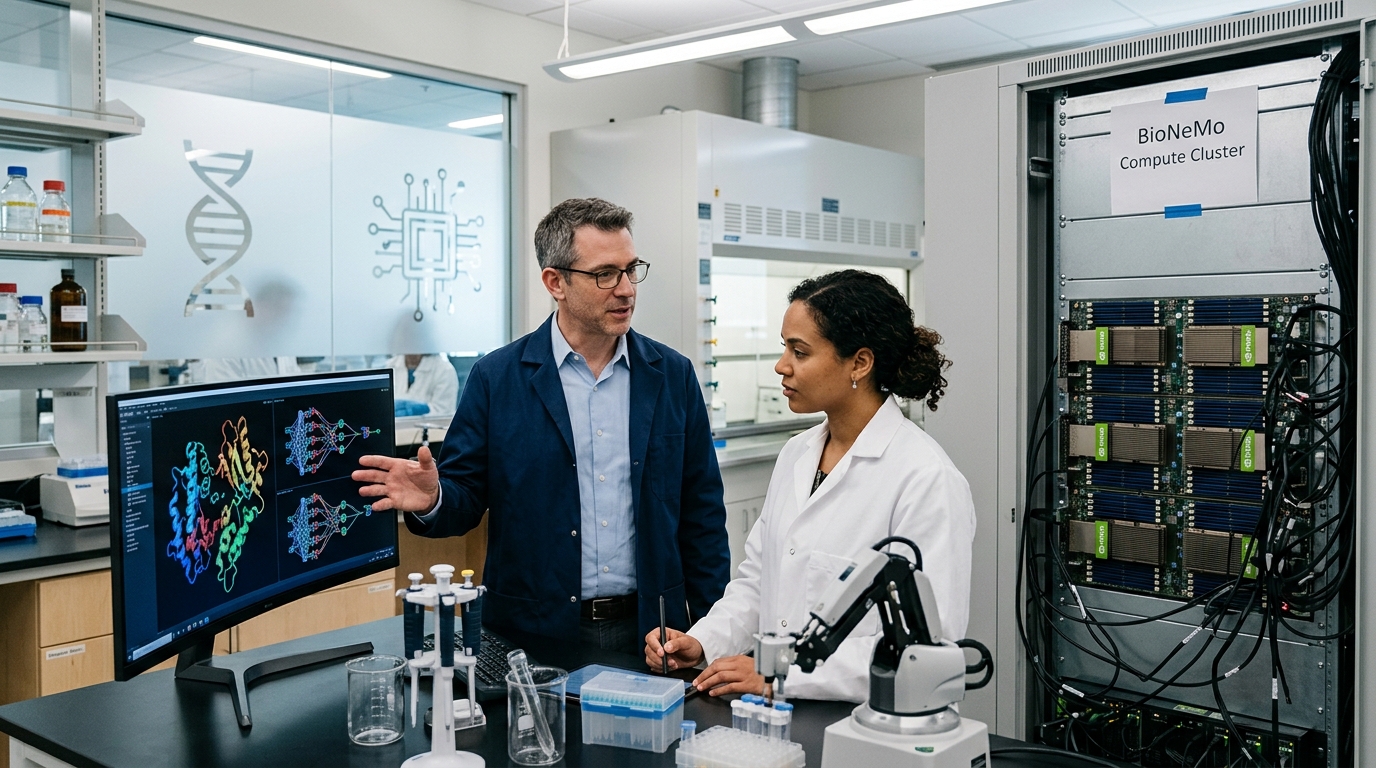
At the intersection of raw computational power and molecular biology, a new partnership is poised to fundamentally reshape our understanding of life and the treatment of disease. NVIDIA, the undisputed leader in AI hardware, has announced the full integration of Anthropic’s Claude models into its BioNeMo platform. This move is more than a mere technical upgrade; it is a strategic convergence that brings the superior reasoning capabilities of Large Language Models (LLMs) directly into the biotechnology laboratory.
The BioNeMo Platform as a Catalyst
NVIDIA BioNeMo is a cloud-native framework that allows researchers to train, customize, and deploy generative AI models for drug discovery. Until now, BioNeMo focused primarily on specialized models for protein structure prediction (such as AlphaFold) and small molecule generation. However, the addition of Anthropic’s Claude provides the missing link: the ability to interpret complex scientific data using natural language and sophisticated logic.
Anthropic, renowned for its "Constitutional AI" approach, has developed Claude with an emphasis on safety and precision. In the context of biological research, this means the model can analyze vast literatures, synthesize hypotheses, and guide scientists in utilizing BioNeMo’s specialized tools. Imagine a researcher asking Claude: "Find me a protein that binds to receptor X, considering the latest publications on toxicity," and the system not only answering but also designing the molecule via BioNeMo.
Accelerating the Discovery Cycle
The traditional process of discovering a new drug takes, on average, over a decade and costs billions of dollars, with failure rates in clinical trials reaching 90%. The NVIDIA-Anthropic synergy aims to drastically reduce these figures. By using Claude for data analysis and BioNeMo for simulating molecular interactions, biotech companies can transition from a "Design-Build-Test" cycle to a "Digital Twin" model.
- Structure Prediction: Faster modeling of proteins associated with rare diseases.
- Molecule Optimization: Claude can suggest modifications to existing drugs to minimize side effects.
- Genomic Analysis: Processing massive amounts of DNA sequences to identify genetic markers.
"Integrating Claude’s reasoning into the NVIDIA ecosystem is not just about speed; it’s about the quality of the questions we can now ask nature," says a leading industry analyst.
Challenges and Ethical Dilemmas
Despite the excitement, the use of AI in biology raises serious questions. Data security is paramount, as pharmaceutical companies handle highly sensitive information and intellectual property. NVIDIA and Anthropic have committed to creating "sandboxed" environments where customer data will not be used to retrain the models.
Furthermore, there is the risk of "dual-use." The same technology that designs a vaccine could theoretically be used to design a biological weapon. This is where Anthropic’s safety philosophy becomes critical. Claude is programmed to refuse the creation of harmful content, but the effectiveness of these "guardrails" at such specialized levels remains to be proven in practice.
The Future of Digital Biology
As we move through 2026, digital biology is ceasing to be a promise and is becoming the new normal. The NVIDIA-Anthropic collaboration serves as a blueprint for how tech giants will dominate the healthcare sector. The ability to "program" biology as we program software is now within reach, and the implications for humanity—from fighting cancer to extending life expectancy—are immeasurable. Science is no longer just a matter of test tubes, but of algorithms that think alongside us.