In an era where Artificial Intelligence (AI) is striving to embed itself into every facet of human existence, Google appears to have crossed an invisible line of both aesthetics and ethics. The latest advertising campaign for Google Workspace and its Gemini model, themed around a "1776 group project," attempts to portray the drafting of the U.S. Declaration of Independence as a mere digital document optimized by algorithms. The result, however, is not a showcase of innovation, but a profound reflection on how Big Tech perceives historical gravity and human creativity.
The Sacrilege of Prompting History
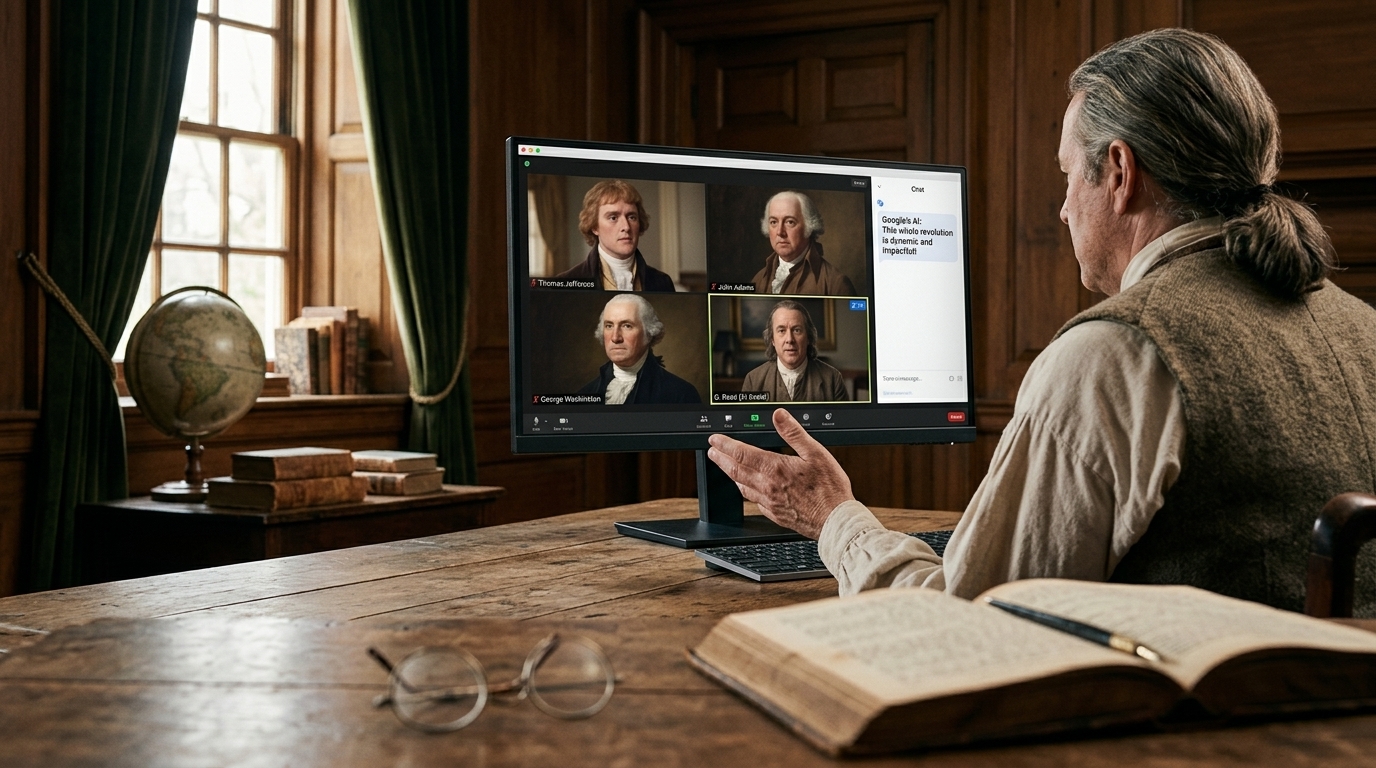
The commercial opens with a line that sounds like it was pulled from a Gen Z social media post: "Group project, but make it 1776." We see Thomas Jefferson, Benjamin Franklin, and John Adams exchanging comments in a Google Doc, while Gemini intervenes to "polish" the text that founded modern democracy. The central premise is simple: AI can make the writing process more efficient, faster, and more collaborative.
However, the backlash that erupted almost immediately isn't about the technology itself, but the context. The Declaration of Independence was not a university "group project." It was a document written under the threat of the gallows, a text that distilled centuries of political philosophy and the visceral struggle for liberty. To depict Jefferson asking a chatbot to make the text "more inclusive" or "more punchy" is not just anachronistic; it is a trivialization of the intellectual and physical toll required to birth a nation.
- The transformation of historical milestones into content marketing.
- The devaluation of human judgment in favor of algorithmic suggestions.
- The risk of "AI-washing" fundamental societal values.
The Efficiency Trap
The issue with Google's commercial reflects a broader pathology in Silicon Valley: the belief that everything is a matter of optimization. In Google's worldview, Gemini is not just a tool, but a co-creator that can replace the grueling process of thought. If Jefferson had Gemini, would it have taken less time? Perhaps. But would the document have the same soul?
The art of writing, especially at a political and philosophical level, relies on choosing words not based on statistical probability—as Large Language Models (LLMs) do—but based on moral weight. When Google suggests that AI could have "helped" with the Declaration, it is essentially saying that the essence of the message is secondary to the convenience of its production. This approach fosters a culture of "slop," where content is mass-produced without the fingerprint of human experience or the stakes of real-world consequences.
"AI can compose sentences, but it cannot comprehend sacrifice. Google's ad ignores this fundamental distinction."
Ethical Implications and Public Backlash
Public reaction on social media was swift and overwhelmingly negative. Many users pointed out the irony: a company often accused of monopolistic practices and algorithmic gatekeeping is using the ultimate symbol of freedom to sell Workspace subscriptions. Furthermore, using AI to revise history—even in a fictionalized ad—evokes memories of Gemini’s previous blunders, such as generating historically inaccurate images (e.g., racially diverse Nazis), which caused a firestorm earlier in 2024.
What seems to escape Google’s marketing executives is that AI is at a critical juncture of public acceptance. Instead of being presented as a tool that solves real-world problems, it is being pushed as a "magic wand" that can touch even the hallowed halls of history. This doesn't inspire awe; it inspires distrust. If AI can "fix" Jefferson, what prevents it from distorting modern truth?
Conclusion: The Need for Digital Humility
Google’s commercial serves as a case study in what happens when technological hubris meets a lack of cultural literacy. Artificial Intelligence has immense potential in science, medicine, and daily productivity. However, the attempt to invade the core of human identity and historical memory in terms of "project management" is a move that undermines its own value. The Declaration of Independence was an act of courage, not a prompt. And that is something no algorithm can ever simulate.