The ability of Large Language Models (LLMs) to solve mathematical problems and write code has impressed the scientific community over the past few years. However, there remains a "wall" that even the most powerful models struggle to scale: graph theory. Graphs—structures consisting of nodes and edges—form the backbone of modern systems, from social networks and supply chains to molecular biology. New research titled "GraphDC," published on ArXiv (cs.AI), proposes a radical solution to this problem by utilizing a multi-agent system based on the classical principle of "Divide-and-Conquer."
The Challenge of Topological Complexity
Why do LLMs fail at graphs? The answer lies in their inherent architecture. Transformer models are exceptional at processing linear sequences of text but struggle to "visualize" or comprehend non-linear, multi-dimensional relationships. As a graph increases in size, the number of possible paths and interdependencies grows exponentially. This leads to "hallucinations," where the model loses track of steps in algorithms like Dijkstra’s (shortest path discovery) or Depth-First Search (DFS).
The research behind GraphDC highlights that attempting to solve an entire graph problem in a single pass—monolithic reasoning—is destined for failure in large-scale networks. The models' working memory becomes overtaxed, and the attention mechanism disperses across irrelevant nodes, losing the essence of the topological structure.
The GraphDC Architecture: Agents in Collaboration
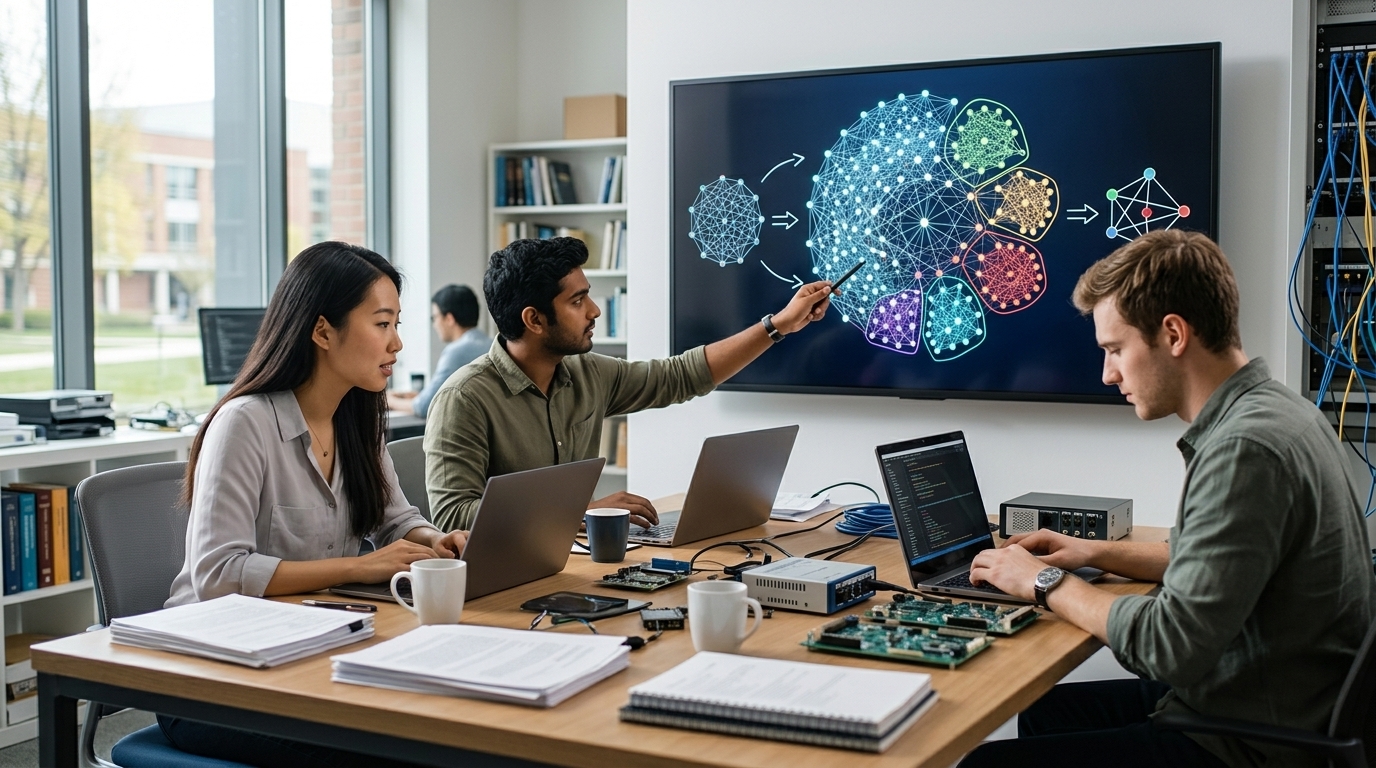
GraphDC is not just another model but a framework that orchestrates several specialized AI agents. The process is divided into three primary stages:
- Decomposition: The first agent analyzes the large graph and breaks it down into smaller, manageable sub-graphs or sub-problems. This is the "Divide" part of the strategy.
- Local Solving: A team of agents takes on the task of solving the algorithmic problem within each sub-graph individually. Because the size is limited, the accuracy of the LLMs reaches nearly 100%.
- Aggregation: The final agent collects the local solutions and synthesizes them to provide the answer to the original, global problem. This is the "Conquer" part.
This approach allows the system to maintain its computational accuracy regardless of the graph's size, transforming an exponentially difficult problem into a series of linear, manageable tasks.
Experimental Data and Superiority
In tests conducted by the researchers, GraphDC was compared against leading models such as GPT-4o and Claude 3.5. The results were revelatory. While traditional models collapsed on graphs with more than 50 nodes, GraphDC maintained high success rates even in networks with hundreds of elements. Particular emphasis was placed on problems such as cycle detection, component connectivity, and centrality calculations.
"The success of GraphDC lies not in increasing the model's parameters, but in organizing its reasoning. It is the transition from brute force computational power to strategic methodology," the researchers state.
Furthermore, the system demonstrated a remarkable capacity for self-correction. If an agent in the local solving stage makes an error, the aggregator agent can often identify the inconsistency and request a re-evaluation of that specific segment—a feat impossible in a monolithic architecture.
From the Lab to the Real Economy
The applications of GraphDC extend far beyond academic theory. In the field of cybersecurity, it can be used to analyze attack networks and identify vulnerabilities in complex IT infrastructures. In pharmaceuticals, it can accelerate the analysis of protein interactions, where data is represented as massive graphs.
Additionally, in the logistics industry, optimizing routes on a global scale requires solving graph problems in real-time. GraphDC offers a scalable solution that can be integrated into existing ERP systems, providing "intelligent" reasoning where traditional algorithms are too rigid and simple LLMs are too inaccurate.
Conclusion: The Future of Collaborative AI
The research on GraphDC signals a shift in AI development. Instead of trying to build an "omniscient" brain, the trend is moving toward creating societies of specialized agents that communicate and collaborate. This model mirrors human organization in large institutions and appears to be the key to solving humanity's most complex problems. GraphDC is not just an algorithm; it is a lesson in how structured thinking can tame the chaos of information.